
|
(Dr Michael J. Roy, MD MPH, FACP is one of the foremost experts in counterterrorism. He is the director of the Division of Military Internal Medicine and an Associate Professor of Medicine at the Uniformed Services University of the Health Sciences. We as forensic pathologists became interested in him and his work, largely because of the book on counterterrorism he wrote (Physician's Guide to Terrorist Attack, Humana Press, 2004). This book was featured in our journal and as many as four experts from three different continents reviewed this book (in the current issue).
We at the "Anil Aggrawal's Internet Journal of Forensic Medicine and Toxicology" approached him for an online interview and he graciously agreed. The interview was conducted for well over two months. Some excerpts....)
 |
Qu. 1. Is this (Physician's Guide to Terrorist Attack) your first book? What are your future projects/books?
Ans. I have written chapters for several books previously, but this is the first book I have edited. The challenge with writing is carving out sufficient time, but overall I would have to say that is easier than trying to get a large number of authors to complete their work on time and in an appropriate format. While many of the authors were compliant, others were far more of a challenge. Nevertheless, this was a good learning experience for me, and I think I would be much more efficient as an editor in the future. I do have some ideas for books that I would like to write in the future.
|
Qu. 2. How did you become interested in terrorism related issues?
Ans. It really started in the mid-1990's when I was Clinical Director of the Gulf War Health Center, evaluating and caring for hundreds of Gulf War veterans at Walter Reed Army Medical Center in Washington, DC. It became apparent to me that war was very stressful, even when the campaign went well, and that many veterans were left physically and emotionally scarred. During this time, I was asked by reporters to comment on the sarin attack in the Tokyo subway, and I was struck by the similar sequelae - no matter how many had physical injuries, they are always outnumbered by the psychological injuries. I have always been interested in ways to try to prevent such injuries, examining the risk factors and the measures we can take to limit disability. I see similar effects in primary care patients, whether they have survived life-threatening illness or childhood trauma.
Qu. 3. Do you think terrorist nations/terrorists would one day use atom bomb to hold the whole world to ransom? What is our defense in the face of such a scenario?
Ans. I think radiation, ranging from a "dirty bomb", or conventional explosive device combined with radioactive materials, to a full-fledged nuclear device, poses a more ominous and frightening scenario than any other type of terrorism, and for this very reason, I think someone will try to use it. As we say in medicine, and ounce of prevention is worth a pound of cure, so I think trying to prevent the proliferation of nuclear devices, to prevent the dispersal of radioactive substances that could be used in a dirty bomb, and to in general to prevent terrorists from having the opportunity, is the best defense. However, it troubles me to see the everyday effects of the security measures that we have felt compelled to take since September 11, 2001. Beyond that, I think rapid deployment strike forces are the key to try to capture terrorists who make such a threat.
Qu. 4. Do you sincerely think, biological agents could cause as much havoc as did conventional weapons in first and second world wars?
Ans. I think this is unlikely, given the delayed onset of action and the measures that we can take to prevent the spread of many biological agents, especially bacteria. At this point in time, an Ebola-like virus is the most threatening type of agent because of its high case fatality rate, its ability to be easily disseminated, and the lack of effective therapy. It remains a distinct possibility that an even more threatening agent could be developed in the future.
Qu. 5. In chapter 4, you give us the definition of a terrorist as defined by FBI. You also give a list of countries which are supposed to be harboring terrorists. How do you respond to a recent US court decision, which says that "one country's terrorist can be another country's freedom fighter"? Does it not make your entire definition topsy-turvy? For this US decision, kindly see the attached jpg file, which is from a recent Indian newspaper.
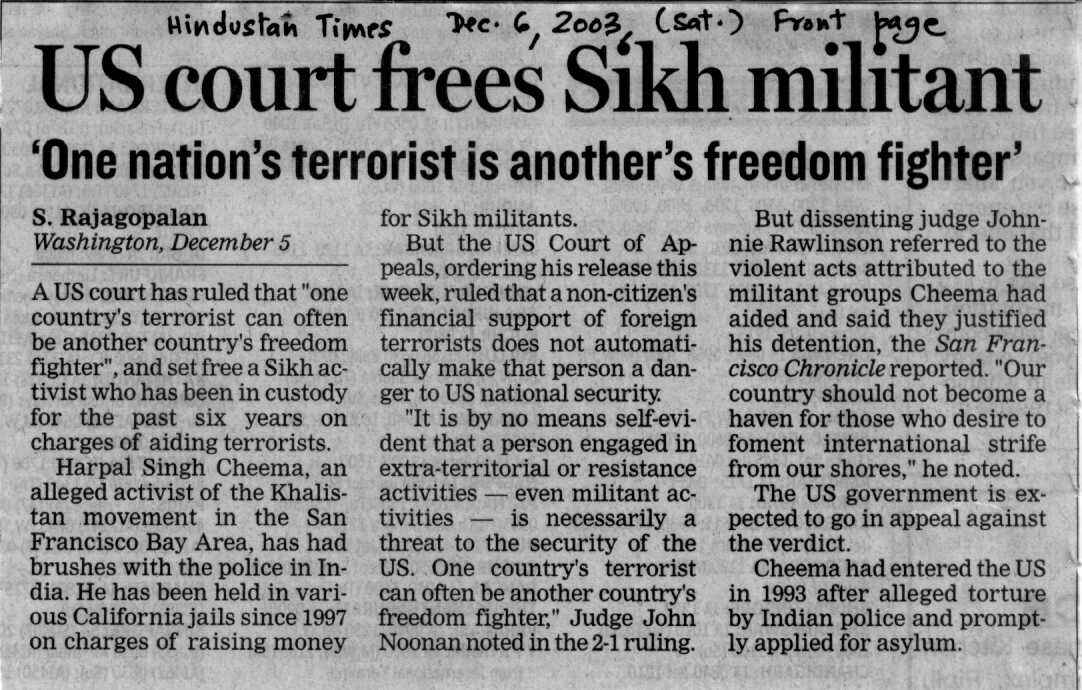 |
Ans. This is a very challenging question! I must acknowledge that I am a physician and not a legal expert, but I find myself more inclined to agree with the dissenting judge's opinion in this case. The majority opinion is a cliché that undoubtedly has a kernel of truth to it, but overall does seem to fly in the face of the government definitions we cited. It would not surprise me to see this decision overturned on appeal. I would also note that I think it is hard to argue that those who took innocent lives disseminating sarin in a Tokyo subway, spreading anthrax through the U.S. mail, or even crashing commercial airliners into public buildings represent the actions of freedom fighters.
Please kindly acknowledge that the opinions I express are solely my personal opinions and do not necessarily reflect those of the U.S. Department of the Army or Department of Defense.
Qu. 6. If you were to born again, and were allowed to choose your profession, what would it be and why?
Ans. While I might sometimes imagine what it would be like to be a star baseball or soccer player, I am quite happy with my career path, and if I had the chance to do it all again, I would be happy to live exactly the life I have had.
 Dr. Roy can be approached via E-mail at mroy@usuhs.mil. The review of his book Physician's Guide to Terrorist Attack appears in the same issue. Readers wanting to visit this review may want to click here.
 N.B. It is essential to read this journal - and especially this interview as it contains several tables and high resolution graphics - under a screen resolution of 1600 x 1200 dpi or more. If the resolution is less than this, you may see broken or overlapping tables/graphics, graphics overlying text or other anomalies. It is strongly advised to switch over to this resolution to read this journal - and especially this interview. These pages are viewed best in Netscape Navigator 4.7 and above.
-Anil Aggrawal

 Interview appearing in the previous issue
Interviews : Collective Index
Interviews in our sister publication : Collective Index
Interview appearing in the previous issue
Interviews : Collective Index
Interviews in our sister publication : Collective Index
Click here to contact us.
This page has been constructed and maintained by Dr. Anil Aggrawal, Professor of Forensic Medicine, at the Maulana Azad Medical College, New Delhi-110002. You may want to give me the feedback to make this pages better. Please be kind enough to write your comments in the guestbook maintained above. These comments would help me make these pages better.
 IMPORTANT NOTE: ALL MATERIAL APPEARING IN THIS ONLINE JOURNAL ARE COPYRIGHTED BY "ANIL AGGRAWAL'S INTERNET JOURNAL OF FORENSIC MEDICINE AND TOXICOLOGY" AND MAY NOT BE REPOSTED, REPRINTED OR OTHERWISE USED IN ANY MANNER WITHOUT THE WRITTEN PERMISSION OF THE WEBMASTER

|