


|
|
EXTRACTS |
 Forensic Dental Evidence: An Investigator's Handbook by C. Michael Bowers. Hard Bound, 7" x 10".
Elsevier Academic Press, 525 B Street, Suite 1900, San Diego, California 92101-4495, USA. Publication Date 2004. xx + 211 pages, ISBN 0-1212-1042-1. Price $59.95
 Official Site: http://www.elsevier.com/wps/find/bookdescription.cws_home/702219/description
 For an exclusive interview with C. Michael Bowers, the author of this book, please click here.
 |
This book is a valuable tool to be used by the budding odontologist or any investigator trying to gain knowledge in the field of forensic odontology. I would highly recommend this book for library additions in any Medical Examiner's office, police department, forensic nursing station, law office or any agency that would use the services of a forensic odontologist.., so concludes our expert reviewer. The board of editors decided to run some extracts from this immensely useful book, so one could judge what a valuable addition to forensic literature this book has been.
 |
|
|
In the very first chapter (entitled "Dental Detectives") the author gives some interesting case histories where dental evidence played an important part in solving a case. We chose the case of Ted Bundy to highlight here. For the uninitiated a little backgrounder might be of some help here. Theodore Robert Bundy - better known as Ted Bundy (November 24, 1946 - January 24, 1989) was one of the most infamous serial killers who killed numerous young women in several different states of USA, namely Washington, Utah, Colorado and Florida. His main period of activity was between 1974 and 1979. Nobody knows how many women he killed; estimates range between 30 (a number which Bundy actually confessed) to above 100. Bundy was arrested on 16 August 1975 in Salt Lake City.
 |
After a dramatic turn of events, on June 7, 1977 he escaped in a Hollywood style fashion by opening the window of a law library (He was facing a murder trial in the Pitkin County, Colorado, and during the court recess, he requested for, and was allowed to, visit the courthouse's law library). The window was no less than 30 feet above the ground! (Paradoxically this made him something of a hero in the eyes of the local youth!). He was caught eight days later, but escaped once again on 30 December 1977 - this time through a hole patiently carved with a smuggled hacksaw in the ceiling of his cell. He was recaptured - for the third time - on 15 February 1978.
 |
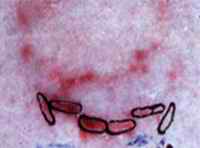 |
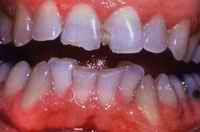
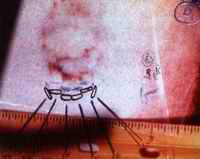
In this brief period of freedom (between 30 December 1977 and 15 February 1978) he murdered at least three women in Tallahassee, Florida. Margaret Brown, 21, and Lisa Levy, 20 were murdered on 15 Jan 1978 and Kim Leach, 12 on 9 Feb 1978. One of these - Lisa Levy's - case was a classic case requiring the expertise of a forensic odontologist. Bite marks had been found on Lisa Levy's buttocks. On 27 April, 1978, an impression of Bundy's teeth were taken. These were matched with the bitemarks found on Lisa's buttocks. A perfect match was found. Among others, this was a major piece of evidence, which ultimately took him to the electric chair - on January 24, 1989.
This is how Bowers describes this case on pages 26-27.
A particularly well-known bite mark case in the U.S. is the dental evidence brought against executed serial murderer Theodore (Ted) Bundy in a Florida court. The case involved a double murder and aggravated assault that occurred in 1978. The dental evidence centered on a skin injury on the body of one of the murder victims. The prosecution dental experts considered these marks to have been made by human teeth. Defense experts considered the bite mark evidence to be non-specific for Bundy's teeth (Figures 1.22-1.24). Other physical evidence obtained from Bundy and later associated to the crime included hair samples from one victim's bedroom. The jury, in reviewing the evidence, convicted Bundy of murder. They attested that the bite mark evidence was very compelling. This case occurred before the advent of DNA analysis from saliva taken from bite mark injuries.
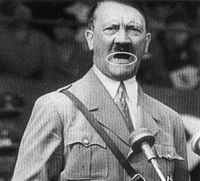 |
Bowers then goes on to describe another famous case solved by forensic odontology - that of the proper identification of Adolph Hitler, the Führer. He was burned down by his comrades (so Russians would not capture him alive). Russians did capture his remains however. These were ingeniously matched by forensic odontologists with Hitler's known dental records. We would not describe the case here - the reader would enjoy reading the whole case from the book. We would however just reproduce one highly illustrative picture here which appears as figure 1.25 on page 28.
Chapter 3 entitled "Recognition, recovery and analysis of bite mark evidence" is another highly interesting chapter. Much of the chapter deals with human bite marks. However we reproduce below one of the "off-beat" sections from this chapter. This one - appearing on page 86 - deals with animal bites.
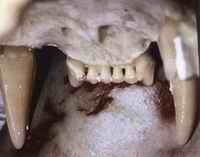 |
Large carnivore bite marks are seen in dog bite and mountain lion cases. The bite wounds produced can be remarkable in their depth and amount of damage to skin and underlying muscle. These animals have extremely long canines and a complement of six incisors plus the two canines for a total of eight. Figure 3.20 shows a plaster model of a dog's upper jaw. Figure 3.21 shows a California mountain lion jaw.
And finally we would like to reproduce some legal issues in forensic odontology, which Bowers discusses in chapter 8. The following passage is from page 181 of this book.
Dentists testify in criminal cases about dental identification of the deceased or the identification of biters from tooth marks.
The courts consider an expert to be a person whose knowledge, training and experience creates an understanding of facts that are outside the abilities of the average individual. This knowledge must be relevant (be related) to the question being asked in court, such as, "Is this injury a human bite mark!" or "Did this particular automobile tire fail and cause the accident?". This knowledge has to help the judge and the jury in rendering a verdict. Using this simple test, people possessing many skills are allowed into the courtroom, such as dentists, automobile tire engineers, policemen and plumbers. The expert, once admitted, is allowed to render an opinion on matters that occurred outside his/her presence. This is a very powerful and important tool in criminal cases where quite often both the prosecution and defense counsel have their own experts whose opinions do not agree. Experts actually reconstruct, to the best of their ability, the events that occurred during an act related to a crime. Certainly, regarding dental evidence, the best information for a court is from a certified forensic odontologist.
Forensic dentistry is not recognized by the American Dental Association as a dental specialty. This attitude varies between countries. The UK has established a court certification for all forensic experts. Law enforcement, however, has relied on dentists who assist them to be competent and familiar with forensic protocols.
The typical forensic dental expert is a practicing dentist or a dental educator. A handful of dentists work for federal agencies. The US military has active duty dentists forensically trained through the Armed Forces Institute of Pathology (AFIP) at most major bases.
|
|
The professional forensic organizations where most practicing forensic dentists belong are the American Academy of Forensic Sciences (AAFS) and the American Society of Forensic Odontology (ASFO). The AAFS has an odontology section with a membership of over 300 dentists. Their experience varies from Trainee to Fellow. The ASFO has a membership of over 1,000. This includes dentists, dental hygienists and anyone interested in forensic odontology.
Bowers rounds up the book with a final excellent chapter on photography and forensic dental evidence. I enjoyed reading this book thoroughly, and this book will be a treasure for me forever.
Order this book by Clicking here
 Request a PDF file of this review by clicking here. (If your screen resolution can not be increased, or if printing this page is giving you problems like overlapping of graphics and/or tables etc, you can take a proper printout from a pdf file. You will need an Acrobat Reader though.)
N.B. It is essential to read this journal - and especially this review as it contains several tables and high resolution graphics - under a screen resolution of 1600 x 1200 dpi or more. If the resolution is less than this, you may see broken or overlapping tables/graphics, graphics overlying text or other anomalies. It is strongly advised to switch over to this resolution to read this journal - and especially this review. These pages are viewed best in Netscape Navigator 4.7 and above.
-Anil Aggrawal


 [ Major links ]
[ Aims and Objectives ] [ FAQ ] [ Editorial Board ] [ Contributing Partners ] [ Sitemap ]
[ Paper/Thesis submission guidelines ] [ Editorials - Cumulative Index ] [ Be our sponsor! ]
[ Cumulative index of Book Reviews sorted by | Publishers |
General Interest Books |
Technical Books ] [ Animated Reviews ] [ Featured Reviews ]
[ Links ] [ Submit books/journals/software/multimedia for review ] [ journal CD ] [ History of the Journal ] [ Interviews ] [ Credits ]
[ Online Courses ] [ Awards ] [ Anil Aggrawal's Internet Journal of Book Reviews - Sister Publication ]
[ Cumulative reviews of Software/Multimedia | Books on CD/Audio tapes ] [ contact us ]
Books for review must be submitted at the following address.
Professor Anil Aggrawal (Editor-in-Chief)
Anil Aggrawal's Internet Journal of Forensic Medicine and Toxicology
S-299 Greater Kailash-1
New Delhi-110048
India
Click here to contact us.
 This page has been constructed and maintained by Dr. Anil Aggrawal, Professor of Forensic Medicine, at the Maulana Azad Medical College, New Delhi-110002. You may want to give me the feedback to make this pages better. Please be kind enough to write your comments in the guestbook maintained above. These comments would help me make these pages better.
 IMPORTANT NOTE: ALL PAPERS APPEARING IN THIS ONLINE JOURNAL ARE COPYRIGHTED BY "ANIL AGGRAWAL'S INTERNET JOURNAL OF FORENSIC MEDICINE AND TOXICOLOGY" AND MAY NOT BE REPOSTED, REPRINTED OR OTHERWISE USED IN ANY MANNER WITHOUT THE WRITTEN PERMISSION OF THE WEBMASTER
Questions or suggestions ? Please use ICQ 19727771 or email to dr_anil@hotmail.com

|
