|



|
|
 Cracking Cases - The Science of Solving Crimes by Dr. Henry C. Lee with Thomas W.O'neil. Illustrations, Hard Cover, 6" x 9". Illustrations, Notes, Index.
Prometheus Books, 59 John Glenn Drive, Amherst, New York 14228-2197, USA. Phone: (716) 691-0133 or Toll Free: (800) 421-0351 Fax: (716) 691-0137. Publication Date 2002. 316 pages, Category: Popular Science, ISBN 1-57392-985-9. Price $26.00
 Official site of this book: http://www.prometheusbooks.com/catalog/book_1193.html
 Please Click here to read excerpts from the companion volume Cracking More Cases.
 Please Click here to read review of this book.
 |
This is one of those rare high quality books, that won critical acclaim from our expert reviewer. The board of editors decided to run some excerpts from this highly readable book, so one could judge what a valuable addition to forensic literature this book has been.
 |
At several places in this book (Cracking Cases), the reader gets an insight in what goes in Lee's work. In the Mathison murder case, Henry Lee had to make a trip to Hawaii, which could arguably be described as combining work with pleasure. Lee also describes, how he takes his wife to several of his crime scene visits, where she works as his loyal assistant. This is how Lee describes his arrival in Hawaii and his starting work there.
THE MATHISON MURDER CASEPages 33-34
Although I have been to Hawaii many times to work on cases and to testify, this was my first trip to Hilo. My trips there have always been limited to Honolulu. Over the years, I have made many good friends, such as the former District Attorney Keith Kaneshiro and his principal assistant, Carol Sunaga. This list also includes former Crime Lab Director Gilbert Chang and current Director Joanne Fruyo, Dr. Lee Goff, Chief Medical Examiner Dr. Kanti VonGuluthner, former Major Wilson Sullivan, Tracy Tanaka, Curtis Kubo from the Honolulu Police Department, and Sergeant Brian Kaya and John Wilt from Maui. In most of my trips, my wife, Margaret S. Lee, accompanies me, often working with me as my loyal assistant. Margaret helps me pack the wide array of equipment I need to bring along. This equipment list includes laser lights, a large magnifier, microscopes, chemicals, and reagents. My first impression of Big Island, Hawaii, where Hilo is located, was dominated by its extreme beauty and its immensity. Margaret and I checked into our hotel and went to our room. We had a gorgeous view of a tropical rock garden, and in the distance I can still see, in my mind's eye, the greenish and blue Pacific Ocean, which sent a stream of white-tipped breakers up against the black volcanic rocks below our windows. Standing there I could take in all of the bay area, dominated by palm trees and the deep blue waters. I could have simply enjoyed this experience for days, except for the fact that I was there to answer the call to assist and to seek answers for what events led to a very tragic and untimely death. Early the following day, Paul Ferreira and I got to work and mapped out our schedule for the next few days. We would first visit the scene. We planned to walk through the entire roadside crime scene to reconstruct the possible sequence of events and then settle in to examine the Mathisons' van to search for evidence and to reconstruct the blood-spatter evidence.
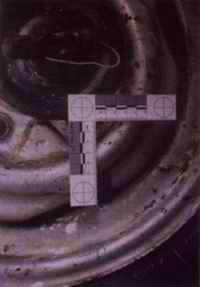
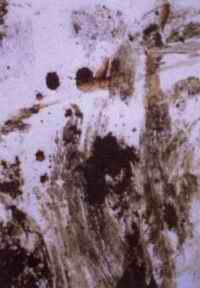
Early the following day, Paul Ferreira and I got to work and mapped out our schedule for the next few days. We would first visit the scene. We planned to walk through the entire roadside crime scene to reconstruct the possible sequence of events and then settle in to examine the Mathisons' van to search for evidence and to reconstruct the blood-spatter evidence. Although the van had considerable rust on its exterior, it was in good shape. It had been housed in the Hilo police garage. Camera and magnifying glass in hand, I spent nearly ten hours examining the van. I examined every inch of the van's exterior. I could find no fresh damage areas, no visible bloodstains, no tissue-like material, and no fabric impressions on the exterior surface of the van. Usually, in traffic accidents involving a vehicle hitting a person, we find damage to the vehicle and exchanges of trace evidence due to the force of impact. Those are the clues which a forensic scientist would often find if a vehicle has been in an accident. What I did find was a purplish-colored stain on the exterior of the van, behind the driver's side door. Chemical testing for the presence of blood here proved negative, and the stain appeared to have come from some kind of fruit or berry. Some dried vegetation was noted on the lower part of the driver's doorjamb. With the assistance of Margaret, Paul Ferreira, and Francis Rodillas, the van was then placed on a lift so I could inspect its undercarriage. |
||
Lee then goes on to describe, what he found in its undercarriage. Readers may want to read (from the book of course) about these exciting discoveries, and the intelligent deductions Lee made from them.
|
|
In most cases, Lee sums up the cases by giving a section called "The Scientific Facts". This section usually appears towards the end of each chapter. In the chapter on the famous "Woodchipper case", I read with interest his clever use of Luminol to bring out blood stains. Very satisfying was the fact, that the term "Luminol" is used correctly. I have seen several experts using the term as "Luminal" in place of "Luminol". "Luminal" of course is the trade name of the sedative phenobarbital. Medical students - especially those in forensic medicine - have to remember both terms. We do get Luminal poisoning often. Several of my students find difficulty in remembering - and differentiating between - the two terms, and the mnemonic I suggest them is this:
Luminal : Phenobarbital
Luminol : Blood
This is what Lee describes in his famous "Woodchipper case" on pages 150-152
THE SCIENTIFIC FACTS OF THE WOODCHIPPER CASEPages 150-152
The Woodchipper murder is a case in which a great many forensic disciplines came together to create a net of evidence powerful enough to gain a successful solution and justice. This was achieved, even though only fragments of the body would eventually be found. Odontology, pathology, serology, blood-spatter evidence, credit card tracing evidence, fabric and hair examination, time-line analysis, and weather evidence, were just some of the forensic fields that played a critical role in this case's successful prosecution. I suggest that we closely analyze just one of these fields in our discussion of the forensic procedures used to solve this murder. When I walked into the Crafts' master bedroom on Christmas Day in 1986, I immediately saw some reddish-brownish stains on the queen-sized mattress that Richard and Helle Crafts used. I knew that there was a good possibility that these stains were human blood and that there could be more blood traces in that room, but ones which were not visible to the naked eye. To enhance any blood traces I could not readily see, I used two blood enhancement reagents, known as luminol and TMB (tetramethylbenzidine).
Luminol is a mixture of three dry chemicals which are added to distilled water. TMB is a mixture of chemicals with ethanol and glacial acetic acid. When mixed in the proper amounts, the resulting luminol or TMB can provide a presumptive determination whether the stains in question are blood. The stains will quickly show up in a bright, luminescence with luminol and a blue color with TMB, should the source be blood. When first developed, these chemicals were used for presumptive blood-testing purposes. But, over the years, experienced investigators have been able to use luminol and TMB to bring up visually blood traces which they would otherwise miss. We apply luminol/TMB at a crime scene with a spray bottle which enables large areas to be quickly surveyed. This overview additionally permits the investigator to establish blood trails and other critical patterns. At times, these patterns can lead the investigator to see foot or handprints which would be otherwise invisible. The application of luminol may affect some blood serological examinations, so appropriate samples should be properly collected before it is applied. Using luminol has some other requirements. First, it must be used in the dark. This can be difficult, so the room and the investigator must be prepared, including allowing the eyes to become accustomed to the pitch dark. The investigator should test the mixture on a piece of paper which has one part human blood to one hundred parts water as a positive control. Then he should apply the luminol. If he is applying it to a wall, he should be sure to spray on small amounts since large amounts will collect on the surface, causing the solution to run. This can quickly destroy the target pattern. Also, luminol will not work if the temperature is at or below the freezing level (thirty-two degrees, Fahrenheit).
The other major problem which luminol presents is the difficulty in photographing the results in the total dark. As part of the preparations, the camera equipment should be set up, off to one side. The investigator will have to take his photos at a ninety-degree angle to the target surface. Therefore, he should mount the camera on a tripod. While taking pictures, he will have to estimate the intensity of the light being produced by the pattern and should bracket his camera's light meter accordingly. The results, even in optimum conditions, can vary. I have had photos develop with as little as ten seconds of exposure and others that would not develop with three minutes' exposure. As a rule, a footprint showing a lot of detail will develop with a fifteen-second exposure while a fingerprint may not develop at all. The investigator should also try to frame the photography by providing a scale. He can carefully allow a small amount of light into the room while the shutter is open to provide this scale. Another way: He should apply fluorescent paint to a ruler, which will show up in the photograph as long as the ruler has been subjected to light prior to the photo. It is vital to take lots of photos. Eight or ten per pattern is a good average. Obviously, using luminol and TMB to bring up the blood evidence in the Crafts' master bedroom was a critical part of my forensic investigation there. These scientific means for solving crimes are reliable but must be used only with proper preparations. Also these tests and tools are considered safe. TMB has proven to be noncarcinogenic. Criminal investigations today are a combination of old-fashioned and systematic detective work, such as checking telephone bills and credit card records, and intelligently applying modern techniques, such as blood enhancement reagents. |
|||
It is not unnatural for a person involved in crime detection to become philosophical at times. This is what Lee has to say in the last chapter entitled Epilogue.
EPILOGUEPages 298-299
The five cases presented, with their cast of individuals who were citizens from all walks of life, involved men and women who, to the outside world, seemed successful and at peace. The truth, however, was far different. Even in the O.J.Simpson case, where the accused was acquitted of two murders, there had been a lengthy history of domestic conflict, a struggle for control, and even abuse. All five marriages were conflicted very deeply and in each instance ended up in tragedy. Stepping into the crime scenes or looking through a microscope at what was the aftermath of these struggles is a very sobering experience. And these crimes are not isolated. Spousal abuse remains the number one unreported crime in America. The criminal investigator and forensic scientist are later responsible for scientifically finding the evidence which will clearly exhibit to a judge and jury just how a murder has been committed and by whom. Most ironically for myself, three of the five cases featured a husband who was also a police officer, though in one case that role was only at a part-time level. There does not seem to be any way to account for this. I say this since I have worked with, literally, thousands of wonderful men and women who have devoted their lives and talents to law enforcement.
In each of the troubled marriages covered in this book, there was a breakdown in the participants turning for help. Marriage counseling was at a minimum in all five situations. Family, friends, and society should work together to stop the inevitable slide to divorce and death. The first step for any battered and/or controlled woman to prevent any further physical and psychological abuse is to assess the problem and then to take action, action which will not slide back into ambivalence. I feel that it is important for me to express these facts as clearly as possible. Love, compassion, and mutual respect are all essentials of any successful marriage. As I conclude this work, I hope that the reader has also been able to perceive aspects of the forensic expert's responsibilities and work. We must always struggle to establish the facts and truth in any investigation. How did a terrible crime occur? What were the means the perpetrator used? Were there any witnesses? What could they have been able to perceive? Has the crime scene been adequately preserved? Is forensic evidence present? Has all of the evidence been correctly collected and preserved? Have the detectives and forensic scientists established a chain of custody which will stand up to the glare of a court-room proceeding? Has all the physical evidence been examined according to the highest scientific standards? Has all of the evidence been presented, whether it is incriminating or exculpatory in nature? In short, have the police and prosecution investigations been dedicated to finding the truth, the whole truth, and nothing but the truth?
Throughout this book I have endeavored to show how an investigation should be conducted and I have pointed out where the strict standards this goal requires have not been observed. As part of this, I have told how a forensic scientist works and the large number of hours we have to put into this profession. Now I am in my sixties and, as I look back at my life, I have decided to put forward the considerable energy this work requires. That's because I feel deeply that science, when given a fair chance, can define the truth in any case. That is my life's credo: Find the truth and bring it before the court, no matter where the facts lead us. But, as I have pointed out in each of the five cases, I have not worked in a vacuum, off somewhere in a laboratory, and on my own. I have had the great opportunity of working with countless dedicated police officers, detectives, prosecutors, lawyers, and forensic scientists in this, my quest. Whether fellow forensic scientists, police officers, criminalists, detectives, or prosecutors, I will always consider myself very lucky for having worked with such highly talented and dedicated colleagues. Ultimately, any court decision which reflects this truth is the direct result of a great team effort. I am simply one member of that team, and I am proud to end this work on this note. I will always be grateful for the great teammates I have found throughout the world, individuals who have combined to find the truth and nothing but the truth. |
|||
And finally, here is the complete table of cases described in this book, for those who are interested.
COMPLETE TABLE OF CASES
|
||||||||||||||||||||||||||||||||||||||||||||||||||||||||||||
This book - in short - is highly recommended, if you love forensics as much as I do. Go and read this book if you want to read and enjoy all cases in full.
Order these Books by clicking below.
 For review of Henry Lee's Crime Scene Handbook please click here.
Click here to read excerpts from Cracking More Cases.
Request a PDF file of these excerpts by clicking here. (If your screen resolution can not be increased, or if printing this page is giving you problems like overlapping of graphics and/or tables etc, you can take a proper printout from a pdf file. You will need an Acrobat Reader though.)
N.B. It is essential to read this journal - and especially this review as it contains several tables and high resolution graphics - under a screen resolution of 1600 x 1200 dpi or more. If the resolution is less than this, you may see broken or overlapping tables/graphics, graphics overlying text or other anomalies. It is strongly advised to switch over to this resolution to read this journal - and especially this review. These pages are viewed best in Netscape Navigator 4.7 and above.
-Anil Aggrawal


 [ Major links ]
[ Aims and Objectives ] [ FAQ ] [ Editorial Board ] [ Contributing Partners ] [ Sitemap ]
[ Paper/Thesis submission guidelines ] [ Editorials - Cumulative Index ] [ Be our sponsor! ]
[ Cumulative index of Book Reviews sorted by | Publishers | General Interest Books | Technical Books ] [ Animated Reviews ] [ Featured Reviews ]
[ Links ] [ Submit books/journals/software/multimedia for review ] [ journal CD ] [ History of the Journal ] [ Interviews ] [ Credits ]
[ Online Courses ] [ Awards ] [ Anil Aggrawal's Internet Journal of Book Reviews - Sister Publication ]
[ Cumulative reviews of Software/Multimedia | Books on CD/Audio tapes ] [ contact us ]
Books for review must be submitted at the following address.
Professor Anil Aggrawal (Editor-in-Chief)
Anil Aggrawal's Internet Journal of Forensic Medicine and Toxicology
S-299 Greater Kailash-1
New Delhi-110048
India
Click here to contact us.
This page has been constructed and maintained by Dr. Anil Aggrawal, Professor of Forensic Medicine, at the Maulana Azad Medical College, New Delhi-110002. You may want to give me the feedback to make this pages better. Please be kind enough to write your comments in the guestbook maintained above. These comments would help me make these pages better.
 IMPORTANT NOTE: ALL PAPERS APPEARING IN THIS ONLINE JOURNAL ARE COPYRIGHTED BY "ANIL AGGRAWAL'S INTERNET JOURNAL OF FORENSIC MEDICINE AND TOXICOLOGY" AND MAY NOT BE REPOSTED, REPRINTED OR OTHERWISE USED IN ANY MANNER WITHOUT THE WRITTEN PERMISSION OF THE WEBMASTER
Questions or suggestions ? Please use ICQ 19727771 or email to dr_anil@hotmail.com
Page Professor Anil Aggrawal via ICQ

|