|



|
|
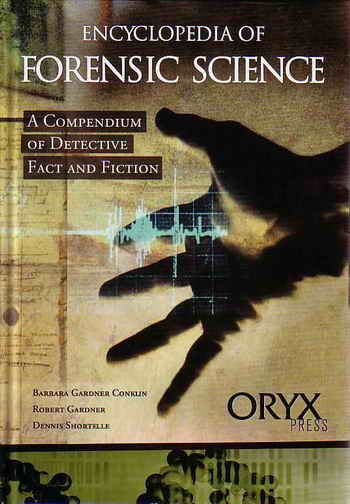
 Encyclopedia of Forensic Science - A Compendium of Detective Fact and Fiction by Barbara Gardner Conklin, Robert Gardner and Dennis Shortelle. Hard Cover, 7" x 10". Illustrations, Notes, Index.
Oryx Press, (An imprint of Greenwood Publishing Group, Inc), 88 Post Road West, Westport, CT 06881. Publication Date 2002. xvi + 329 pages, ISBN 1-57356-170-3. Library of Congress Control No. 2001036638. Price $70.95, £40.99  Official site of this book: http://www.greenwood.com/books/BookDetail.asp?sku=OXFORS
 Please Click here to read review of this book.
 |
This extraordinary book gives information on virtually every topic related to forensic medicine. The icing on the cake is its simple and lucid language.
 |
Among the topics discussed are types of forensic evidence such as bite marks, blood, hair evidence, glass evidence, insanity defence, forensic photography, eye prints and toolmarks; poisons and drugs such as strychnine, carbon monoxide, cyanide and arsenic; forensic scientists such as Alphonse Bertillion, Milton Helpern and Edmond Locard; famous criminal cases such as Georgi Markov case, Cleveland torson murders and Unabomber; famous criminals such as Theodore Bundy, Jack the Ripper and Wayne Williams, and much much more.
There are entries on even fiction writers of forensic science such as Anthony Abbot, Lawrence Blochman, Edna Buchanan, Patricia Cornwell, Jeffrey Deaver, Sir Arthur Conan Doyle, R. Austin Freeman, Erle Stanley Gardner, Arthur Benjamin Reeve, Kathy Reichs and Dorothy L. Sayers. Finally fictional characters in and television programs about forensic science have alsobeen discussed. Some examples: Dr. Daniel Webster Coffee, Thatcher Colt, CSI: Crime Scene Investigation, Sherlock Holmes, Craig Kennedy, Perry Mason, Pudd'nhead Wilson, Quincy, Dr. Kay Scarpetta, Dr. John Evelyn Thorndyke and Peter Death Bredon Wimsey.
|
|
The editors at the journal office decided to give some excerpts from this book, to give the reader some idea of the range of topics discussed. Here is what the authors have to describe about bite marks (pages 18-21)
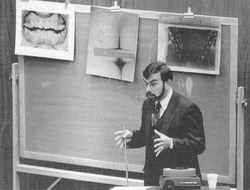
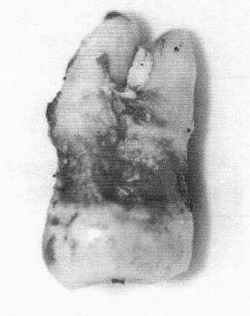
Bite MarksPages 18-21Bite marks are often caused by criminals who sometimes, in a fit of emotion, bite their victims and leave, not fingerprints, but bite prints. Even after bites heal, the marks can be made visible by shining ultraviolet light onto the area involved. The pigmented cells that form around the wounds during healing absorb ultraviolet light more than normal cells, providing a distinct contrast that can be photographed. Some forensic investigators believe that bite marks are not always recognized as such by medical examiners, since they often resemble bruises. A number of cases have been solved by examining the impressions left by teeth. In one case, detectives found a wad of chewing gum with teeth marks at the scene of a murder. A forensic odontologist made casts of the impressions in the gum by applying silicone to the hardened gum. It was clear that the teeth that chewed the gum did not match the teeth of the victim, nor did they match those of one suspect; however, there was a close match to the impressions taken from another suspect. As confirming evidence, the forensic lab was able to capture enough saliva from the gum to determine that the chewer had type-AB blood, a type found in only 4 percent of the population, and one that matched the suspect's blood type. With this evidence confronting him, the suspect confessed to the crime. The Gordon Hay CaseOn the morning of August 7, 1967, the body of 15-year-old Linda Peacock was found in a cemetery in Biggar, Scotland. She had been struck with a blunt object and then strangled with a rope. Although she had not been raped, her blouse and bra had been disturbed, and her right breast revealed an oval shaped bruise thought to be a bite mark. Forensic odontologist Dr. Warren Harvey and pathologist Professor Keith Simpson agreed that the bruises were caused by teeth and that one of the teeth was particularly irregular. The investigation focused on boys in a nearby detention center because Peacock had been seen talking to one of the young men the evening she was killed. Impressions were made of the teeth of a number of suspects and compared with photographic transparencies of the bite marks. The teeth of 17 year-old Gordon Hay matched the bite marks. He had pitted upper and lower right canines with sharp edges that could have produced the ragged marks left on Linda Peacock's breast. The unusual canines were the result of a disorder known as hypocalcination. The bite marks on the breast were upside-down, which correlated with the mud on the knees of the suspect's pants and other forensic evidence indicating that the victim had been strangled from behind. Apparently, Hay, had while kneeling behind his victim, had bent over her shoulder to bite her breast. The jury found the bite mark evidence convincing, and Hay was convicted of murder. Because of his age, he was sentenced "to be detained during her Majesty's pleasure". The Theodore Bundy Case
Prior to dawn on January 15, 1978, a club-carrying masked man entered the Chi Omega house on the Florida State University (FSU) campus in Tallahassee, killed two young women, and battered two others. He left little evidence except for a bite mark on one of the dead victim's buttocks. A month later, a man was arrested for stealing a motor vehicle. Though he was using an assumed name, records revealed that he was Theodore Bundy, a convicted felon suspected of being the serial killer who had committed dozens of sex murders throughout the northwestern United States. Bundy had escaped from prison two weeks before the killings at the sorority house at FSU. He had been convicted of abducting a woman who escaped and later identified him in a lineup, but police had been unable to tie him to the serial murders. When a detective searched Bundy's apartment for fingerprints, there were none, because Bundy had carefully wiped them all away. After making impressions of Bundy's dentition, forensic dentist Dr. Richard Souviron prepared solid casts of the suspect's teeth. Before the jury, Souviron demonstrated how a transparency of a photograph of Bundy's front teeth matched a same-size photograph of the bite marks on the victim's buttock. For the first time, a jury had clear evidence that Bundy was a murderer. He was convicted on July 23, 1978, and was executed more than a decade later. During that decade, he hinted at, but never confessed to, killing 40 to 50 women, most of whom were young and attractive, with long hair they parted in the middle. The victims of serial killers are often very similar in appearance. In this case, Bundy's victims were similar in appearance to his wife, who had once rejected him. The Carmine Calabro CaseOn Columbus Day 1979, the naked body of Francine Elveson, a 26-year-old teacher, was found on the roof of her apartment building in New York City. She had been strangled and mutilated, and the killer had left bite marks on the victim's thighs. A single pubic hair, identified as Negroid, led police to suspect that a black man was the culprit. With bite marks as a substantial clue, police asked the building's residents to submit impressions of their teeth. None matched the bite marks on Francine Elveson's body. After a months-long search without any success, local police asked the FBI for a profile of the killer. The profile indicated, among other things, that it was likely that the criminal lived in the building, had a serious mental problem that had required treatment, and was probably white.
If the killer was white, what was the source of the Negroid pubic hair? A careful investigation found that the bag used to carry the victim's body to an autopsy had previously been used to carry a murder victim who had been black. Failure to clean the bag thoroughly must have left some debris from the dead black man. The police now resumed their search with an emphasis on white, not black, suspects. No one living in the building had been treated for psychoses, but one man had a son, Carmine Calabro, who was being treated at a nearby hospital. Police found that security at the hospital was minimal. Calabro could have left the facility, committed the crime, and returned without anyone noticing his absence. Calabro agreed to a request for an im¬pression of his teeth. A cast made from the impression revealed that Calabro's teeth provided a perfect match for the bite marks left on Francine Elveson's body. He was found guilty and was sentenced to life in prison. The Irene Kennedy CaseAlthough bite marks have proved to be convincing evidence, the case of Irene Kennedy reveals the dangers involved in accepting such evidence with absolute confidence. On December 1, 1998, Irene Kennedy, 75, and Thomas Kennedy, 78, began their early morning walk in Francis William Bird Park in Walpole, Massachusetts. As was their custom, they walked a short distance and then separated to follow different paths before reuniting at the end of their strolls. But Irene Kennedy never rejoined her husband. She was brutally murdered, and her nearly naked body was left covered with bite marks. Police dogs brought to the crime scene led police to the nearby home of Edmund Burke, the eccentric brother of the Kennedys' son-in-law. Burke was questioned and was asked to submit samples of blood, saliva, fingerprints, palm prints, and dental impressions. After carefully examining Burke's dental impressions and the bite marks on Irene Kennedy's body, forensic scientist Dr. Lowell Levine reportedly told police that the bite marks on the body were, with reasonable scientific certainty, made by Edmund Burke. On the basis of the available evidence, Burke was arrested on December 10 and charged with murder. Eight days later, the results of tests comparing the DNA in Burke's saliva with that collected from the bites on Irene Kennedy were released. The DNA samples did not match, but Burke was not released. A month later, a bloody palm print found on Irene Kennedy's thigh did not match the print of Burke's palm. Burke was released on January 20. DNA and palm prints, two types of evidence more conclusive than bite marks, had shown that Burke was not Irene Kennedy's murderer. The crime remains unsolved. See alsoBertillon, Alphonse; Crime Scene; Fingerprints; Footprints; Odontology; Palm prints; Psychological Profiling; Serial Killers. ReferencesCyriax, Olivcr. Crime: An Encyclopedia. North Pomfret, VT: Trafalgar Square, 1996.
|
||
Note that the authors have illustrated the use of bite marks in forensic science with as many as four real cases, and have even illustrated one case. They have taken care of include references and cross references, which enhances the value of this book greatly. The authors take care to impress that bite mark evidence is not always infallible. The Irene Kennedy Case given at the end illustrates this point very well, where the forensic scientist Dr. Lowell Levine was ultimately proved wrong.
The entry on Fibre entry is illustrated with as many as three cases (i) The Roger Payne Case (1968) (ii) Wayne Williams Case (1979-1981) and (iii) The John Serratore Case. This is what the authors have to say on pages 106-108.
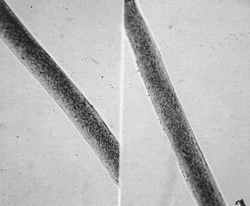
Fibre EvidencePages 105-108The Roger Payne Case (1968)The murder of Claire Josephs in Bromley, England, in 1968 was solved in large part through fiber evidence. Her husband found her body. Her throat had been cut, and police discovered that a serrated bread knife was missing from the kitchen. At the time of the murder, she had been wearing a red woolen dress. Lacking evidence of forcible entry and given the presence of a half-empty coffee cup and cookies on the kitchen table, police surmised that the victim knew her killer. Consequently, investigators concentrated on friends and relatives. When they interviewed Roger Payne, a bank clerk who had visited the Josephses with his wife earlier that year, they noticed scratch marks on his hands. Analysis of his suit under ultraviolet light revealed 61 red wool fibers that were consistent with those on Claire Josephs's dress. Furthermore, 20 rayon fibers found on Claire Josephs's raincoat hanging inside her front door matched fibers from Payne's scarf, which he had likely hung over her raincoat upon entering the home. In addition, investigators found fibers matching the Josephs's carpet on the floor of Payne's car. The fiber evidence combined with bloodstains in Payne's car that matched Claire Josephs's blood type sealed the case. Payne was convicted and sentenced to life in prison. Wayne Williams Case (1979-1981)
Serial killer Wayne Williams is believed to have murdered 30 young black males during a two-year period. The strangled bodies of 12 young black males were discovered. Another 18 young men were reported missing. After newspaper reports stated that police had found fibers on the victims' bodies, the killer had been stripping his victims and throwing their bodies into rivers. This at¬tempt to conceal evidence led to his arrest. Aware of his pattern of dropping bodies into rivers, police established surveillance crews at bridges. On May 22, 1981, police heard a splash in the Chattahoochee River. They stopped a car driven by 23-year-old photographer Wayne Williams but could find no reason to detain him. Two days later, Nathaniel Carter, the 12th known victim, was found a mile downstream. Police now had just cause to obtain a warrant to search Williams's car and apartment. Forensic scientists working with Du Pont chemists had determined that the fibers found on the victims were made by the Wellman Corporation and were used in carpeting manufactured for one year by the West Point Pepperell Corporation. The carpets had been sold for two years in 10 southeastern states. Based on sales, it was calculated that the probability of finding such a carpet in an Atlanta apartment was 1 in 7,792. Fibers found on another victim were con¬sistent with those from Williams's 1970 Chevy station wagon. On the basis of Gen¬eral Motors manufacturing figures and the number of vehicles of that model in the Atlanta area, police determined that the probability of finding matching fibers on a victim was 1 in 3,828. There were also fibers from other carpets and hairs from Williams's head, from his dog, and fibers from victims on a glove; however, the crucial evidence was the probability of finding fibers from both the carpets in the accused murderer's bedroom and from the carpeting in his car on victims. Using many charts and photographs, prosecutors pointed out that the probability of finding victims with both the bedroom and car fibers was 1 in 7,792 times 3,828 or 1 in 29,827,776. With such odds against him, Wayne Williams was convicted of murder and sentenced to life in prison. The John Serratore CaseIn June 1999, a New South Wales Supreme Court jury in Sydney, Australia, found John Serratore, 27, guilty of strangling Frances Tizzone, a 21-year-old student, four years earlier. The two had planned to become engaged before Tizzone broke it off. The verdict was based to a large extent on fibers that were found on the dead woman's shoes. Forensic scientists maintained that these fibers were consistent with fibers from the carpet in Serratore's car. Furthermore, they stated that the fibers would not have remained on her footwear had she taken more than a few steps. Hence the murder must have occurred while she was either in or very near Serratore's automobile. While the evidence could not establish that Serratore was the murderer, it did show that he was at least an accomplice and led to a conviction and a sentence of 20 years in prison |
|
The authors describe a number of exotic poisons and famous murders committed with them. The famous murder by Dr. Robert Buchanan is described in the entry on Opium. This is what the authors have to say on page 214.
OpiumPage 214CodeineCodeine is also found in opium, but is more commonly prepared from morphine. It is a milder narcotic than morphine and is widely used as a cough suppressant. Because it is a much weaker narcotic than morphine or heroin, it is less attractive to drug addicts. MethadoneMethadone is one of the narcotic drugs not derived from opium or morphine. It is widely used to treat drug addicts because it seems to inhibit the craving for heroin without producing significant side effects. The Dr. Robert Buchanan Case
In 1892, Anna Buchanan, who ran a very profitable brothel, died of a cerebral hemorrhage according to the New York coroner who signed her death certificate. As a result of her death, her husband, Dr. Robert Buchanan, inherited $50,000, which was a significant sum at that time. One of her pimps, also a former lover, identified only as Mr. Smith, demanded that the coroner's office open an investigation. He was overheard by Ike White, a reporter for the New York World, who took up the cause. White discovered that Buchanan had returned to Nova Scotia, where he remarried his former wife only three weeks after Anna Buchanan's death. His discovery served to whet his suspicion and led him to interview others who had worked at the brothel. One of them recalled a comment that Robert Buchanan had made during the trial of Carlyle Harris, who had murdered his wife by giving her an overdose of morphine. Buchanan called Harris an amateur because his wife's pinpoint pupils led investigators to suspect morphine poisoning. Buchanan had boasted that he knew a way to avoid such telltale evidence. When White interviewed the nurse who had attended Anna Buchanan just prior to her death, the woman remembered that Buchanan had placed drops in his wife's eyes several times during her short illness. Could the drops have contained atropine, which, because it causes pupils to dilate, could have hidden the effect of morphine? White knew that he was onto something, and he launched a newspaper campaign demanding that Anna Buchanan's body be exhumed for examination. The police finally responded by exhuming the body. Toxicologist Rudolph Witthaus found clear evidence of morphine in the victim's tissues and agreed with White that the usual pinpointing of the pupils could have been prevented by atropine drops. At the trial, the prosecution administered a lethal dose of morphine to a cat followed by drops of belladonna, which contains atropine. It was clear that the pinpointing effect was prevented by the belladonna. Buchanan was found guilty of murder and was executed on July 2, 1895, just 26 months after Carlyle Harris was executed for the same crime. A More Recent Drug CaseIn June 1988, Hong Kong authorities received word from Australian police that one of their undercover operations had discovered a drug syndicate that was planning to use a yacht to smuggle a large shipment of heroin from Hong Kong to Australia. Hong Kong police responded with their own undercover agents who, posing as sailors aboard the yacht, arrested 3 pushers and confiscated 43 kilograms (95 pounds) of heroin. Undercover agents then faked the delivery of yacht-borne heroin in Sydney, Australia, where they arrested 16 more people. |
|
As one can see, the authors have taken care to include more recent cases too. While most forensic science aficionados would probably know about Dr. Robert Buchanan case, not many would be aware of the more recent 1988 case . I certainly wasn't.
Finally, I can not refrain myself from uncovering another remarkable aspect of this book - description of forensic related aspects that occur in literature, art, TV shows and movies. This has not been attempted by many authors before. This is how the authors describe Pudd'nhead Wilson on pages 232-3
Pudd'nhead WilsonPage 232-3Pudd'nhead Wilson, a novel about the antebellum South, is the story of David Wilson, a fictional forensic scientist created by the pen of Mark Twain (Samuel Clemens). The story begins as Wilson arrives in Dawson's Landing south of St. Louis on the Mississippi River, where he hopes to establish a law practice. Unfortunately, soon after his arrival, he is nicknamed Pudd'nhead by the dull-witted residents, who cannot grasp his sardonic humor. Wilson tries unsuccessfully for years to establish himself as a lawyer. To make a living, he works as an accountant and surveyor, but continues to seek legal clients. As a hobby, which is essential to Twain's plot, Wilson collects fingerprints. During the course of two decades at Dawson's Landing, he collects the fingerprints of nearly every resident, white and slave, on glass plates that he carefully preserves and studies. A major character in the novel is a very light-skinned (one sixteenth black), sharp minded mulatto slave named Roxana who bears a son, fathered by one of the town's leading aristocrats, on the same day that her master's wife also gives birth to a boy. A short time later, the master's wife dies, and Roxana is given the responsibility of caring for both infants. Since her master is preoccupied with business affairs, he cannot distinguish one child from the other except by the clothes they wear. Recognizing the opportunity to save her son from the terror of slavery, Roxana exchanges him (Chambers) for her master's son (Thomas Driscoll), a switch that is never perceived by her master. Two decades later, Wilson's opportunity as a lawyer arises when he defends Italian twins accused of killing Judge York Driscoll, uncle and now guardian of the false heir, Thomas Driscoll, a deceitful, conniving, and vicious young man who has learned through his mother of his true identity. All evidence points to the twins. They were discovered at the crime scene, and one of them had threat¬ened to kill the judge. However, there are fingerprints on the knife used as the murder instrument, and witnesses saw a young woman leaving the judge's house shortly after the murder. Wilson searches his files of fingerprints but can find no woman's fingerprints that match those on the knife. However, as luck would have it, Tom Driscoll drops by in a mood to irk Wilson, who he feels has lost the case. Inadvertently, Tom, seeing Wilson engaged in examining fingerprints, notes that one plate contains the prints of Roxana as well as his and those of Chambers. Suddenly, Wilson recognizes, but does not reveal to Tom, the prints that match those on the knife. He sees, too, because he took the fingerprints of both boys before and after they were switched by Roxana, that Tom is really Chambers, the child of a slave. The true Tom, the judge's heir, has been raised as a slave. The next day, in a dramatic courtroom scene, Wilson shows that the prints on the knife do not match those of either of the Italian twins, but they do match those of the man thought to be Thomas Driscoll. He then explains how the boys were switched by Roxana. On the basis of the evidence, the twins are freed, and the true heir receives his inheritance and freedom, but cannot escape the slave culture in which he was raised. The villainous false heir, Tom, who confesses his guilt, is sold down the river, where he becomes a slave, leaving his mother distraught. When Twain wrote this novel in the 1890s, fingerprints had not been established as a vehicle for crime detection by police departments. Consequently, he must have been well aware of the research that had been done on fingerprinting and of the potential that fingerprints offered in establishing criminal guilt. |
Take my advice and read this book. You would thank me I recommended this beauty to you!
 Read review of this book by clicking here.
Order this Book by clicking below.
 Encyclopedia of Forensic Science
Request a PDF file of this review by clicking here. (If your screen resolution can not be increased, or if printing this page is giving you problems like overlapping of graphics and/or tables etc, you can take a proper printout from a pdf file. You will need an Acrobat Reader though.)
N.B. It is essential to read this journal - and especially this review as it contains several tables and high resolution graphics - under a screen resolution of 1600 x 1200 dpi or more. If the resolution is less than this, you may see broken or overlapping tables/graphics, graphics overlying text or other anomalies. It is strongly advised to switch over to this resolution to read this journal - and especially this review. These pages are viewed best in Netscape Navigator 4.7 and above.
-Anil Aggrawal


 [ Major links ]
[ Aims and Objectives ] [ FAQ ] [ Editorial Board ] [ Contributing Partners ] [ Sitemap ]
[ Paper/Thesis submission guidelines ] [ Editorials - Cumulative Index ] [ Discussion ] [ Chat room ] [ Be our sponsor! ]
[ Cumulative index of Book Reviews sorted by | Publishers | General Interest Books | Technical Books ] [ Animated Reviews ] [ Featured Reviews ] [ E-books ]
[ Reviews with Quizzes ] [ Links ] [ Submit books/journals/software/multimedia for review ] [ journal CD ] [ History of the Journal ] [ Interviews ] [ Credits ]
[ Cumulative index of | Theses/dissertations | [ Online Courses ] [ Awards ] [ Anil Aggrawal's Internet Journal of Book Reviews - Sister Publication ]
[ Cumulative reviews of Software/Multimedia | Books on CD/Audio tapes ] | Calenders | Models ] [ contact us ]
[ Undergraduate section | Postgraduate section ] [ Forensic gadgets/toys/other tidbits ]
Books for review must be submitted at the following address.
Professor Anil Aggrawal (Editor-in-Chief)
Anil Aggrawal's Internet Journal of Forensic Medicine and Toxicology
S-299 Greater Kailash-1
New Delhi-110048
India
Click here to contact us.
This page has been constructed and maintained by Dr. Anil Aggrawal, Professor of Forensic Medicine, at the Maulana Azad Medical College, New Delhi-110002. You may want to give me the feedback to make this pages better. Please be kind enough to write your comments in the guestbook maintained above. These comments would help me make these pages better.
 IMPORTANT NOTE: ALL PAPERS APPEARING IN THIS ONLINE JOURNAL ARE COPYRIGHTED BY "ANIL AGGRAWAL'S INTERNET JOURNAL OF FORENSIC MEDICINE AND TOXICOLOGY" AND MAY NOT BE REPOSTED, REPRINTED OR OTHERWISE USED IN ANY MANNER WITHOUT THE WRITTEN PERMISSION OF THE WEBMASTER
Questions or suggestions ? Please use ICQ 19727771 or email to dr_anil@hotmail.com

|