|



|
|
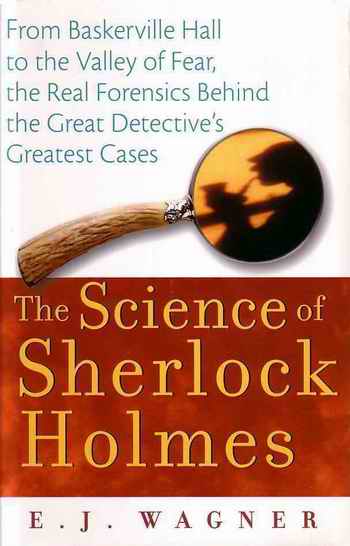
 The Science of Sherlock Holmes - From Baskerville Hall to the Valley of Fear, the Real Forensics Behind the Great Detective's Greatest Cases by E.J. Wagner. Hard Bound, 9.5" x 6.5" x 1.0".
John Wiley & Sons Inc, Hoboken, New Jersey, USA. Publication Date March 2006. 256 pages, ISBN 0-471-64879-5. Price $24.95 USA, £ 16.99 UK, $31.99 Canada
 Official site of this book: http://as.wiley.com/WileyCDA/WileyTitle/productCd-0471648795.html
 Description of this book: http://www.forensic.to/webhome/ejwagner/SSHbook01.html
For the author's personal website please click here. The site is mirrored here
 For all reviews of this book (including this one), please click here.
Please Click here to read an exclusive interview with the author E.J.Wagner conducted by the editor-in-chief of this journal.
 |
Even today, Sherlock Holmes is considered as the world's greatest detective and one of the most famous characters in fiction. His adventures from over a hundred years ago still enthral readers, and sequels and movies seem as if they are never going to stop. There has been a plethora of recent memoirs of contemporary scientific detectives, but the present volume stands out as distinctly different. Wagner uses the Holmes stories merely as a starting point to give histories of aspects of scientific detective-work. There are many famous cases that she includes, like those of Lizzie Borden or the Tichborne Claimant, which, if Holmes had been on the case, would have been solved sooner to everyone's satisfaction except that of the culprits.
 |
Wagner follows the developing science of criminal investigation from its infancy in the nineteenth century into the earliest twentieth century. She carefully traces the beginnings of forensic science from the work of the great Italian physician Giovanni Battista Morgagni who, she writes, "began to change the focus of anatomical dissection, not only searching for an understanding of the structure of the human body, but also trying to match the changes in the cadaver to the clinical symptoms of disease reported before death. From there," she says, "it was a short step to the idea of dissecting bodies to look for changes caused by criminal acts."
We learn about the unique character of Holmes, as Wagner reminds us, from Stamford 's description of him as told to Watson in A Study in Scarlet . "Holmes is a little too scientific for my tastes", says Stamford , "it approaches to cold-bloodedness. I could imagine his giving a friend a little pinch of the latest vegetable alkaloid, not out of malevolence, you understand, but simply out of a spirit of inquiry in order to have an accurate idea of the effects. To do him justice, I think that he would take it himself with the same readiness. He appears to have a passion for definite and exact knowledge."
|
Holmes was rationality triumphant - a cool thinker who could outwit the best brains that the underworld could produce. Surprisingly, he never studied medicine, neither did he appear to have pursued any course of reading which might fit him for a degree, in science or any other recognized portal which would give him an entrance into the learned world. Yet his zeal for certain studies was remarkable, and within eccentric limits his knowledge was extraordinarily ample and minute. One of Holmes's attractive tributes was his reliance on scientific evaluation of the clues he found; he not only used forensic science as it was then known, he originated aspects of it, at least in fiction.
We find, as Wagner points out, a remarkable example of Holmes's inventiveness in A Study in Scarlet where he tells Watson of his discovery of a reagent which is precipitated by haemoglobin, and by nothing else. "Criminal cases are continually hinging upon that one point", he tells Watson. "A man is suspected of a crime months perhaps after it has been committed. His linen or clothes are examined and brownish stains discovered upon them. Are they bloodstains, or mud stains, or rust stains, or fruit stains, or what are they? That is a question which has puzzled many an expert, and why? Because there was no reliable test. Now we have the Sherlock Holmes's test, and there will no longer be any difficulty."
Before Holmes's time, people were just as fascinated as we are by crime, and discussed physical evidence left by evildoers, but the evidence was often evaluated with superstition or folklore.
But Wagner has not depended solely on Sherlock Holmes stories to talk about his science, but rather has used them to introduce a topic or, occasionally, to relate a true crime that occurred before a Holmes story was written, and then to show the parallels that indicate that Doyle had based his story on that true crime. She has blended familiar examples from Doyle's accounts into a history of the growth of forensic science, pointing out where fiction strayed from fact, avoiding the technical details that often make writings on the topic incomprehensible to the layman. Basically, The Science of Sherlock Holmes is a book on forensic science written for the non-specialist. And it goes to the credit of the author that she could make it so engrossing that there is not a dull moment in the entire text.
A case in point is the story of one Charles Walton, a rheumatic old man of seventy-four who was found dead in 1945 in a field, his body pinned to the ground with his pitchfork, and a cross deeply carved in his chest. As a youth, Walton had had an encounter with a spectral dog that Wagner tells us "changed shape, until it appeared to become a woman wearing a black cloak and revealed a dark figure without a head." The story is reminiscent of Doyle's novel The Hound of the Baskervilles , but in the novel Holmes ensures the triumph of fact and science over fantasy and superstition. He is able to establish how a cunning individual of the Baskervilles family had changed his name to Vandeleur and fled from Costa Rica to England, where he established a school in the east of Yorkshire with the sole intention of grabbing a valuable estate, and how he used a real dog to kill the owner of the estate taking advantage of a prevailing folklore of the spectral dog. He proved conclusively that the "enormous coal-black hound, but not such a hound as mortal eyes have ever seen"-as Doyle described it- was no supernatural bringer of death to the Baskervilles, but a ruse that took advantage of superstition. " The Hound of the Baskervilles was an enormous success," Wagner says, "not least because of its resonance with ancient folklore."
 ...Basically, The Science of Sherlock Holmes is a book on forensic science written for the non-specialist. And it goes to the credit of the author that she could make it so engrossing that there is not a dull moment in the entire text... ...Basically, The Science of Sherlock Holmes is a book on forensic science written for the non-specialist. And it goes to the credit of the author that she could make it so engrossing that there is not a dull moment in the entire text...
|
"Unusual animals and insects fly and creep and slither through a number of Sherlock Holmes stories" as Wagner observes. Besides the haunting hound that terrifies the peasants in The Hound of the Baskervilles , we have the snake in The Adventure of the Speckled Band , and the jellyfish in The Adventure of the Lion's Man. "But the bizarre animals are not there just to frighten - they are foils for scientific inquiry."
Wagner extends the concept further. She describes how insects - even those "too tiny to notice. . . left traces of themselves in the form of larvae and exudates. . . . Clearly, these creatures were often present at the scene of violent crime. Could science find a way to make these silent witnesses give testimony?" Although this was a new concept in most of Europe, Wagner describes how it had actually been put to use in China as far back as A.D. 1235.
Wagner cites Sherlock Holmes's eye for detail in solving a murder mystery in The Boscombe Valley Mystery , where he reminds Watson that his method "is founded upon the observance of trifles." And the trifles he observes and weaves through his reasoning include not only traces of tobacco ash and varieties of earth but, as Wagner tells us, also the effects of bullets. Holmes, hot on the trail, remarks in The Adventure of the Dancing Men , "It is now necessary that we should try to throw some light upon this third bullet, which has clearly, from the splintering of the wood, been fired from inside the room."
...In this book Wagner has produced a highly informative yet readable book on a subject that not many authors can write with confidence. But that is not surprising, considering the immense effort the author had to put in in collecting facts by scanning records and documents and putting them together in a cogent form...Without doubt, she has done a remarkable job....
|
"Observations of the direction of a bullet's path and its individual characteristics are the basis for the science of ballistics. Coupled with Holmes's vast knowledge of scientific esoterica, these observations often lead to the unravelling of intricate crimes. In using ballistic evidence as a detection tool", observes Wagner, "the fictional Holmes is following a path already blazed by real-life detectives, such as the dashing Vidocq of the Sûreté and the indomitable Henry Goddard of the Bow Street Runners." (Sûreté is the French security police.) Wagner tells us that the French detective Eugène François Vidocq "is credited by a number of biographers with ordering, in 1822, the removal of a bullet from an aristocratic murder victim's body in order to compare it with her husband's duelling pistols.
In The Science of Sherlock Holmes Wagner has produced a highly informative yet readable book on a subject that not many authors can write with confidence. But that is not surprising, considering the immense effort the author had to put in in collecting facts by scanning records and documents and putting them together in a cogent form. As she states in her preface, the task involved "contacting old friends who were specialists on fingerprinting, trace evidence, poisoning, and a number of other esoteric subjects and begging them for information." It also required "detailed reading of old autopsy reports, crumbling newspapers, and lecture notes." Without doubt, she has done a remarkable job.
Please Click here to read an exclusive interview with the author E.J.Wagner conducted by the editor-in-chief of this journal.
Click here to send an Email to E.J.Wagner, the author of this book.
Other reviews of this book:
Order this Book by clicking below.
 The Science of Sherlock Holmes by E.J. Wagner
Request a PDF file of this review by clicking here. (If your screen resolution can not be increased, or if printing this page is giving you problems like overlapping of graphics and/or tables etc, you can take a proper printout from a pdf file. You will need an Acrobat Reader though.)
N.B. It is essential to read this journal - and especially this review as it contains several tables and high resolution graphics - under a screen resolution of 1600 x 1200 dpi or more. If the resolution is less than this, you may see broken or overlapping tables/graphics, graphics overlying text or other anomalies. It is strongly advised to switch over to this resolution to read this journal - and especially this review. These pages are viewed best in Netscape Navigator 4.7 and above.
-Anil Aggrawal

 [ Major links ]
[ Aims and Objectives ] [ FAQ ] [ Editorial Board ] [ Contributing Partners ] [ Sitemap ]
[ Paper/Thesis submission guidelines ] [ Editorials - Cumulative Index ] [ Discussion ] [ Chat room ] [ Be our sponsor! ]
[ Cumulative index of Book Reviews sorted by | Publishers | General Interest Books | Technical Books ] [ Animated Reviews ] [ Featured Reviews ] [ E-books ]
[ Reviews with Quizzes ] [ Links ] [ Submit books/journals/software/multimedia for review ] [ journal CD ] [ History of the Journal ] [ Interviews ] [ Credits ]
[ Cumulative index of | Theses/dissertations | [ Online Courses ] [ Awards ] [ Anil Aggrawal's Internet Journal of Book Reviews - Sister Publication ]
[ Cumulative reviews of Software/Multimedia | Books on CD/Audio tapes ] | Calenders | Models ] [ contact us ]
[ Undergraduate section | Postgraduate section ] [ Forensic gadgets/toys/other tidbits ]
Books for review must be submitted at the following address.
Professor Anil Aggrawal (Editor-in-Chief)
Anil Aggrawal's Internet Journal of Forensic Medicine and Toxicology
S-299 Greater Kailash-1
New Delhi-110048
India
Click here to contact us.
This page has been constructed and maintained by Dr. Anil Aggrawal, Professor of Forensic Medicine, at the Maulana Azad Medical College, New Delhi-110002. You may want to give me the feedback to make this pages better. Please be kind enough to write your comments in the guestbook maintained above. These comments would help me make these pages better.
 IMPORTANT NOTE: ALL PAPERS APPEARING IN THIS ONLINE JOURNAL ARE COPYRIGHTED BY "ANIL AGGRAWAL'S INTERNET JOURNAL OF FORENSIC MEDICINE AND TOXICOLOGY" AND MAY NOT BE REPOSTED, REPRINTED OR OTHERWISE USED IN ANY MANNER WITHOUT THE WRITTEN PERMISSION OF THE WEBMASTER
Questions or suggestions ? Please use ICQ 19727771 or email to dr_anil@hotmail.com

|