


|


|
|
 Death Scene Investigation Procedural Guide, 1st Edition, by Michael S. Maloney. Spiral-bound, 10.1” x 7.1” x 1”.
CRC Press LLC, 6000 Broken Sound Parkway NW, Suite 300, Boca Raton, FL 33487-2742. Phone - 1(800)272-7737, Fax - 1(800)374-3401. Publication Date Feb 15, 2012. 366 pages, ISBN-10: 1439845905; ISBN-13: 9781439845905 (alk. paper). Price: $59.95.
Death Scene Investigation Procedural Guide, 1st Edition, by Michael S. Maloney. Spiral-bound, 10.1” x 7.1” x 1”.
CRC Press LLC, 6000 Broken Sound Parkway NW, Suite 300, Boca Raton, FL 33487-2742. Phone - 1(800)272-7737, Fax - 1(800)374-3401. Publication Date Feb 15, 2012. 366 pages, ISBN-10: 1439845905; ISBN-13: 9781439845905 (alk. paper). Price: $59.95.
 Official Site: Click here to visit
Amazon Link: Click here to visit
Official Site: Click here to visit
Amazon Link: Click here to visit
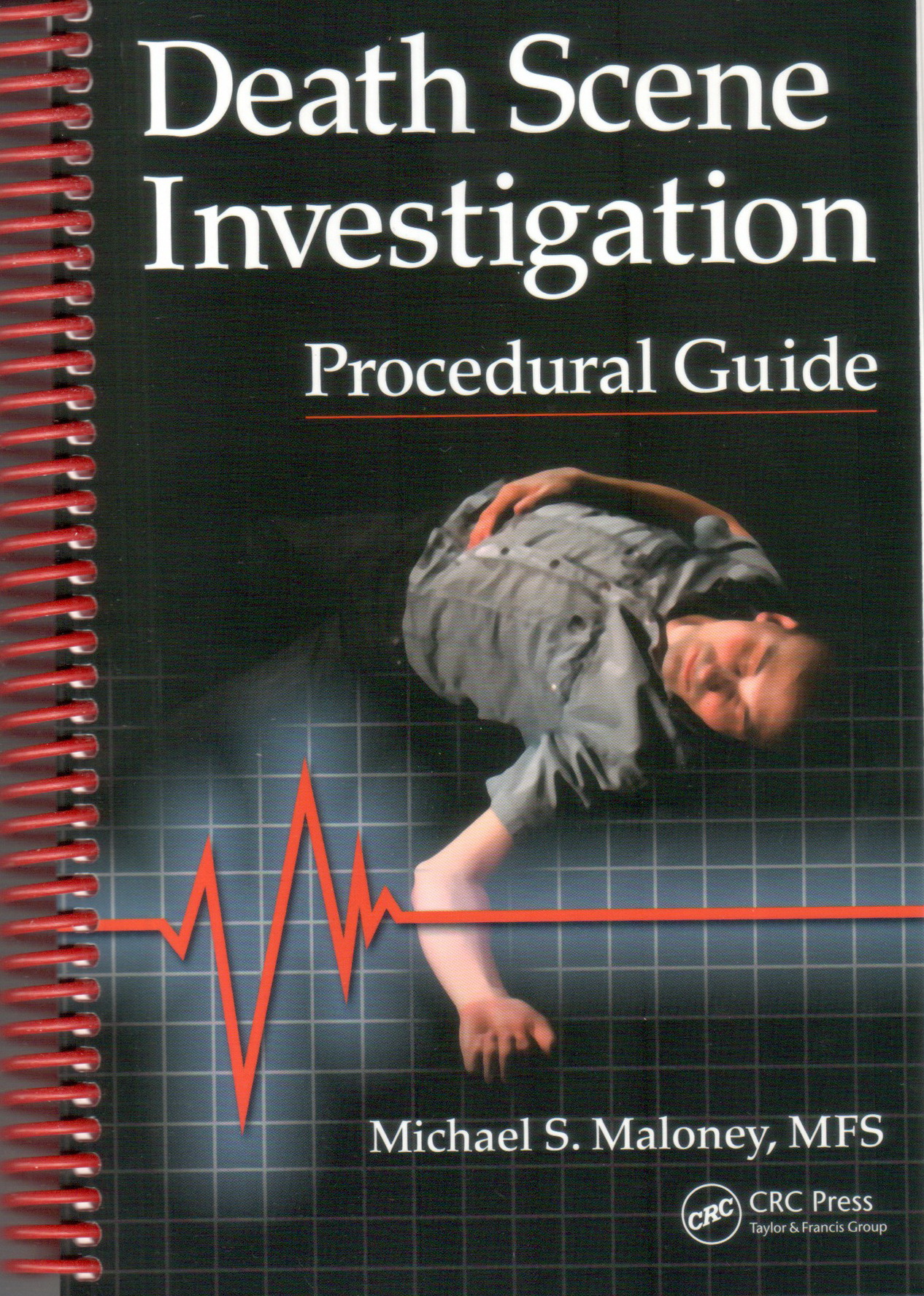 |
Whenever I visit crime scenes, I have always wanted a simple, easy to use, step by step guide, which I could use to ensure that I do not miss out on any vital clue. There had been none, and I always greatly missed and pined for such a book. No more now. The book under review fulfils this much felt need admirably. The book is divided in 6 convenient sections and gives 16 appendices.
Section 1 deals with death scene investigation proper, section 2 with recovery of remains, section 3 with wound dynamics and mechanisms of injury, section 4 with special death scene investigations, section 5 with death scene management and section 6 with death scene processing.
Maloney takes us on a information ride in this book. For instance in chapter 4 on accidental deaths, he begins by telling us the legal considerations. Then death scene interviews, scene considerations, recovery of human remains and initial approach and contact with the body are discussed.
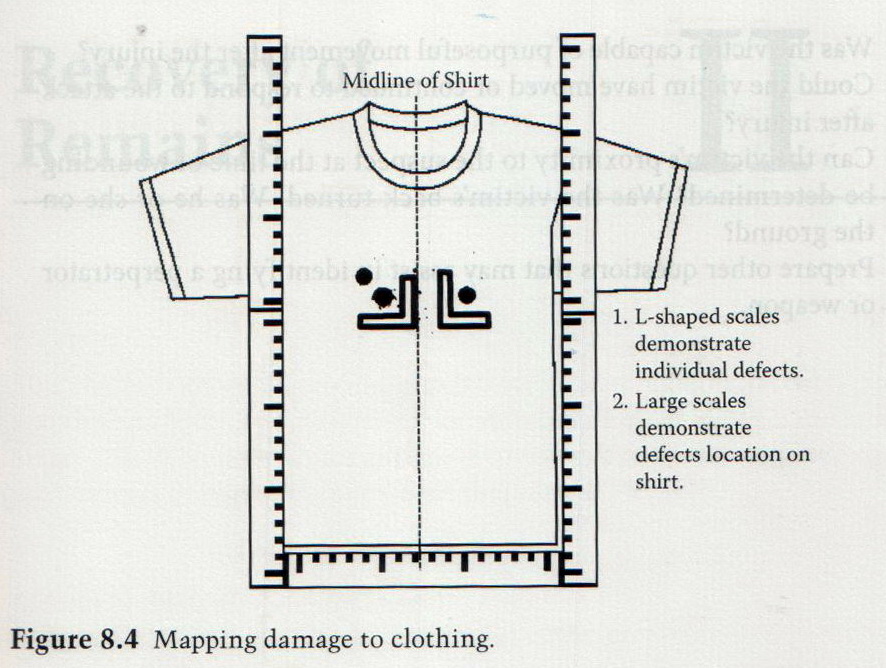
In chapter 8 on autopsy protocol and investigator’s role, we are told not only of the importance of autopsy but of ancillary examinations such as examination of clothes. Detailed techniques of cloth examination are given. Excellent line diagrams [fig 1] supplement the information.
In chapter 9 Maloney deals with crime scene search methodology. We are told about a rarely discussed point to point search. Most of us know about the usual zone or quadrant, Lane, line or strip, Grid, Spiral and Wheel searches. In this search the investigator straightaway moves to the points where he sees pieces of evidences lying around.
 |
Chapter 11 deals with another important work of forensic scientists – recovery of buried human remains. Remains can be located by visual methods, probing methods, cadaver dogs and by technological methods. Technological methods include methane gas detection, Forward Looking Infrared [FLIR] and thermal tomography, magnetometry and electrical resistivity. Thermal tomography works on the fact that decomposition of body and entomological activity increases the temperature of body. FLIR can be mounted on a helicopter or fixed wing aircraft and large areas searched in minimum possible time. Magnetometry detects magnetic fields of buried ferrous objects and while it cannot detect human flesh, it does detect ferrous artifacts buried along bodies, eg zippers, shoe eyelets, belt buckles, snaps and weapons containing iron. Electrical resistivity is based on the principle that electrical resistance of soil changes as fluids from a putrefying body leach into the surrounding soil.
Chapters 15 and 16 deal with sharp and blunt force injuries respectively. A number of fresh points not given in other books are mentioned.
 Click here to read an exclusive interview with Dr. Michael S. Maloney. Click here to read an exclusive interview with Dr. Michael S. Maloney. |
I found all 16 appendices very useful. They are mostly worksheets, which forensic scientists and pathologists can profitably use in their day-to-day work. For instance Appendix K deals with immersion burn worksheets, appendix L with Sudden unexplained infant death worksheet, appendix M with Firearms documentation worksheet, Appendix N with post blast worksheet and so on.
All in all I found the book an excellent text on practical death scene investigation, which gives us very useful practical information on the latest techniques in an easily digestible manner. I am going to use this book in all my future crime scene investigations.

 Request a PDF file of this review by clicking here. (If your screen resolution can not be increased, or if printing this page is giving you problems like overlapping of graphics and/or tables etc, you can take a proper printout from a pdf file. You will need an Acrobat Reader though.)
N.B. It is essential to read this journal - and especially this review as it contains several tables and high resolution graphics - under a screen resolution of 1600 x 1200 dpi or more. If the resolution is less than this, you may see broken or overlapping tables/graphics, graphics overlying text or other anomalies. It is strongly advised to switch over to this resolution to read this journal - and especially this review. These pages are viewed best in Netscape Navigator 4.7 and above.
-Anil Aggrawal

 [ Major links ]
[ Aims and Objectives ] [ FAQ ] [ Editorial Board ] [ Contributing Partners ] [ Sitemap ]
[ Paper/Thesis submission guidelines ] [ Editorials - Cumulative Index ] [ Discussion ] [ Chat room ] [ Be our sponsor! ]
[ Cumulative index of Book Reviews sorted by | Publishers | General Interest Books | Technical Books ] [ Animated Reviews ] [ Featured Reviews ] [ E-books ]
[ Reviews with Quizzes ] [ Links ] [ Submit books/journals/software/multimedia for review ] [ journal CD ] [ History of the Journal ] [ Interviews ] [ Credits ]
[ Cumulative index of | Theses/dissertations | [ Online Courses ] [ Awards ] [ Anil Aggrawal's Internet Journal of Book Reviews - Sister Publication ]
[ Cumulative reviews of Software/Multimedia | Books on CD/Audio tapes ] | Calenders | Models ] [ contact us ]
[ Undergraduate section | Postgraduate section ] [ Forensic gadgets/toys/other tidbits ]
Books for review must be submitted at the following address.
Professor Anil Aggrawal (Editor-in-Chief)
Anil Aggrawal's Internet Journal of Forensic Medicine and Toxicology
S-299 Greater Kailash-1
New Delhi-110048
India
Click here to contact us.
This page has been constructed and maintained by Dr. Anil Aggrawal, Professor of Forensic Medicine, at the Maulana Azad Medical College, New Delhi-110002. You may want to give me the feedback to make this pages better. Please be kind enough to write your comments in the guestbook maintained above. These comments would help me make these pages better.
 IMPORTANT NOTE: ALL PAPERS APPEARING IN THIS ONLINE JOURNAL ARE COPYRIGHTED BY "ANIL AGGRAWAL'S INTERNET JOURNAL OF FORENSIC MEDICINE AND TOXICOLOGY" AND MAY NOT BE REPOSTED, REPRINTED OR OTHERWISE USED IN ANY MANNER WITHOUT THE WRITTEN PERMISSION OF THE WEBMASTER
Questions or suggestions ? Please use ICQ 19727771 or email to dr_anil@hotmail.com
Page Professor Anil Aggrawal via ICQ

|
 ...I would like to have the book in my scene of crime investigation kit....