


|

|
|
|
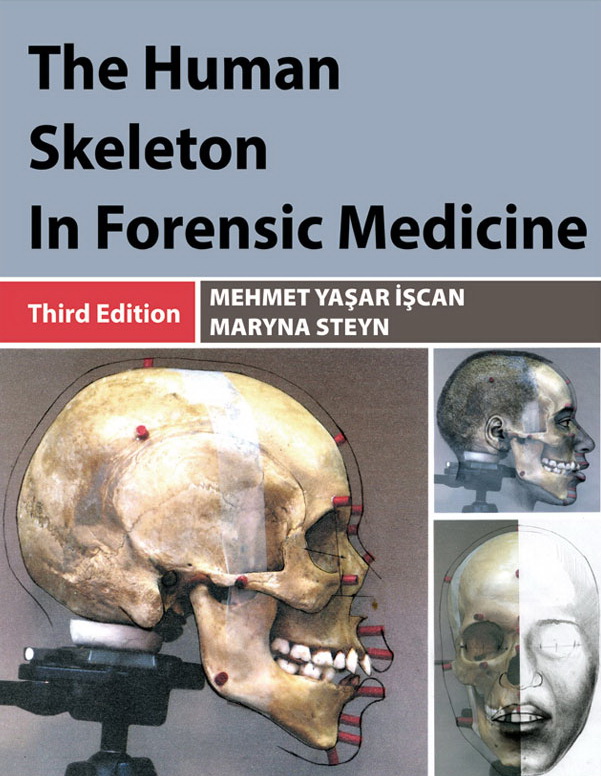
 The Human Skeleton in Forensic Medicine, 3rd Ed, by Mehmet Yasar Iscan and Maryna Steyn. Hardcover, 11.2" x 8.7" x 1.1".
Charles C. Thomas Publisher, 2600 South First Street, Springfield, Illinois 62704. Publication Date 2013. 516 pages, 263 il., 88 tables, ISBN-10: 0398088780; ISBN-13: 978-0398088781. Price – Hardcover: $74.95; eBook: $64.95.
 Visit the Official site of this book by clicking here
 Buy from Amazon by clicking here.
 |
We have all grown up with Iscan’s classic “The Human Skeleton in Forensic Medicine” 2nd edition, which came out more than 25 years back in 1986. During this period, considerable changes occurred in the field and forensic anthropology became a distinct specialty in its own right. That necessitated a new edition. We all were secretly wanting the new edition of "Iscan" to come out. Fortunately it is out now!! This is the book under review.
Chapter 1 introduces the subject of forensic anthropology. In this chapter, the authors explain what is forensic anthropology and who exactly is a forensic anthropologist. The authors start with the classical definition given by Stewart in 1979 [the branch of physical anthropology, which for forensic purposes, deals with the identification of more-or-less skeletonized remains known to be, or suspected of being human], and then take us through several modern definitions. It is the authors’ contention that forensic anthropology must necessarily include examination of living beings also. Indeed the authors have added a separate chapter entitled “Forensic Anthropology Of The Living [ch 12]”. They go on to describe Iscan’s definition [“a multidisciplinary field combining physical anthropology, archaeology and other fields, including forensic dentistry, pathology and Criminalistics.]” and then a few others. But the authors seem to concede that the definition of forensic anthropology is far from settled. Indeed they assert that this lack of clear definition has allowed forensic anthropology to take on different course in different parts of the world. In North America, forensic anthropologists come from a combined archaeology and anthropology background. On the European continent, on the other hand, many are medically qualified. This often includes forensic pathologists or other medical specialists who are experienced at skeletal analyses and practice forensic anthropology as an aspect of their work. In Spain forensic anthropology is mostly practiced as a sub discipline of forensic medicine. In the UK, in contrast, it is often associated with archaeology.
 ...The book now adds detailed discussions on crime scene investigation, including excavation techniques, time interval since death, human or animal remains, mass graves, and preparation of remains. Existing chapters have all been thoroughly revised. They bring readers in line with the current concepts of skeletal age; determination of sex; assessment of ancestry; calculation of stature; factors of individualization; superimposition and restoration of physiognomy... ...The book now adds detailed discussions on crime scene investigation, including excavation techniques, time interval since death, human or animal remains, mass graves, and preparation of remains. Existing chapters have all been thoroughly revised. They bring readers in line with the current concepts of skeletal age; determination of sex; assessment of ancestry; calculation of stature; factors of individualization; superimposition and restoration of physiognomy...
|
In Latin America, practitioners have vast experience but not necessarily high levels of academic training. In Australia and South Africa, most personnel dealing with forensic anthropological casework are based in anatomy departments. The U.S. is the only country with an official system of examination and, following that, accreditation of forensic anthropologists. ABFA board certification requires diplomats to regularly submit case reports to show that they are up to date and their reports of acceptable standard.
A section on “ethics in forensic anthropology” has been added. Such questions were never raised earlier; it is only recently that the issue of ethics in forensic anthropology is being considered.
 |
With the relatively new role of forensic anthropologists in dealing with living people eg in age estimations, a whole new set of ethical issues arise. Issues such as exposure to radiation with x-rays, disclosure, informed consent, and legality of actions are important. It is gratifying to see that the authors have addressed these questions for the first time.
The book now adds detailed discussions on crime scene investigation, including excavation techniques, time interval since death, human or animal remains, mass graves, and preparation of remains.
Existing chapters have all been thoroughly revised. They bring readers in line with the current concepts of skeletal age; determination of sex; assessment of ancestry; calculation of stature; factors of individualization; superimposition and restoration of physiognomy.
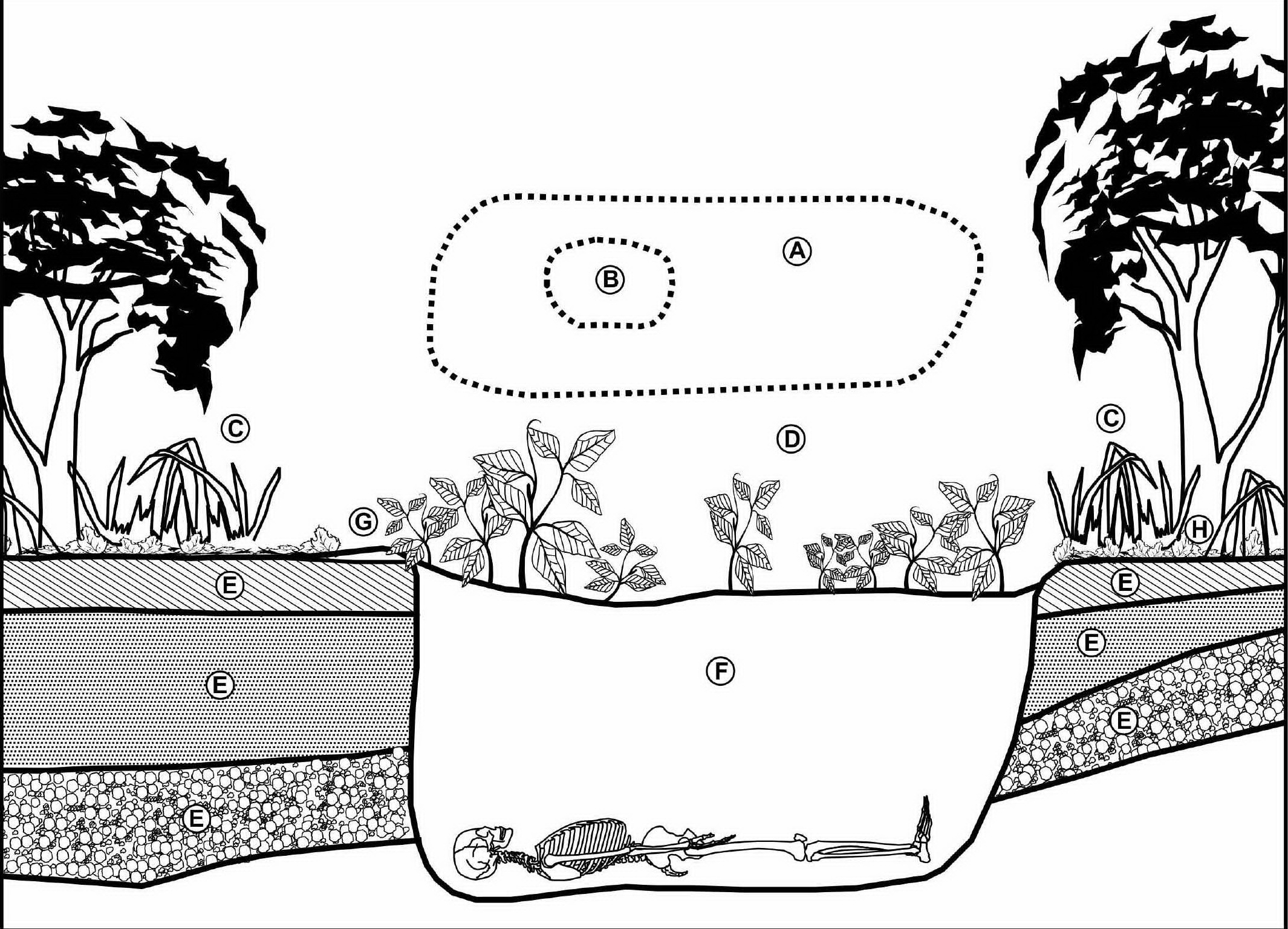
There was no mention of the word “taphonomy” in the earlier edition, for the simple reason, this word did not exist at that time. Now the authors have devoted a whole new chapter to it. Chapter 2 is entitled “Forensic archaeology and taphonomy”. Among other things, this chapter tells us about techniques to locate buried bodies ranging from simple observation to the use of sophisticated equipment. In general, surface changes in soil and vegetation may indicate a grave as in the accompanying diagram.
 |
Other chapters deal with aging and sexing of skeleton and determination of ancestry and stature. I found at least five new chapters which were not there in the earlier edition. these are ch 8 [bone pathology and antemortem trauma], ch 9 [perimortem trauma and thermal destruction], ch 10 [facial approximation and skull-photo superimposition], ch 11 [DNA analysis in forensic anthropology] and ch 12 [Forensic Anthropology Of The Living]. Each chapter is a pleasure to read and is studded with good pics and diagrams.
There is a chapter on dental analysis, which examines such topics as dental anatomy, nomenclature, estimation of age in sub adults and adults, determination of sex and ancestry, and pathological conditions.
Every chapter ends with “summarizing statements” so the reader can recapitulate easily what exactly has he learnt from that chapter.
The previous edition had 2 appendices. Even the current edition has 2; but what the authors have done is that they have removed one appendix entitled “Osteology” and in its place have added a new an more relevant appendix called “Dental anatomy and identification.” The authors give excellent drawings of deciduous and permanent dentition in this appendix.
Although all of the sections of the book have been updated significantly, the authors have retained some sense of history to recognize the many pioneers that have shaped the discipline.
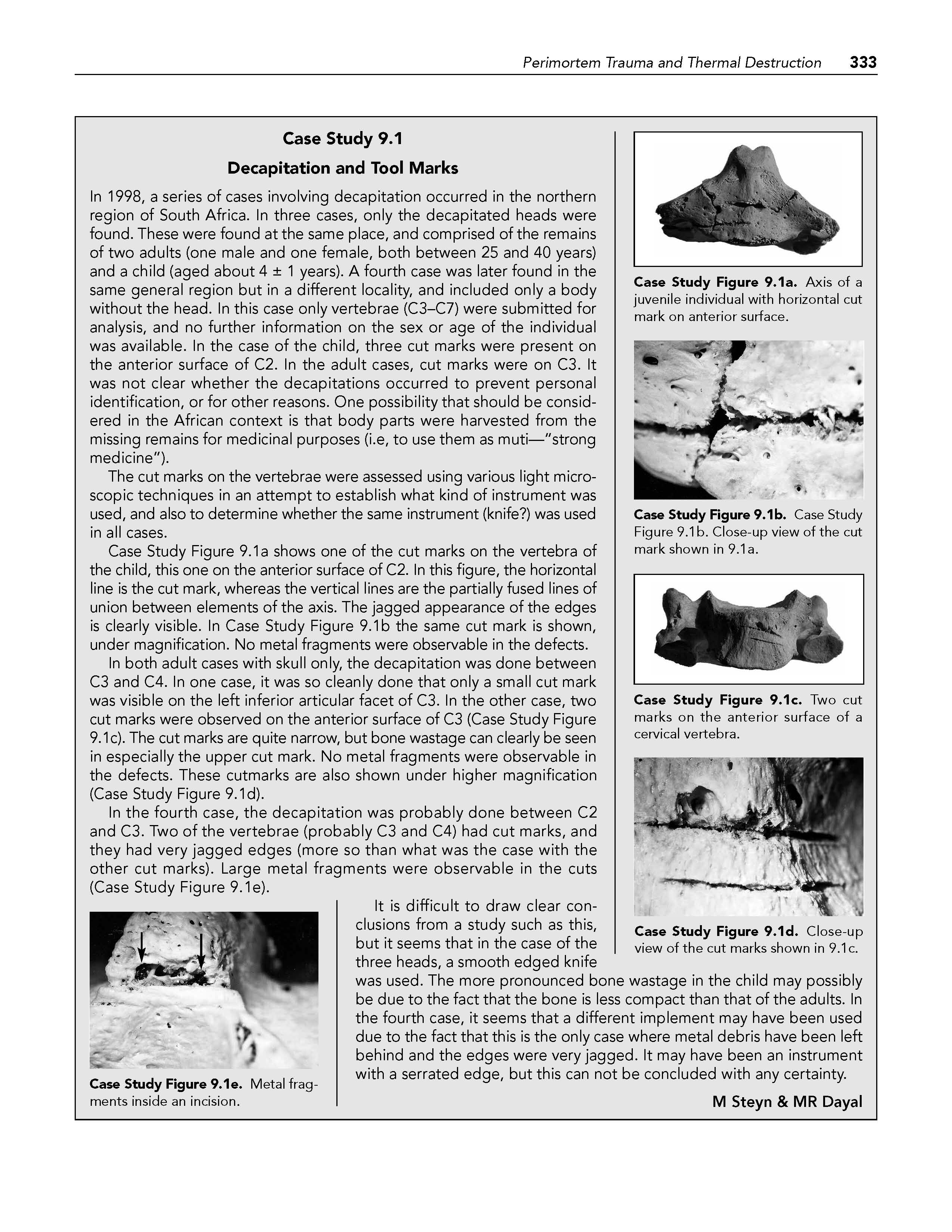
The text will assist forensic anthropologists and forensic pathologists who have to analyze skeletons found in forensic contexts. This book has a global perspective in order to make it usable to practitioners across the world. Short case studies have been added at numerous points to illustrate the diverse aspects of the work.
I enjoyed reading the book thoroughly and feel that this book would increase its hold among practitioners of forensic medicine and forensic anthropology. I for one would certainly keep it with me as a ready source of information, whenever I have to solve some difficult case of forensic anthropology.

Request a PDF file of this review by clicking here. (If your screen resolution can not be increased, or if printing this page is giving you problems like overlapping of graphics and/or tables etc, you can take a proper printout from a pdf file. You will need an Acrobat Reader though.)
N.B. It is essential to read this journal - and especially this review as it contains several tables and high resolution graphics - under a screen resolution of 1600 x 1200 dpi or more. If the resolution is less than this, you may see broken or overlapping tables/graphics, graphics overlying text or other anomalies. It is strongly advised to switch over to this resolution to read this journal - and especially this review. These pages are viewed best in Netscape Navigator 4.7 and above.
-Anil Aggrawal


 [ Major links ]
[ Aims and Objectives ] [ FAQ ] [ Editorial Board ] [ Contributing Partners ] [ Sitemap ]
[ Paper/Thesis submission guidelines ] [ Editorials - Cumulative Index ] [ Discussion ] [ Chat room ] [ Be our sponsor! ]
[ Cumulative index of Book Reviews sorted by | Publishers | General Interest Books | Technical Books ] [ Animated Reviews ] [ Featured Reviews ] [ E-books ]
[ Reviews with Quizzes ] [ Links ] [ Submit books/journals/software/multimedia for review ] [ journal CD ] [ History of the Journal ] [ Interviews ] [ Credits ]
[ Cumulative index of | Theses/dissertations | [ Online Courses ] [ Awards ] [ Anil Aggrawal's Internet Journal of Book Reviews - Sister Publication ]
[ Cumulative reviews of Software/Multimedia | Books on CD/Audio tapes ] | Calenders | Models ] [ contact us ]
[ Undergraduate section | Postgraduate section ] [ Forensic gadgets/toys/other tidbits ]
Books for review must be submitted at the following address.
Professor Anil Aggrawal (Editor-in-Chief)
Anil Aggrawal's Internet Journal of Forensic Medicine and Toxicology
S-299 Greater Kailash-1
New Delhi-110048
India
Click here to contact us.
This page has been constructed and maintained by Dr. Anil Aggrawal, Professor of Forensic Medicine, at the Maulana Azad Medical College, New Delhi-110002. You may want to give me the feedback to make this pages better. Please be kind enough to write your comments in the guestbook maintained above. These comments would help me make these pages better.
 IMPORTANT NOTE: ALL PAPERS APPEARING IN THIS ONLINE JOURNAL ARE COPYRIGHTED BY "ANIL AGGRAWAL'S INTERNET JOURNAL OF FORENSIC MEDICINE AND TOXICOLOGY" AND MAY NOT BE REPOSTED, REPRINTED OR OTHERWISE USED IN ANY MANNER WITHOUT THE WRITTEN PERMISSION OF THE WEBMASTER
Questions or suggestions ? Please use ICQ 19727771 or email to dr_anil@hotmail.com
Page Professor Anil Aggrawal via ICQ

|

