|
|
|
|
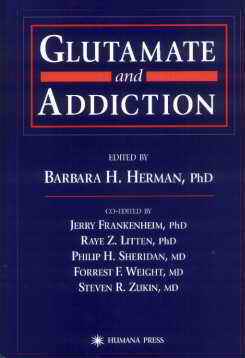
 Glutamate and Addiction, 1stEdition, Edited by Barbara H. Herman, Co-edited by Jerry Frankenheim, Raye Z. Litten, Philip H. Sheridan, Forrest F. Weight and Steven R. Zukin. Hard Bound, 7" x 10".
Humana Press Inc., 999 Riverview Drive, Suite 208, Totowa, New Jersey 07512; Publication Date 26 August, 2002. xviii + 440 pages, ISBN 0-89603-879-3 (Hardcover, acid-free Paper). Price $165.50
 Official Site:Click here to visit
 |
Drug addiction is a time long epidemic and has afflicted many a civilization. I was looking at a picture on the web of Opium smokers in an "opium den" in the East End of London, circa 1874 in the Encyclopedia. The First Opium War was a trade-inspired war between the United Kingdom and the Qing Empire in China from 1839 to 1842.
Guess what the major item in trade was? Opium!
The indigenous peoples of South America have used cocaine for hundreds of years. American Indians chewed coca leaves in order to alleviate feelings of fatigue as well as feelings of hunger. Use of Alcohol was mentioned in the Vedas by "Indra" a Hindu God.
Cocaine, Amphetamine and Methyl Amphetamine have become major stimulant drugs of the 21st Century and their abuse is on the rise.
Thanks for letting me review the book "Glutamate and Addiction" and helping me to read this interesting subject on Neurosciences. The editor of book "Glutamate and Addiction" Barbara H. Herman, Ph D is a renowned scientist and Health Scientist Administrator of National Institute on Drug Abuse (NIDA), at National Institute of Health Bethesda, MD in United States. NIH is the Premium Institution of US in research of Medical Sciences. The Co-editors Jerry Frankenhiem, PhD, Raye Z Litten PhD, Forrest F. Weight MD and Steven R. Zukin MD are reputed scientific staff of National Institute of Health Bethesda. While Co-editor Philip H. Sheridan, MD is reputed scientist of Food and Drug Administration in USA. Authors of this book hail from leading in Medical institutions of the world. This is an excellent book in Neurosciences and molecular biology.
|
This is a serious scientific stuff for medical and public libraries.
The book would attract students of Molecular Biology, Psychiatry and Behavioral Sciences and researchers in Neurosciences. I will not forget to mention that the readers of Forensic Science and scholars of your esteemed journal will enjoy surfing through the Introductions and conclusions in the 29 chapters of this book.
The articles are fairly authenticated by its editors. This book also gives us the insight in addiction at molecular and pharmacological levels. The aim of the book is to explore possibilities in treatment research and drug effects at molecular level.
Addiction is drug seeking and drug taking in a compulsive pattern. The modern research in the physiology and pharmacology of addiction is bringing new light in approaching this plague of mankind. Addiction is linked with the chemical transmitters and receptors of the brain cells and effects the cell interaction and the behavior of the organism. This book is looking at the molecular changes of brain in addiction and the role Glutamate receptors play in addiction. The authors have presented various chapters in this book helping us to understand the role of the Glutamate receptors in this process.
Glutamate receptors play major role in synaptic transmission as excitatory receptors is studied in detail. I especially liked chapter 3 in the book on Glutamate and Neurotoxicity by B.Joy Snider and Denis W. Choi. Historical mention of Toxic effect of Glutamate exposure on neurons was fascinating to me.
 ...Glutamate receptors play major role in synaptic transmission as excitatory receptors is studied in detail. I especially liked chapter 3 in the book on Glutamate and Neurotoxicity by B.Joy Snider and Denis W. Choi. Historical mention of Toxic effect of Glutamate exposure on neurons was fascinating to me... ...Glutamate receptors play major role in synaptic transmission as excitatory receptors is studied in detail. I especially liked chapter 3 in the book on Glutamate and Neurotoxicity by B.Joy Snider and Denis W. Choi. Historical mention of Toxic effect of Glutamate exposure on neurons was fascinating to me... |
It was nice to know that Glutamate receptors have been well studied for last 15 years. We expect new modalities to curb addiction of Cocaine and Amphetamines with this understanding and knowledge. Focus is on drug addiction and dependence and the authors are examining the role of Glutamatergic systems in stimulant drugs and there abuse. Good coverage of subject always appeals to the scientific mind.
The information in the book makes us think of possibilities in developing new drugs to help Dementias, memory disorders. The presentations are very direct in the physiology and pharmacology section of the book viz. Chapters 1 to 5.
Karin Borges and Raymond Dingledine have nicely explained the molecular physiology of the Glutamate receptors. While few presented facts in the articles are indirect conclusions from role of Antagonists on the Glutamate receptors for explaining the role of possible direct effect of the drugs. These will attract new researchers and the students of the subject.
The Glutamate and Alcohol-Induced Neurotoxicity (chapter 24) attracted me like a fly to Honey. Lessons in drinking for the high school and college students lie in this section of the Book.
How the brain cells shrink with alcoholism and the effect of few days of Binge drinking on the perirhinal cortex of rat brain is well exemplified in this chapter.
"Kindling" hypothesis of alcohol withdrawal as suggested by Goddard was very well explained in the Role of alcohol-withdrawal symptoms and seizures. For the uninitiated the term "kindling" was first introduced by Goddard and associates in 1969. It refers to the phenomenon wherein subthreshold electrical stimulation of discrete brain regions that initially produces no overt behavioral effects comes to produce, upon repeated periodic application, full motor seizures. It was subsequently demonstrated that the stimulant could be several different types of chemicals too.
 QUICK NOTES QUICK NOTES
Some major highlights of Glutamate and Addiction at a glance: |
On the basis of "kindling" phenomenon, the authors present a fascinating hypothesis which explains the convulsive seizures in sudden alcohol withdrawal, in chronic alcoholics. I am sure, readers of this chapter would not only be fascinated by this interesting phenomenon, but would be spurred on to conduct further research on this subject. This subject is an absolute must for toxicologists studying alcohol and related phenomena.
Chapter 26 by John H. Krystal is another fascinating chapter on the subject of alcohol pharmacology and physiology. It is entitled "Alcohol and Glutamate Neurotransmission in Humans". We are told about Glutamatergic dysregulation in alcohol dependent patients in this chapter. The fact that NMDA receptor is among the most potent targets for ethanol will fascinate many readers.
Mention about recent advances about glutamate receptor stimulated Calcium ion entry could promote neuronal survival is intriguing.
Thus we hope to learn about the role of these receptors and the drugs could help in treatment of cognitive disorders, dementia and possibly in enhancing our learning faculties.
Mention about the role of NMDA receptors which are sub type of Glutamate receptors in HIV infection by Marcus Kaul, PhD and Stuart A Lipton with illustration of mechanism involving macrophages and blockage by NMDAR antagonists will interest the International scientific readers.
Chapter 8 by Marina E. Wolf, PhD defines neuroplasticity as the ability of the nervous system to modify its response to a stimulus based on prior experience. The role of glutamate receptors and NMDA receptors play an important role in neural plasticity has been very well highlighted by authors.
"Glutamate and Addiction" is a good scientific work for researchers in drug addiction and neurosciences.
|
Dr. Ramesh Kaul was born and brought up in India, where he qualified in medicine and surgery from the prestigious All India Institute of Medical Sciences. Later he obtained his post-doctoral qualification in otorhinolaryngology from the same institute. A man of many interests and tastes, he is widely known among his peers as the modern Leonardo da Vinci. He is Board Certified in Pulmonary Medicine, and is currently working as a pulmonologist in the US. His several fields of interest include investigations into metabotropic receptors. He lives in Pittsburgh and New Castle, with his doctor wife and two children. He can be contacted at MDKAUL@aol.com |
-Anil Aggrawal
[ Aims and Objectives ] [ FAQ ] [ Editorial Board ] [ Contributing Partners ] [ Sitemap ]
[ Paper/Thesis submission guidelines ] [ Editorials - Cumulative Index ] [ Discussion ] [ Chat room ] [ Be our sponsor! ]
[ Cumulative index of Book Reviews sorted by | Publishers |
General Interest Books |
Technical Books ] [ Animated Reviews ] [ Featured Reviews ]
[ Reviews with Quizzes ] [ Links ] [ Submit books/journals/software/multimedia for review ] [ journal CD ] [ History of the Journal ] [ Interviews ] [ Credits ]
[ Cumulative index of | Theses/dissertations | [ Online Courses ] [ Awards ] [ Anil Aggrawal's Internet Journal of Book Reviews - Sister Publication ]
[ Undergraduate section | Postgraduate section ]
[ Cumulative reviews of Software/Multimedia | Books on CD/Audio tapes ] | Calenders | Models ] [ contact us ]
Questions or
suggestions ? Please use ICQ 19727771
or email to
dr_anil@hotmail.com
Page Professor Anil Aggrawal via
ICQ
Order Humana Press Books by clicking here.
 Request a PDF file of this review by clicking here. (If your screen resolution can not be increased, or if printing this page is giving you problems like overlapping of graphics and/or tables etc, you can take a proper printout from a pdf file. You will need an Acrobat Reader though.)
N.B. It is essential to read this journal - and especially this review as it contains several tables and high resolution graphics - under a screen resolution of 1600 x 1200 dpi or more. If the resolution is less than this, you may see broken or overlapping tables/graphics, graphics overlying text or other anomalies. It is strongly advised to switch over to this resolution to read this journal - and especially this review. These pages are viewed best in Netscape Navigator 4.7 and above.


[ Major links ]
Books for review must be submitted at the following address.
Professor Anil Aggrawal (Editor-in-Chief)
Anil Aggrawal's Internet Journal of Forensic Medicine and Toxicology
S-299 Greater Kailash-1
New Delhi-110048
India
Click here to contact us.
This page has been constructed and maintained by Dr. Anil Aggrawal, Professor of Forensic Medicine, at the Maulana Azad Medical College, New Delhi-110002. You may want to give me the feedback to make this pages better. Please be kind enough to write your comments in the guestbook maintained above. These comments would help me make these pages better.
 IMPORTANT NOTE: ALL PAPERS APPEARING IN THIS ONLINE JOURNAL ARE COPYRIGHTED BY "ANIL AGGRAWAL'S INTERNET JOURNAL OF FORENSIC MEDICINE AND TOXICOLOGY" AND MAY NOT BE REPOSTED, REPRINTED OR OTHERWISE USED IN ANY MANNER WITHOUT THE WRITTEN PERMISSION OF THE WEBMASTER

home
> Volume 5, Number 2, July - December 2004
> Reviews
> Technical Books
> Page 6: Glutamate and Addiction
> page 6a: Glutamate and Addiction (Review by Dr. Ramesh Kaul of USA) (you are here)
Navigation ribbon