|
|
|
|
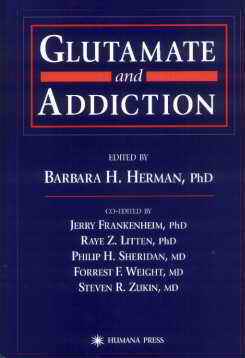
 Glutamate and Addiction, 1stEdition, Edited by Barbara H. Herman, Co-edited by Jerry Frankenheim, Raye Z. Litten, Philip H. Sheridan, Forrest F. Weight and Steven R. Zukin. Hard Bound, 7" x 10".
Humana Press Inc., 999 Riverview Drive, Suite 208, Totowa, New Jersey 07512; Publication Date 26 August, 2002. xviii + 440 pages, ISBN 0-89603-879-3 (Hardcover, acid-free Paper). Price $165.50
 Official Site:Click here to visit
 |
Glutamate is the main excitatory neurotransmitter in the central nervous system, and plays a very important role in varied brain systems and their related functions. Most of the excitatory synaptic transmissions in the brain are mediated by glutamate receptors. In addition, these receptors also mediate many forms of synaptic plasticity, for instance, those that form the physiological basis of learning and memory. There are two main types of glutamate receptors - ionotropic and metabotropic. The former comprise 3 subtypes: a-amino-3-hydroxy-5-methyl-4-isoxazole propionic acid (AMPA), N-methyl-D-aspartate (NMDA), and kainate (KA) receptors, while the metabotropic group consists of at least 8 receptors, termed mGluR1-mGluR8. Although clinical settings involving glutamate receptor modulators (or antagonists) usually involve acute brain injury, stroke, epilepsy, and neuropathic pain, both classes of these receptors are also now known to play an important role in addiction and cognition.
As far back as the late 1980s, Karler et al first suggested a role of glutamate in drug addiction. This was picked up by researchers in the 1990s, beginning with the first preclinical evidence presented for involvement of this system in the development of opiate tolerance and withdrawal. Subsequently, there has been a steady and escalating progression of scientific advances that have implicated a crucial role of glutamatergic systems in cocaine, opiate, and alcohol abuse. The book under review is perhaps the first volume of its kind that has attempted to clarify the exact relationship between glutamatergic systems and addiction. It is in the words of the editor herself, a two and a half year labour of love. And what a book it has turned out to be! It is not very often that one comes across a more fascinating book relating to contemporary research in toxicology. The book brings together some world-renowned experts to critically review the accumulating evidence on the role of glutamatergic systems in drug dependence, and the exciting implications on the treatment of addiction disorders. Their scrutiny covers both clinical approaches utilizing drugs that influence glutamate, as well as the latest preclinical approaches that manipulate specific glutamate receptor subtypes or substrates, in an effort to determine their roles in various addictive conditions.
|
The first section of the book deals most lucidly with the basic physiology and pharmacology of glutamate, which to a novice (like this reviewer) provides a clear understanding of glutamate, while to the more seasoned researcher serves as a means of upgrading his knowledge on glutamatergic systems. Apart from detailed addiction-related information, there is also an exposition on the role of NMDA receptors in neuronal apoptosis and HIV-associated dementia.
The second section actually kicks off the discussion on the role of glutamatergic systems in addiction, with an exquisite series of chapters on stimulant drugs of abuse, particularly amphetamine, methamphetamine, and cocaine. This section covers virtually every aspect of the role of glutamate in stimulant drugs of abuse, with additional information on the effects of novel NMDA/glycine-site antagonists on the blockade of cocaine-induced behavioral toxicity, and implications for therapeutic agent development for cocaine by utilizing the role of mGluR5.
The 3rd section of the book is devoted to the involvement of glutamate in opiate drug abuse, including heroin. There are detailed discussions relating to the role of NMDA receptors in opiate tolerance, sensitization, and physical dependence, as well as mention of other related topics of interest, for instance the modification of conditioned reward by NMDA receptor antagonists.
The final (4th) section reviews the status of research on the role of glutamate in alcohol abuse and alcoholism, with exhaustive discussions on the action of ethanol on glutamate receptors, alcohol-induced neurotoxicity, and a fascinating chapter on the way in which glutamate influences the so-called "alcohol withdrawal kindling", i.e., the production of full-fledged motor seizures due to repeated episodes of alcohol withdrawal, which initially may not cause much by way of symptoms. There is also a review of the role of acamprosate in the treatment of alcoholism, which acts by modifying specific aspects of glutamate function in the central nervous system.
Over all, this authoritative book on glutamate and addiction is a meticulously researched compendium which clarifies for the first time, very elaborately, the relationship between glutamatergic systems and drug abuse, thereby setting the stage for further experimental and clinical investigations into emerging therapeutic approaches to addictive disorders. I would like to recommend this book very highly to all researchers and workers in the field of substance abuse and addiction-related disorders, as well as to all those (like me) who just enjoy delving into the fascinating world of neurotoxicology.
|
Professor, Dept. of Forensic Medicine & Toxicology Chief, Dept of Analytical Toxicology (Incl. Poison Information Service), Amrita Institute of Medical Sciences & Research, Cochin 682026, South India Phones: 0484-2804852 (O); 0484-2807055 (R), 9895282388 (Cell) Email: toxicology@medical.amrita.edu Dr.V.V.Pillay has been in the vanguard of the movement among medical professionals in India to develop the neglected field of Toxicology. He has published extensively in both the scientific and lay press on matters relating to Toxicology, as well as his chosen discipline - Forensic Medicine. Dr.Pillay has authored 6 books on Forensic Medicine and Toxicology, and has received an award for one of them (Modern Medical Toxicology), generally considered to be a trend setter among books on the subject in India. He has reviewed several books on Toxicology for the Internet Journal of Forensic Medicine and Toxicology. Dr.Pillay received a scroll of honour in appreciation of work done in the field of Toxicology from the Medicolegal Society, All India Institute of Medical Sciences, New Delhi. He has established a state-of-the-art Poison Control Centre, recognized by the World Health Organization at the institute where he is currently employed (AIMS, Cochin). Among his most sought-after publications is a 700 page reference work on Toxicology. |
-Anil Aggrawal
[ Aims and Objectives ] [ FAQ ] [ Editorial Board ] [ Contributing Partners ] [ Sitemap ]
[ Paper/Thesis submission guidelines ] [ Editorials - Cumulative Index ] [ Be our sponsor! ]
[ Cumulative index of Book Reviews sorted by | Publishers |
General Interest Books |
Technical Books ] [ Animated Reviews ] [ Featured Reviews ]
[ Links ] [ Submit books/journals/software/multimedia for review ] [ journal CD ] [ History of the Journal ] [ Interviews ] [ Credits ]
[ Online Courses ] [ Awards ] [ Anil Aggrawal's Internet Journal of Book Reviews - Sister Publication ]
[ Cumulative reviews of Software/Multimedia | Books on CD/Audio tapes ] [ contact us ]
Questions or
suggestions ? Please use ICQ 19727771
or email to
dr_anil@hotmail.com
Order Humana Press Books by clicking here.
 Request a PDF file of this review by clicking here. (If your screen resolution can not be increased, or if printing this page is giving you problems like overlapping of graphics and/or tables etc, you can take a proper printout from a pdf file. You will need an Acrobat Reader though.)
N.B. It is essential to read this journal - and especially this review as it contains several tables and high resolution graphics - under a screen resolution of 1600 x 1200 dpi or more. If the resolution is less than this, you may see broken or overlapping tables/graphics, graphics overlying text or other anomalies. It is strongly advised to switch over to this resolution to read this journal - and especially this review. These pages are viewed best in Netscape Navigator 4.7 and above.


 [ Major links ]
Books for review must be submitted at the following address.
Professor Anil Aggrawal (Editor-in-Chief)
[ Major links ]
Books for review must be submitted at the following address.
Professor Anil Aggrawal (Editor-in-Chief)
Anil Aggrawal's Internet Journal of Forensic Medicine and Toxicology
S-299 Greater Kailash-1
New Delhi-110048
India
Click here to contact us.
 This page has been constructed and maintained by Dr. Anil Aggrawal, Professor of Forensic Medicine, at the Maulana Azad Medical College, New Delhi-110002. You may want to give me the feedback to make this pages better. Please be kind enough to write your comments in the guestbook maintained above. These comments would help me make these pages better.
 IMPORTANT NOTE: ALL PAPERS APPEARING IN THIS ONLINE JOURNAL ARE COPYRIGHTED BY "ANIL AGGRAWAL'S INTERNET JOURNAL OF FORENSIC MEDICINE AND TOXICOLOGY" AND MAY NOT BE REPOSTED, REPRINTED OR OTHERWISE USED IN ANY MANNER WITHOUT THE WRITTEN PERMISSION OF THE WEBMASTER

home
> Volume 5, Number 2, July - December 2004
> Reviews
> Technical Books
> Page 6: Glutamate and Addiction
> page 6b: Glutamate and Addiction (Review by Dr. V.V.Pillay of India) (you are here)
Navigation ribbon