|
|
CONCISE, WELL-COMPILED AND RELEVANT GUIDELINES |
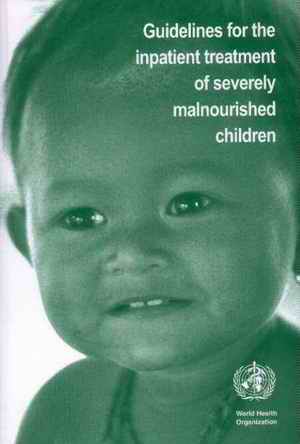
 Guidelines for the inpatient treatment of severely malnourished children, by Ann Ashworth, Sultana Khanum, Alan Jackson and Clarie Schofield. soft cover, 6.25" x 9.5".
World Health Organization, Avenue Appia 20, 1211 Geneva 27, Switzerland, Publication Date 2003, 48 pages, ISBN 92-4-154609-3, NLM Classification: WS 115: Price: US $9.00
 |
Malnutrition is among the leading causes of mortality among under-five children especially among developing countries. Majority of the deaths attributable to malnutrition are accounted for by severe malnutrition. Considering the significance of this important yet treatable cause and the reported death rate among hospitalized severely malnourished children to be as high as 50%, (WHO) has formulated guidelines for the inpatient treatment of severely malnourished children, which are presented in this publication.
These guidelines can be used not only in hospitals but also in therapeutic feeding centers in emergency settings and nutritional rehabilitation centers after initial hospital treatment. The authors state that if properly followed, these guidelines can bring down the death rate among severely malnourished children to as low as 5%.
 |
The guidelines are presented in form of a 48-page book that has a smiling healthy child on its front cover. This photograph aptly portrays the target of any health personal involved in management of a malnourished child and may even serve as a stimulus to those working under difficult conditions. The book is handy, light weight and can be easily carried for ready referral both in hospital and field conditions. The language is easy to understand for anyone with a medical background and its font is clear and readable.
The preface and introduction provide the definition of severe malnutrition, figures for prevalence of severe malnutrition, establish the relevance of the guidelines and present documented data in its support. Further, the book is divided into five sections followed by eleven appendixes.
 ...The contents of the appendixes enhance the utility of the book by providing information on various aspects relevant for management of severe malnutrition. They include reference tables of weight-for-height useful for classification of malnutrition, drug dosages, composition of ReSoMal, charts/cards which can be used for monitoring patient condition during treatment, composition and dosage of F-75, F-100 & F-135, play activities for mental stimulation of the child and a discharge card to be given to the mother/carer for giving advice related to nutrition, medicines, danger signs, vaccination, vitamin A supplementation, play activities and follow up schedule... ...The contents of the appendixes enhance the utility of the book by providing information on various aspects relevant for management of severe malnutrition. They include reference tables of weight-for-height useful for classification of malnutrition, drug dosages, composition of ReSoMal, charts/cards which can be used for monitoring patient condition during treatment, composition and dosage of F-75, F-100 & F-135, play activities for mental stimulation of the child and a discharge card to be given to the mother/carer for giving advice related to nutrition, medicines, danger signs, vaccination, vitamin A supplementation, play activities and follow up schedule...
|
The first section describes ten general but essential principles for routine care that should be followed for treating all severely malnourished children and have been named as 'The Ten Steps' that will take the child towards recovery. A graph depicts the implementation of these steps in a graded manner with time, with the whole treatment period being divided into two phases namely stabilization and rehabilitation phase. Each step, which either covers a feature or a complication of severe malnutrition, is then covered in detail giving the reasons behind its occurrence and suggested treatment, its definition, treatment protocol, guidelines for monitoring treatment and how to prevent its reoccurrence in course of managing the child. The 'steps' covered are relevant and cover not only the physical aspect of health but also mental development of the child by provision of sensory stimulation and emotional support, a point often neglected during treatment.
The next section gives the emergency treatment of shock and severe anemia, which are common but serious conditions of severely malnourished children, covering treatment protocols, monitoring guidelines and further management after initial emergency treatment. The third section covers treatment of associated conditions viz. Vitamin A deficiency, dermatosis, parasitic infections, diarrhea and tuberculosis, which often co-exist with severe malnutrition.
The penultimate section defines the conditions for declaring failure to respond to treatment, assesses the possible reasons behind it and suggests possible interventions that may be tried for countering the failure. The final section enumerates the criteria that should be met before discharging a child for home-based treatment. They have been divided into 3 types of criteria i.e. those related to the child, the mother/carer and the local health workers. It further covers important nutritional issues that should be taken care of by the mother/carer during home-based treatment after discharge. It ends with listing of sources for further reading for interested readers.
The contents of the appendixes enhance the utility of the book by providing information on various aspects relevant for management of severe malnutrition. They include reference tables of weight-for-height useful for classification of malnutrition, drug dosages, composition of ReSoMal (the recommended ORS to be used in severe malnutrition taking the altered electrolyte balance in mind), charts/cards which can be used for monitoring patient condition during treatment, composition and dosage of F-75, F-100 & F-135 (formula feeds recommended for use in severe malnutrition), play activities for mental stimulation of the child and a discharge card to be given to the mother/carer for giving advice related to nutrition, medicines, danger signs, vaccination, vitamin A supplementation, play activities and follow up schedule.
Overall, the booklet provides concise, well-compiled and relevant guidelines will be useful in management of children with severe malnutrition and reduce the burden of under-five mortality attributed to it.
-Rahul Malhotra and Chetna Ahuja
Department of Community Medicine,
Maulana Azad Medical College,
New Delhi, India
|
|
|
|
|
 Order this book by Clicking here

 Request a PDF file of this review by clicking here. (If your screen resolution can not be increased, or if printing this page is giving you problems like overlapping of graphics and/or tables etc, you can take a proper printout from a pdf file. You will need an Acrobat Reader though.)
N.B. It is essential to read this journal - and especially this review as it contains several tables and high resolution graphics - under a screen resolution of 1600 x 1200 dpi or more. If the resolution is less than this, you may see broken or overlapping tables/graphics, graphics overlying text or other anomalies. It is strongly advised to switch over to this resolution to read this journal - and especially this review. These pages are viewed best in Netscape Navigator 4.7 and above.
-Anil Aggrawal


 [ Major links ]
[ Aims and Objectives ] [ FAQ ] [ Editorial Board ] [ Contributing Partners ] [ Sitemap ]
[ Paper/Thesis submission guidelines ] [ Editorials - Cumulative Index ] [ Be our sponsor! ]
[ Cumulative index of Book Reviews sorted by | Publishers | General Interest Books | Technical Books ] [ Animated Reviews ] [ Featured Reviews ]
[ Reviews with Quizzes ] [ Links ] [ Submit books/journals/software/multimedia for review ] [ journal CD ] [ History of the Journal ] [ Interviews ] [ Credits ]
[ Cumulative index of | Theses/dissertations | Online Courses | Awards ] [ Anil Aggrawal's Internet Journal of Book Reviews - Sister Publication ]
[ Cumulative reviews of Software/Multimedia | Books on CD/Audio tapes | Calenders | Models ] [ contact us ]
Books for review must be submitted at the following address.
Professor Anil Aggrawal (Editor-in-Chief)
Anil Aggrawal's Internet Journal of Forensic Medicine and Toxicology
S-299 Greater Kailash-1
New Delhi-110048
India
Click here to contact us.
This page has been constructed and maintained by Dr. Anil Aggrawal, Professor of Forensic Medicine, at the Maulana Azad Medical College, New Delhi-110002. You may want to give me the feedback to make this pages better. Please be kind enough to write your comments in the guestbook maintained above. These comments would help me make these pages better.
 IMPORTANT NOTE: ALL PAPERS APPEARING IN THIS ONLINE JOURNAL ARE COPYRIGHTED BY "ANIL AGGRAWAL'S INTERNET JOURNAL OF FORENSIC MEDICINE AND TOXICOLOGY" AND MAY NOT BE REPOSTED, REPRINTED OR OTHERWISE USED IN ANY MANNER WITHOUT THE WRITTEN PERMISSION OF THE WEBMASTER
Questions or suggestions ? Please use ICQ 19727771 or email to dr_anil@hotmail.com
Page Professor Anil Aggrawal via ICQ

|