


|
|
|
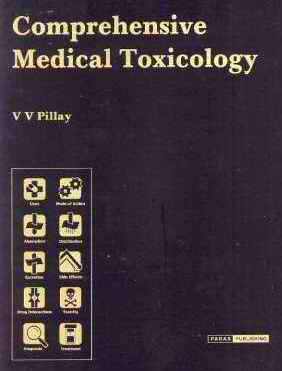
 Comprehensive Medical Toxicology, 1stEdition, by V V Pillay. Hardback, 11" x 8.5".
Paras Medical Publisher, 5-1-473, Jambagh Road, P.O.Box No. 544, Hyderabad - 500 095, India. Publication Date January 2003. 650 pages, ISBN 81-88129-86-0. Price Indian Rupees 750, US $40
 |
This is such a revolutionary book, we thought we should give some excerpts from it, to enable the reader to gauge a better idea about its excellence.
Pillay seems to revel in imparting off-beat and highly interesting sidelights into the history of almost every poison he describes. While one can get to read things like signs and symptoms, fatal dose, fatal period, autopsy features and forensic significance of poisons in almost any standard textbook of toxicology, interesting sidelights on historical aspects of poisons and other interesting tidbits are rarely seen in standard textbooks. Two toxicology books which have attempted this to some extent are the classical "Clinical Toxicology" 3rd edition, by CJ Polson, MA Green and MR Lee [Pitman Books Ltd, London, 1983] and "Toxicology - A Case Oriented Approach" 1st edition, by John Joseph Fenton [CRC Press, Boca Raton, 2002]. Polson's book is however out of print now, and Fenton's book, though good and available, may be heavy on one's pocket.
Sample the following nugget from Section II of Pillay's book. This section is entitled "Chemical Toxicology". In this section Pillay dwells on poisons such as caustics, inorganic elements, heavy metals, alcohols, hydrocarbons, pesticides and toxic gases. On page 116, while discussing toxicity of organic mercurials, Pillay has this to tell us:
Between 1953 and 1970, on the island of Kyushu around Minimata Bay in Japan, more than 2000 people were diagnosed to be suffering from a curious cluster of neurological symptoms comprising paraesthesiae, narrowing of vision, dysarthria, diminution of hearing, amnesia, ataxia, staggering gait, weakness, and emotional instability. Some developed paralysis and became stuporous, and out of all the people afflicted nearly a hundred died. The condition came to be known as the Minimata disease, and intensive investigations pointed to one inescapable conclusion: it was caused by consumption of fish contaminated with methyl mercury, which originated from a nearby vinyl chloride plant. The most severely affected victims were actually infants who had been exposed in utero.
 |
 ...For ages doctors have pooh-poohed the suggestion that mercury could be poisonous. After all they had been using a variety of mercury compounds as effective therapies for a variety of illnesses! Therefore none of the medical fraternity was particularly impressed when it was demonstrated for the first time several decades ago that the fish in the sea contained high concentrations of mercury. But the Minimata tragedy finally shattered this complacency. A further blow came in 1964 when a similar outbreak of poisoning was reported from another part of Japan: Niigata along the Agano river... ...For ages doctors have pooh-poohed the suggestion that mercury could be poisonous. After all they had been using a variety of mercury compounds as effective therapies for a variety of illnesses! Therefore none of the medical fraternity was particularly impressed when it was demonstrated for the first time several decades ago that the fish in the sea contained high concentrations of mercury. But the Minimata tragedy finally shattered this complacency. A further blow came in 1964 when a similar outbreak of poisoning was reported from another part of Japan: Niigata along the Agano river...
|
For ages doctors have pooh-poohed the suggestion that mercury could be poisonous. After all they had been using a variety of mercury compounds as effective therapies for a variety of illnesses! Therefore none of the medical fraternity was particularly impressed when it was demonstrated for the first time several decades ago that the fish in the sea contained high concentrations of mercury. But the Minimata tragedy finally shattered this complacency. A further blow came in 1964 when a similar outbreak of poisoning was reported from another part of Japan: Niigata along the Agano river. Forty-three cases were diagnosed as having the Minimata disease out of whom six died. Then came the shocking tragedy in Iraq in 1971-72, when 500 people died out of a total of 6530 victims due to consumption of imported wheat and barley meant for sowing, treated with methyl mercury. Nearly 95,000 tonnes of seed grain treated with methyl mercury was baked into bread!
Unlike inorganic mercury compounds, methyl mercury is a subtle, difficult to detect, long-lasting poison. When large quantities of industrial waste and agricultural fungicides containing mercury are released into the ocean apart from volcanic discharges (amounting to an estimated 10,000 tonnes of mercury every year), methylation of this relatively inoffensive metal results in the production of methyl mercury, which then enters the algae-fish-human food chain. This biological methylation is accomplished by a deep sea bacterium called Methanobacterium omelanskii. These bacteria are consumed by plankton, which in turn are eaten by fish. When human beings partake of such contaminated fish, the scene is set for a tragedy.
In the human body, methyl mercury is bound by haemoglobin and circulates in this form in the blood stream for several weeks or months. Excretion is very slow and the estimated half-life in man is 70 days, while in fish it is 200 days. It passes easily into the CNS where it selectively and irreversibly damages the cells of the granular layer of cerebellum and cerebral cortex. Methyl mercury is especially injurious to the CNS of infants and children.
It has been estimated that even after mercury contamination has ceased, the contaminated area may remain polluted for 10-100 years. No satisfactory method of de-pollution has so far been evolved. Dredging appears to be ineffective. Other methods such as sludge treatment, use of selenium, etc., are being tried. Meanwhile, scientists recommend that it would be wise to restrict the intake of certain kinds of fish (marine as well as fresh water), which are susceptible to contamination with methyl mercury, e.g., tuna, perch, pike, white bass, etc. The "safe" weekly limit has been suggested to be about 500-750 g/week of such fish.
Pillay then goes on to describe the autopsy features, forensic significance and other technical aspects of mercury poisoning.
While Pillay informs his readers with his excellent text, he doesn't fail to bewilder too with rare and off-beat information. In fact he does this with an almost certain regularity - and very successfully. Sample this nugget from Section III entitled "Pharmaceutical Toxicology". This comes from page 449 of his book.
On Sept 10, 1978, 11 month-old Chad, the son of Bruce and Sandy Shelton of Omaha, Nebraska (USA), was rushed to hospital after he became seriously ill and began to bleed from every orifice. Investigations revealed severe thrombocytopenia and acute liver failure. No cause could be determined. Chad died early next morning in spite of heroic measures to save him.
...When the police sought the help of a toxicologist as to the probable nature of the poison, she suggested an unusual substance as one of the possibilities - dimethylamine nitrosamine. It is a substance that is widely used in cancer research in animals...
|
A few hours after Chad's tragic death, a 25 year old truck driver, Dwane Johnson was admitted to the same hospital with similar manifestations. He quickly became comatose and died (of acute liver failure). One of the nurses noticed that Dwane happened to be Chad's uncle.
A short while later, Chad's parents, Bruce and Sandy Shelton, and his sister, were all admitted with similar though much milder, symptoms. They survived. But by now, the attending physicians suspected poisoning and informed the police. Investigations revealed that there had been a family get-together at the Shelton's home a week earlier, during which lemonade had been served. Everyone who had drunk this had become sick. Since Dwane and his little nephew Chad had consumed relatively large amounts of lemonade, they had succumbed.
When the police sought the help of a toxicologist as to the probable nature of the poison, she suggested an unusual substance as one of the possibilities - dimethylamine nitrosamine. It is a substance that is widely used in cancer research in animals. It is completely metabolized and excreted after absorption, and leaves behind no trace in the body. It is a well known carcinogen.
On further investigation, police discovered that three years earlier, Dwane and his wife Sandy had an altercation with an armed assailant at their home, who happened to be an old boy friend of Sandy. His name was Steven Roy Harper, and he had been sentenced for the offence to 5 years in prison, but had been released in just one year. A search warrant of Harper's present home revealed evidence of animal experiments in his garage. A local veterinarian mentioned that Harper's dog and cat had recently died of liver failure from unknown causes.
Dwane's tissues, which had been preserved at the time of the autopsy on his body, were now subjected to DNA analysis to find out whether dimethylamine nitrosamine could have been involved. The analysis revealed changes consistent with administration of the substance. Harper was arrested and interrogated. It transpired that he had obtained dimethylamine nitrosamine from a laboratory he was working in, and had broken into the Shelton's home one night and poured the toxic carcinogen into a pitcher of lemonade in the refrigerator. This lemonade was subsequently used by the Sheltons in their family get-together.
Harper was convicted and sentenced to death in the electric chair. But he committed suicide in his cell while on Death Row.
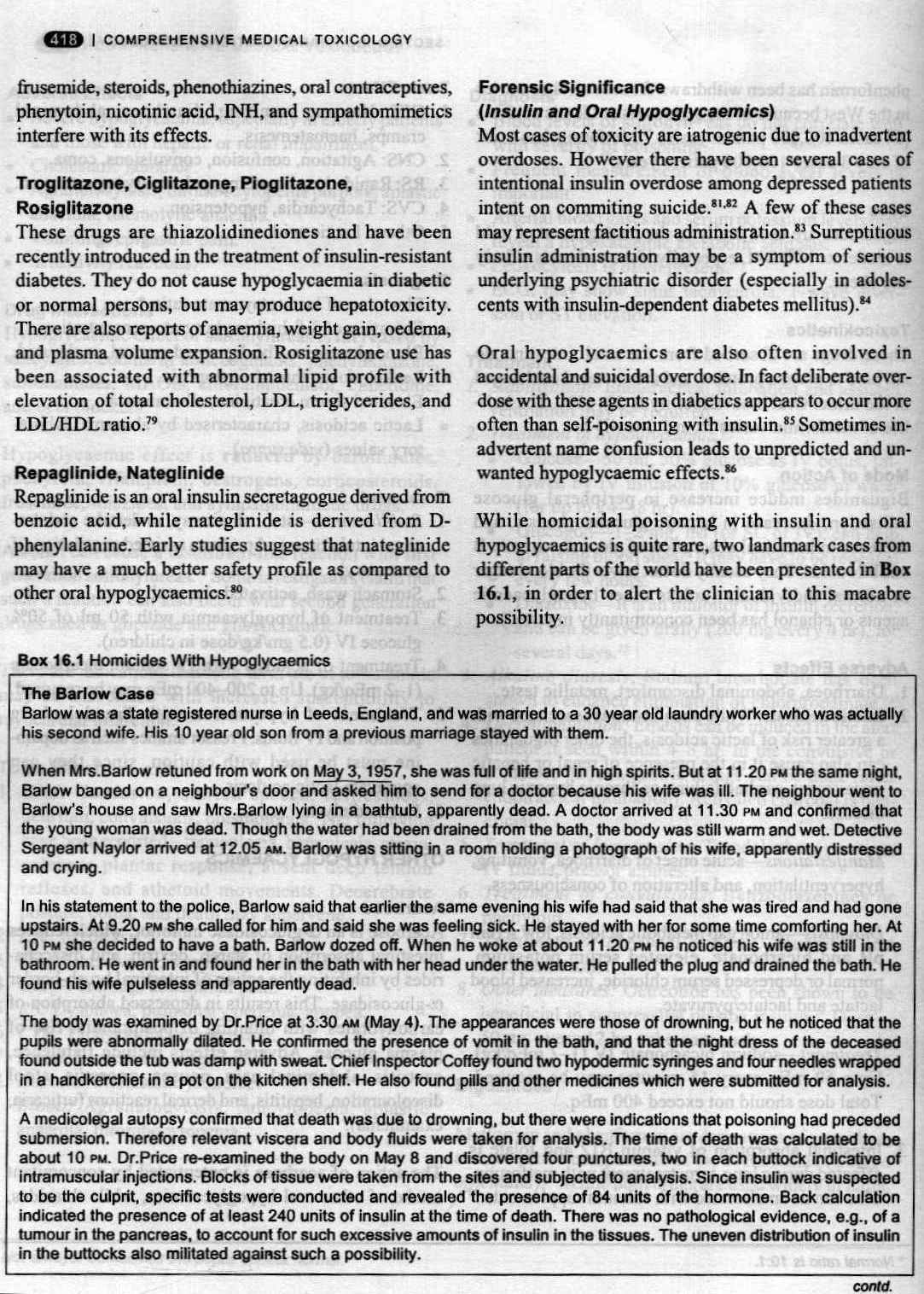
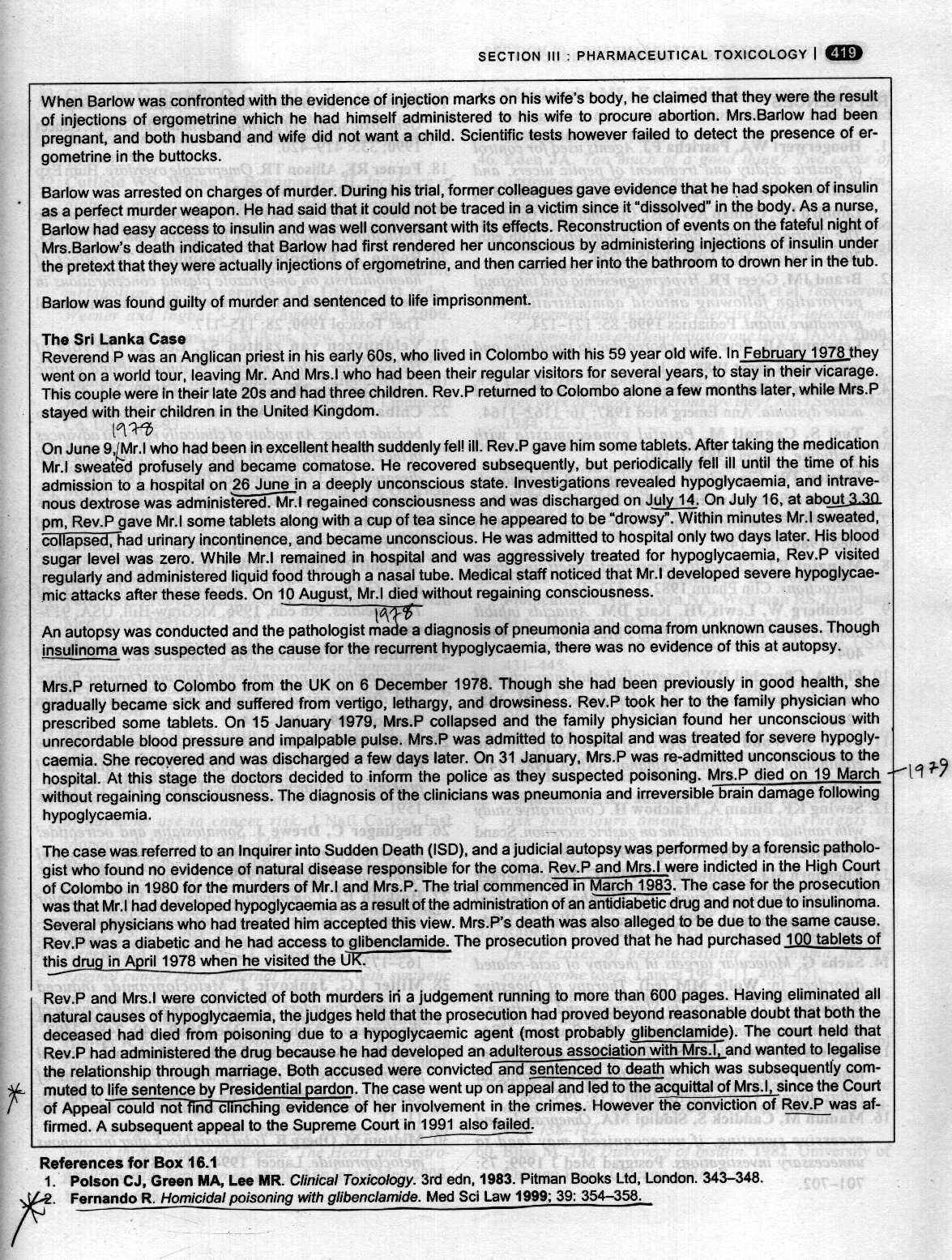
The above extract comes from the part of his book where he describes the toxicology of antineoplastic agents. Toxicology of antineoplastic agents is certainly not the most interesting chapter in any toxicology text, and an average reader would tend to skip the pages. However with pieces of information like this, Pillay ensures that the reader doesn't skip through any part of his book.
Let us sample another lesser interesting parts of toxicology - Microbial food poisoning. When going through this chapter, I chuckled to myself, "Got him! Now what possible off-beat information could he give in a topic like this?"
The pleasure was short-lived. On page 514, Pillay tells us:
Cholera has existed in India since ancient times, and has spread periodically to other parts of the world in the form of pandemics resulting in thousands of deaths. Till the early part of the 19th century, cholera was virtually confined to India, occasionally causing epidemics in different parts of the country. From 1817 to 1923, the disease spread from Bengal in six separate pandemic waves to engulf most parts of the world. From 1923 to 1961, there was a lull before the 7th pandemic broke loose, this time originating from Indonesia and exposing the world for the first time to a new strain of vibrios called the El Tor vibrio.
...Cholera has existed in India since ancient times, and has spread periodically to other parts of the world in the form of pandemics resulting in thousands of deaths. Till the early part of the 19th century, cholera was virtually confined to India, occasionally causing epidemics in different parts of the country. From 1817 to 1923, the disease spread from Bengal in six separate pandemic waves to engulf most parts of the world...
|
After spreading to Hong Kong and the Philippines, the El Tor infection proceeded westwards and invaded India in 1964. By 1966, most parts of the Indian sub-continent were gripped by the pandemic, which then spread to West Asia. In the 1970s, the infection involved most parts of Africa and Southern Europe. Small outbreaks occurred even in Australia and the USA. In January 1991, the pandemic reached Peru, thereby encircling the globe in a span of 30 years. For the first time in the 20th century, cholera had invaded South America, and by 1992 over half a million cases and 5000 deaths had been reported from this continent alone. Till date the pandemic has affected more than 80 countries in Asia, Africa, America, and Europe.
Ever since cholera El Tor biotype invaded India in 1964, the geographic distribution of cholera has changed considerably in this country. West Bengal is no more "home" to cholera, which is now endemic in many Indian states. In several of these areas, the disease persists as a smoldering infection, though classically severe epidemics with high mortality are uncommon. In fact, the case fatality rate dropped from 49.3% in 1961 to just 4.26% in 1997. Currently the main endemic regions in India are located in the states of Gujarat, Delhi, Maharashtra, Karnataka, Tamilnadu, and Kerala. These states put together account for nearly 80% of the reported incidence in the country.
In October 1992, a new epidemic began in Chennai, caused by an atypical strain of V. cholerae. Similar epidemics broke out in Calcutta and Bangladesh in 1993 causing several thousand deaths. These strains could not be identified as any of the 138 known types of V. cholerae, and have been designated as a new serogroup: 0139 or Bengal. Although the extent of the ongoing epidemic is unclear, the new strain is now associated with fulminant illness along a 100 mile coastline of the Bay of Bengal (from Chennai to Bangladesh), and appears to have largely replaced the other strains prevalent earlier.
The above excerpt has been taken from Section IV of his book entitled "Biotoxicology". I could go on and on, but would give just one more extract from page 532. Pillay is discussing mushrooms here...
Mushroom poisoning has had a long and colorful history, beginning with the dawn of the Christian era. Cases have been mentioned as far back as 450 BC (by Euripedes) and 100 AD (by Pliny). There is evidence to suggest that the Roman Emperor Claudius 1 (10 BC to AD 54), was poisoned to death with mushrooms. Tacitus, the famous Roman historian (AD 55-120) writing in his Annals of Rome, however, indicates that it was not really the mushroom which killed Claudius. He describes how Agrippina, the mother of Nero, arranged for the murder of the Emperor by utilizing a delicious mushroom as a vehicle on which some poisonous substance (supplied by Locusta, an "expert" on poisons), was sprinkled. This was done by the eunuch who habitually served the Emperor and tasted his food. Claudius was drunk at the time. The poison did not prove to be very quick acting, and the Emperor was saved by a bout of diarrhoea which flushed out the toxin! His doctor was summoned who diabolically (under instructions from Agrippina) inserted a feather dipped in deadly poison down the poor Emperor's throat, under the pretence of inducing emesis. Claudius died, and Nero his stepson, succeeded him and went on to become the most notoriously cruel ruler in Roman history.
 |
 |
Some historians suggest that the biblical tree of good and evil was in fact a mushroom (Amanita muscaria). A fresco retrieved from a disused church in France, dating back to AD 129, shows Eve standing beside a handsome specimen of fly agaric with both hands gripping her lower abdomen. It appears that she is in the throes of colic presumably brought on by eating the forbidden fruit, though dissenting investigators say that her posture merely indicates a bashful attempt to cover her naked crotch.
Fly agaric also finds mention in the accounts of ancient travelers passing through Siberia. One of them writes, "The Russians who trade, with them carry thither, a kind of mushroom...... .which they exchange for squirrel, fox, ermine, sable, and other furs; those who are rich amongst them lay up large provisions of these mushrooms for the winter. When they make a feast, they pour water upon some of these mushrooms and boil them. They then drink the liquor which intoxicates them; the poorer sort who cannot afford to lay in a store of these mushrooms, post themselves on these occasions round the huts of the rich and watch the opportunity of guests coming down to make water; and then hold a wooden bowl to receive the urine, which they drink greedily as having still some virtue of the mushroom in it, and by this way they also get drunk...."
Another account is given by some other travelers who likened the effects of agaric to hashish. The subject experienced hallucinations of a kind which made "a small hole look to them like a bottomless pit, and a pool of water as the sea." They estimated a moderate dose to be 3-4 mushrooms, and 10-12 were required to produce the full effect. It was their conclusion that in those parts, the hospitable invitation was not as normally stated, "Come in and have a drink," but "come in and have a mushroom!"
In the latter half of the 20th century, hallucinogenic mushrooms attained popularity in the UK and the USA, among teenagers and the youth. This was largely because of description of their effects in Castenada's cult classic "The Teachings of Don Juan: A Yaqui Way of Knowledge". Cases of poisoning due to such mushrooms became increasingly common, though effects were usually temporary. In some cases however, long term effects in the form of "flashback phenomena" occurred, similar to those encountered with LSD.
Today unintentional exposures to mushrooms represent a relatively constant percentage of exposures reported from the American Association of Poison Control Centers. It is estimated that approximately 5 mushroom exposures per 100,000 population occur per year, with geographic and climatic conditions as well as mycologic habitats leading to variations.
Mushroom poisoning is generally uncommon in India, though cases are beginning to be reported from certain parts of the country.
Take my advice and read this book. You will thank me I recommended such a beauty to you.
 Review 3 by Wayne Jones, Sweden
Review 4 by John Trestrail, USA
 Order this book by clicking here.
 Request a PDF file of this review by clicking here. (If your screen resolution can not be increased, or if printing this page is giving you problems like overlapping of graphics and/or tables etc, you can take a proper printout from a pdf file. You will need an Acrobat Reader though.)
N.B. It is essential to read this journal - and especially this review as it contains several tables and high resolution graphics - under a screen resolution of 1600 x 1200 dpi or more. If the resolution is less than this, you may see broken or overlapping tables/graphics, graphics overlying text or other anomalies. It is strongly advised to switch over to this resolution to read this journal - and especially this review. These pages are viewed best in Netscape Navigator 4.7 and above.
-Anil Aggrawal


 [ Major links ]
[ Aims and Objectives ] [ FAQ ] [ Editorial Board ] [ Contributing Partners ] [ Sitemap ]
[ Paper/Thesis submission guidelines ] [ Editorials - Cumulative Index ] [ Discussion ] [ Chat room ] [ Be our sponsor! ]
[ Cumulative index of Book Reviews sorted by | Publishers | General Interest Books | Technical Books ] [ Animated Reviews ] [ Featured Reviews ] [ E-books ]
[ Reviews with Quizzes ] [ Links ] [ Submit books/journals/software/multimedia for review ] [ journal CD ] [ History of the Journal ] [ Interviews ] [ Credits ]
[ Cumulative index of | Theses/dissertations | [ Online Courses ] [ Awards ] [ Anil Aggrawal's Internet Journal of Book Reviews - Sister Publication ]
[ Cumulative reviews of Software/Multimedia | Books on CD/Audio tapes ] | Calenders | Models ] [ contact us ]
[ Undergraduate section | Postgraduate section ] [ Forensic gadgets/toys/other tidbits ]
Books for review must be submitted at the following address.
Professor Anil Aggrawal (Editor-in-Chief)
Anil Aggrawal's Internet Journal of Forensic Medicine and Toxicology
S-299 Greater Kailash-1
New Delhi-110048
India
Click here to contact us.
This page has been constructed and maintained by Dr. Anil Aggrawal, Professor of Forensic Medicine, at the Maulana Azad Medical College, New Delhi-110002. You may want to give me the feedback to make this pages better. Please be kind enough to write your comments in the guestbook maintained above. These comments would help me make these pages better.
 IMPORTANT NOTE: ALL PAPERS APPEARING IN THIS ONLINE JOURNAL ARE COPYRIGHTED BY "ANIL AGGRAWAL'S INTERNET JOURNAL OF FORENSIC MEDICINE AND TOXICOLOGY" AND MAY NOT BE REPOSTED, REPRINTED OR OTHERWISE USED IN ANY MANNER WITHOUT THE WRITTEN PERMISSION OF THE WEBMASTER
Questions or suggestions ? Please use ICQ 19727771 or email to dr_anil@hotmail.com
Page Professor Anil Aggrawal via ICQ

|

