


|

|
|
 Commercial Vehicle Accident Reconstruction and Investigation, 1st Edition, by Roy F. Sutphen Sr. and Rick W. Varner, Casebound, 6" x 9".
Lawyers and Judges Publishing Company, Inc, P.O. Box 30040, Tucson, AZ 85751-0040: web - http://www.lawyersandjudges.com, Publication Date July 30, 2003. 392 pages, ISBN-10: 1930056478; ISBN-13: 978-1930056473. Price: $109.00
 Visit the Official site of this book by clicking here
 Buy from Amazon by clicking here.
 For table of contents, please click here.
 |
Commercial vehicle accidents are one of the important cause of fatalities in road traffic accidents. This is more so in developing countries like India, where these vehicles are not so well maintained, the road quality is poor and the working conditions for the drivers tough. Added to that the not so vigilant legal system and one is left to the mercy of God while one is one the road. The absence of a computerized database for the vehicles makes it very difficult to trace the vehicle if it is a hit and run case.
The first part of the book viz. chapters 1 - 7 deal with the various types of commercial vehicles and the various laws in the US that deal with these vehicles and the persons driving them. The first major point that can be noted in this part is the various figures and charts that have been used to describe the different types of vehicles. Also noteworthy is the use of flow charts to give an example of how the investigation officer should proceed while investigating a driver of an alleged vehicle involved in accident. The only blip in this section is that the authors have only described laws of US as applicable to various aspects of commercial vehicles and the persons driving them.
The next part of the book, viz. chapters 8 - 15 (chapter 15 dealing with braking systems has been further subdivided into seven parts A through G) describe the various parts of the vehicles. The description of these parts are so beautiful that after going through these sections, one can get a fair idea about the functioning of the vehicles. A detailed description cannot be undertaken in a book of this size, but notwithstanding the space constraint, the authors have done a commendable job in compiling a pretty handsome description. Once again, its the photographs that take the cake, as far as the best part of the section is concerned. By including such a large number of photographs, the authors have been able to cut down on the written part to the bare minimum, thereby saving space and keeping the size of the book within manageable limits. That is an important aspect of any book as a large size of the book is always a hindrance to its readership. A special mention is required here regarding the chapters on braking system, as they have been divided into eight different chapters. Such unusually large allocation of space to a single part of the vehicle demonstrates the kind of importance it has in causing/preventing accidents. And it also demonstrates that the authors kept this aspect well in mind and gave the requisite part its due importance.
 |
Having gone through the vehicle (its parts and their functioning), the next part of the book (chapters 16 - 29) deal with the ways of gathering information while investigating a case of commercial vehicle accident. It starts by demonstrating the ways of investigating the vehicle, followed by the ways of investigating the scene of accident and finally how the driver is to be investigated. In short, this section of the book describes the ways in which an investigation has to proceed while investigating a case of commercial vehicle accident, gathering information from one and all. The addition, in this section, apart from the usual pictures, diagrams, charts etc are the presence of all kinds of equations of physics. This is something that is expected in such a demonstration as the various laws of physics are the most important basis on which one has to find out where the fault lies. In spite of it being a very technical and mathematical description, the authors have described it in such an easy and free flowing language, that not even once does one feel that one is going through such a highly specialized topic. That in essence describes the deftness with which the authors have prepared the whole book.
Having gone through the book, we would just say that this is an excellent account of the ways in which any accident involving commercial vehicles should be investigated. We would suggest that any person, of whatever rank or department, who is involved with these kind of investigative work, must have a copy of this book at his ready disposal for reference.
Excerpts from the book:
Here are some excerpts from the book, so reader can get some ideas as to what is contained within the book. This is what the authors have to say in chapter 22 (Roadway Evidence) - pages 271 - 275.
The roadway at the scene of a commercial motor vehicle collision is normally loaded with evidence. It is the investigator's job to try to understand what all the marks and debris mean.
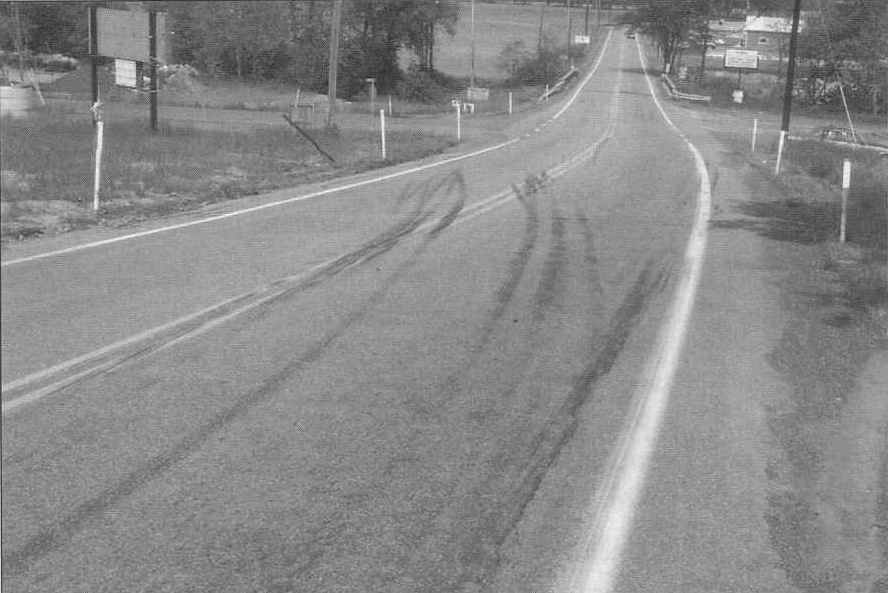 |
Physical evidence is unimpeachable - it was either there or it was not. Properly documented and photographed physical evidence cannot be argued with. With this in mind then, the proper documenting and photographing and locating of physical evidence at the scene or from the vehicles are the most important parts of any investigation. Likewise the lack of physical evidence may be telling a story also. Lack of skid marks tells you that the driver either didn't see the problem or did not have time to perceive and react to the problem.
Part of the physical evidence is the roadway itself. The roadway may be curved, thus limiting visibility, or it may be straight, giving a great deal of visibility. Roadway signs may be confusing or improperly placed. Potholes, bumps in the road, and ditches along the road all may have played roles in the collision, and all must be taken into consideration.
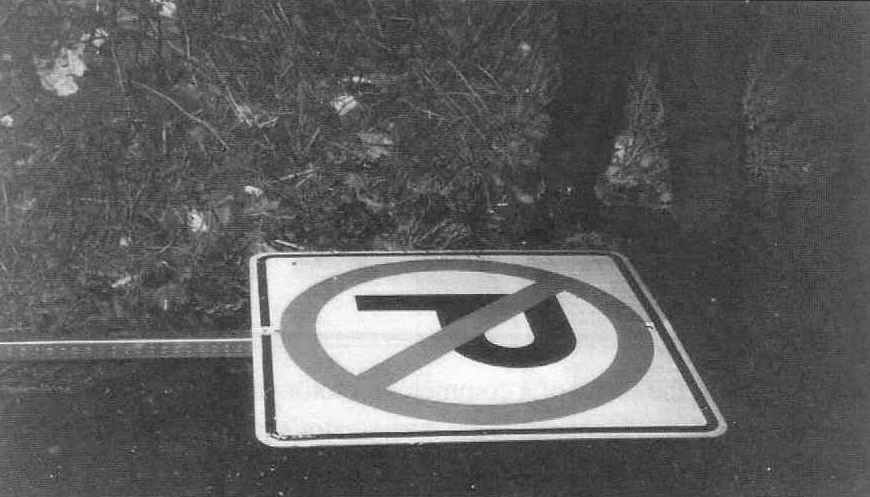
Road signs are placed to give motorists advance warning of hazards along a roadway. If that warning is missing or erroneous, collisions can occur.
Figure 22.2 shows a No Parking sign that had been knocked down on the Pennsylvania Turnpike where a commercial vehicle parked and then was struck by another commercial vehicle on a dark night. The driver who struck the parked vehicle was lured in as he was drowsy and following lights.
Roadway factors and sight lines are influences that need to be taken into consideration, along with any physical evidence found at the scene. Remember that sight lines change at various times of the day or night. How far you can see at 8 A.M. is different from how far you can see at 10 P.M. Darkness can affect sight distance and sun glare can also be a factor.
 |
On a five-axle truck tractor semitrailer, there are eighteen wheels. Each of these eighteen wheels are capable of leaving marks on the roadway when "locked up." If the brakes are set up properly, the trailer brakes will lock up first, and then the tractor drive wheels and, finally, the steering axle wheels-if the steering axle locks up at all. If the skid marks are overlapping it will be difficult, if not impossible, to distinguish the different wheels. If there is any rotation, however, the skid marks should be relatively simple to differentiate. When differentiated, each tire mark should be recorded. As seen in the braking efficiency chapter, each mark can be explained. Rotation should alert the investigator to look for the cause when performing the vehicle inspection.
Recalling information from basic collision investigation training, when a truck tractor semitrailer locks the brakes with an empty or lightly loaded trailer, there may be skip skids, depending on speed, suspension and other factors. Skip skids may also be present with a bobtail unit, a loaded vehicle with a poor suspension or on a roadway with an uneven surface. If the gaps in the skids are two to three feet apart, consider the gap to be part of the skid. If the gaps in the skids are twenty-five to thirty feet apart, the gap would not be included in the calculations. Gap skids generally are caused by the driver stab braking, the driver using the trolley valve, a load shift or an air system malfunction.
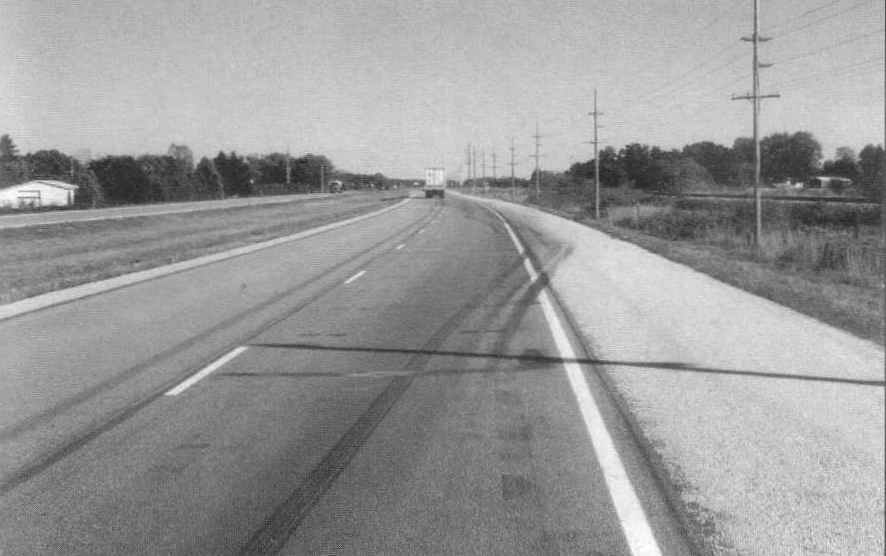 |
If the vehicle's brake system is in balance, the first axle to lock up will be the fifth axle, or the last in a combination. The steering axle, due to weight shift, will not usually lock until the vehicle is below 5 mph.
How a vehicle is loaded can have an effect on tire rotation and types of skid marks. A truck that is empty or lightly loaded is unstable dynamically. It may have an unexpected lockup, resulting in stability problems. A lightly loaded truck cannot develop the same amount of braking force that it would have when heavily loaded because the brakes lock up faster. When the manufacturers build tractors and semitrailers, they develop the braking system to work best under loaded conditions.
Conversely, a truck that is overloaded, or heavily loaded on certain axles, will stop at a longer distance than normal because the maximum braking capability is surpassed.
Another type of tire mark that may be found at the scene of a rollover is a mark that looks very much like a skid mark or yaw mark. Actually, it is a weight shift mark and has nothing to do with the actual braking of the vehicle. It is made when the trailer shifts to one side or another before rollover. These marks are often mistakenly noted as skid marks or yaw marks. Since they are neither, they should not be included in any speed calculations. They are easily distinguished with close observation. The outside edge of the mark will be darker than the inside edge. Normally, only the outside tires on the vehicle will leave the mark.
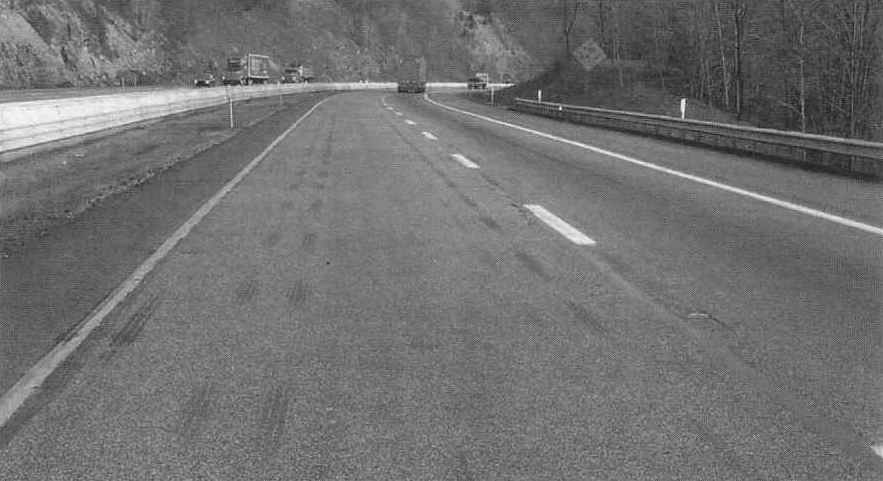 |
Offset skid marks are important at an accident scene, as they help to establish the point of impact.
Another tire mark that is sometimes misinterpreted is the mark a truck tractor semitrailer makes when it jackknifes. The marks that the tractor makes as it rotates should not be confused with a critical speed scuff, although they look similar.
Flat tire scrub marks may become important in an accident investigation, showing that the tire was flat prior to impact or after impact. These may be hard to distinguish on dual wheels since they may only lightly mark the roadway. Look for the other tire on the dual hub to display marks depicting a tire that is over-deflected due to the extra weight that it is now carrying.
Tire prints made in soft dirt, snow or sand may become important in an investigation. Assure they are documented, measured and photographed for use later.
The book gives a host of similar information on all aspects of vehicular accidents, especially how a forensic scientist can reconstruct a collision. We are sure our readers would enjoy the book as much as we at the journal office did.
Review by -Puneet Setia and Avneesh Gupta
|
|
|
|
|
Request a PDF file of this review by clicking here. (If your screen resolution can not be increased, or if printing this page is giving you problems like overlapping of graphics and/or tables etc, you can take a proper printout from a pdf file. You will need an Acrobat Reader though.)
N.B. It is essential to read this journal - and especially this review as it contains several tables and high resolution graphics - under a screen resolution of 1600 x 1200 dpi or more. If the resolution is less than this, you may see broken or overlapping tables/graphics, graphics overlying text or other anomalies. It is strongly advised to switch over to this resolution to read this journal - and especially this review. These pages are viewed best in Netscape Navigator 4.7 and above.
-Anil Aggrawal


 [ Major links ]
[ Aims and Objectives ] [ FAQ ] [ Editorial Board ] [ Contributing Partners ] [ Sitemap ]
[ Paper/Thesis submission guidelines ] [ Editorials - Cumulative Index ] [ Discussion ] [ Chat room ] [ Be our sponsor! ]
[ Cumulative index of Book Reviews sorted by | Publishers | General Interest Books | Technical Books ] [ Animated Reviews ] [ Featured Reviews ] [ E-books ]
[ Reviews with Quizzes ] [ Links ] [ Submit books/journals/software/multimedia for review ] [ journal CD ] [ History of the Journal ] [ Interviews ] [ Credits ]
[ Cumulative index of | Theses/dissertations | [ Online Courses ] [ Awards ] [ Anil Aggrawal's Internet Journal of Book Reviews - Sister Publication ]
[ Cumulative reviews of Software/Multimedia | Books on CD/Audio tapes ] | Calenders | Models ] [ contact us ]
[ Undergraduate section | Postgraduate section ] [ Forensic gadgets/toys/other tidbits ]
Books for review must be submitted at the following address.
Professor Anil Aggrawal (Editor-in-Chief)
Anil Aggrawal's Internet Journal of Forensic Medicine and Toxicology
S-299 Greater Kailash-1
New Delhi-110048
India
Click here to contact us.
This page has been constructed and maintained by Dr. Anil Aggrawal, Professor of Forensic Medicine, at the Maulana Azad Medical College, New Delhi-110002. You may want to give me the feedback to make this pages better. Please be kind enough to write your comments in the guestbook maintained above. These comments would help me make these pages better.
 IMPORTANT NOTE: ALL PAPERS APPEARING IN THIS ONLINE JOURNAL ARE COPYRIGHTED BY "ANIL AGGRAWAL'S INTERNET JOURNAL OF FORENSIC MEDICINE AND TOXICOLOGY" AND MAY NOT BE REPOSTED, REPRINTED OR OTHERWISE USED IN ANY MANNER WITHOUT THE WRITTEN PERMISSION OF THE WEBMASTER
Questions or suggestions ? Please use ICQ 19727771 or email to dr_anil@hotmail.com
Page Professor Anil Aggrawal via ICQ

|

 ...Having gone through the book, we would just say that this is an excellent account of the ways in which any accident involving commercial vehicles should be investigated. We would suggest that any person, of whatever rank or department, who is involved with these kind of investigative work, must have a copy of this book at his ready disposal for reference...

