|
 OTHER REVIEWS IN THIS ISSUE OTHER REVIEWS IN THIS ISSUE Pages: |1|
2|
3|
4|
5|
6|
7|
8|
9|
10|
11|
12| Pages: |1|
2|
3|
4|
5|
6|
7|
8|
9|
10|
11|
12|
[Popular Books Section]
|



|
|
 Self-Assessment in Forensic Medicine & Toxicology: MCQs in Forensic Medicine & Toxicology, 1stEdition, by V V Pillay and B K Bastia. Softcover, 5.5" x 8.5".
Paras Medical Publisher, 5-1-473, Jambagh Road, P.O.Box No. 544, Hyderabad - 500 095, India. Publication Date 2002. 204 pages, ISBN 81-88129-46-1. Price Indian Rupees 95.00
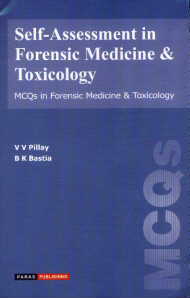 |
Self assessment in Forensic Medicine and Toxicology is a 204 page paper bound volume with 650 questions in 22 chapters on Forensic Medicine and 350 questions in 15 chapters on toxicology. The book is designed as an instrument of self assessment for students and practitioners of forensic medicine and forensic toxicology. The book was edited by Drs. V.V. Pillay and B.K. Bastia with contributions by K.M. Saralaya, Anand Menon, Bhoopendra Singh and Ajee Kuruvilla. The book is published by Paras Publishing Hyderabad, India, (E-mail: parasmedpub@hotmail.com). The cover price is 95 Rs.
My review of this book is by an alien looking at the work with a foreign eye. There are several reasons for this. First, most of the world has a developed specialty in forensic medicine. This is certainly true in India, Europe, England, Asia and the Middle East. The United States for various historical reasons never developed the specialty of forensic medicine. What the United States developed was the specialty of forensic pathology and forensic psychiatry each of which is significantly narrower in scope than forensic medicine. As a forensic pathologist I look at this work from that perspective. My specialty deals nearly exclusively with the investigation of death. Forensic medicine, as practiced in much of the rest of the world, deals with a much broader range of topics including impotence, virginity, sexual offenses and forensic psychiatry. These topics make up four of the 22 chapters in Forensic Medicine. In addition, three chapters cover legal procedure, medical law and ethics and medicolegal aspects of injuries and death. These chapters deal with the particularities of Indian Statutory Law. Thus, for the reader from the United States, 7 of 22 chapters are not completely applicable to the practice of forensic pathology in the U.S. For readers elsewhere, but not from India, the three chapters dealing with Indian Law are the only ones not directly applicable to the practice in most countries.
Technically, the questions are all multiple choice with four possible answers from a to d, although often there is the possibility of all of the above as the fourth possibility and sometimes none of the above. At the end of each chapter the author's answers are supplied. Thus, it is possible to easily check one's answers as one goes along.
|
The book is dedicated to the task of provoking "careful thought, requiring recall and comprehension." Thus the work in its entirety can be recommended for a world wide audience, including the United States, even though 1/3 of the scope is Indian. Often practitioners in various disciplines and the forensic sciences in particular, become quite insular and chauvinistic in their methods of approach to universal problems arising in forensic medicine or pathology. As the human condition is really basically the same, irrespective of the overlay of legal systems and religions, which vary significantly from culture to culture; the problems faced by the practitioner of forensic medicine and pathology are really universal. To have available a work which so nicely describes the approach in India is certainly educational for non-Indian practitioners, and indeed one can make an argument that the knowledge imparted to non-Indians is of even greater value, as it presents many novel problems and solutions to a person from the United States.
Illustrative of the expansion of knowledge of other cultures is the discussion of "dowry deaths." In the first chapter entitled "Legal procedure", there are three questions involving "dowry deaths"; there are three more in chapter 12, entitled "Medicolegal aspects of injuries and death". For a person from the United States with general ignorance of Indian customs and laws, the concept of "dowry deaths" invites further study. With amazing ease, because of the resources of the internet and the World Wide Web, it is quickly possible to learn that dowries are paid by the family of the bride to the family of the groom. Often such dowries are in the form of promises of goods to be delivered at a time after the marriage. With failure of delivery of the dowry, there is a tradition, particularly in the rural areas, to harass the bride sometimes to the point of suicide, or even to kill the bride. The problem was widespread enough that the legislature requires the investigation of all deaths of married women within 7 years of marriage, by a magistrate and the investigation cannot be handled by the police themselves. Such is a clear example of an important cultural practice which impacts upon forensic medicine and pathology.
Of course some concepts espoused in the book are subject to controversy. The question is asked as to which is the best method of investigation of unnatural deaths (Chapter 1, Question 10, Page 3) and the possibilities listed are (i) inquests by police, (ii) coroner or (iii)magistrate and the (iv) medical examiner system. The correct answer is said to be the medical examiner system. As India lacks a medical examiner system, perhaps this represents a belief that what one does not have must be better. In the United States there is an expression which conveys this concept. It is that "the grass is always greener on the other side of the fence." Perhaps, I can agree with the authors concerning whether the medical examiner system is better than other systems of enquiry. However, from my own personal experience it is a close call. All systems of death investigation are easily corrupted, the most common reason being lack of interest on the part of the political system in death investigation. Lack of interest is expressed as lack of funding with concomitant decline in quality. Thus, there are certainly abysmal medical examiners systems and exemplary inquest systems, as well as the reverse. Which provides the best service is really quite difficult to discern, certainly in any scientific fashion.
Another quibble might be in the definition of a hostile witness. In English Common Law as I understand it, a witness may only be asked direct questions on direct examination. Direct questions, are those in which the answer is not suggested by the question. For example, what if anything, did you do then? Direct examination is the questioning done by the attorney who has called the witness. Cross examination is the questioning done by the attorney representing the other side. The attorney for the other side may ask leading questions of the form "Isn't it true that?..." It is impermissible to ask leading questions of a witness an attorney has called on direct. This rule may be ignored if the witness has been declared hostile by the court. A hostile witness, who is hostile by interest, i.e. an opposing party in a suit, or who is hostile for other demonstrable reasons, may be asked leading questions by the attorney calling the witness. Incorrectly, in my view, hostile witness is defined in the book as a perjurer, a person who lies under oath (Chapter 1, Question 26, Page 6). While a hostile witness may well be a perjurer, then so to may be a non-hostile witness. Being hostile does not connote perjury; only difficulty for the examiner.
 ....it is eye opening to learn a number of things. For instance, the name for a surgically altered gunshot wound which makes medicolegal interpretation difficult or impossible is "Kennedy phenomenon". While I have not heard such nomenclature used in the United States, it is certainly the only correct answer in the book, and definitely is a grand description of surgically altered gunshot wounds, even if rarely used in its country of origin.... ....it is eye opening to learn a number of things. For instance, the name for a surgically altered gunshot wound which makes medicolegal interpretation difficult or impossible is "Kennedy phenomenon". While I have not heard such nomenclature used in the United States, it is certainly the only correct answer in the book, and definitely is a grand description of surgically altered gunshot wounds, even if rarely used in its country of origin....
|
With the exception of some more small quibbles, the vast bulk of the information is quite accurate. Again, it is eye opening to learn a number of things. For instance, the name for a surgically altered gunshot wound which makes medicolegal interpretation difficult or impossible is "Kennedy phenomenon" (Chapter 9, Question 28, Page 62). While I have not heard such nomenclature used in the United States, it is certainly the only correct answer in the book, and definitely is a grand description of surgically altered gunshot wounds, even if rarely used in its country of origin.
In the area of electrocution certainly a "joule burn" is the best and most proper answer of those supplied in the book as describing electrocution burns. However, "arborescent burns" are seen in electrocutions with extremely high voltages, generally greater than 250,000. Thus there really needs to be some modification to the question such as changing the question to ask "In most electrocutions one of the following types of burns is seen." This makes "joule burn" the only proper answer.
There is a typographic error on page 127 which describes the answers as being to chapter 1 when they are in fact the answers for chapter 21. This was the only typographic error which I was able to discover after careful search.
The section on Toxicology encompasses some 15 chapters, but only 350 questions and only 70 pages or just over 1/3 of the book. Again, colloquialisms crop up which may be peculiar to India or perhaps much of the rest of the world, but unknown in the United States. "Hunan hand" is not a term which is used in the U.S., but is easily correctly deduced by reflecting on the sorts of spices which are popular in Hunan.
Other questions are quite perplexing for persons unfamiliar with the Indian Subcontinent, such as what viper or cobra has the largest 4th infralabial scale. Here, I must confess that additional reading was required to ascertain the correct answer, vipers and cobras being relatively rare in the U.S. Further, I was quite unacquainted with the properties of polyvalent antivenom available in India, although I am now acquainted with this.
Most of the remaining chapters deal with toxins and drugs which are more generally available throughout the world, so my success rate in answering the questions rose significantly. I was however shocked to learn that the statutory blood alcohol level was 30 mg/dl for drunk driving, and was wrong when I selected 50 mg/dl which is fairly common in Europe.
On the whole, this is a fine book for the student or for the seasoned expert. It may well be of more value to the student or practitioner outside of India as there is much to learn and think about as the result of completing this work for the non-Indian. This book is well worth adding to one's library.
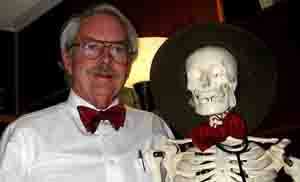 |
-Ronald K. Wright Dr. Ronald K. Wright is Associate Professor of Pathology and Director of Forensic Pathology Division at Jackson Memorial Hospital Miami, Florida. He can be contacted at rkw@rkwrightmd.com. Dr. Wright is on the left as you look at the photograph. |
 Order This book by clicking here.
 Request a PDF file of this review by clicking here. (If your screen resolution can not be increased, or if printing this page is giving you problems like overlapping of graphics and/or tables etc, you can take a proper printout from a pdf file. You will need an Acrobat Reader though.)

N.B. It is essential to read this journal - and especially this review as it contains several tables and high resolution graphics - under a screen resolution of 1600 x 1200 dpi or more. If the resolution is less than this, you may see broken or overlapping tables/graphics, graphics overlying text or other anomalies. It is strongly advised to switch over to this resolution to read this journal - and especially this review. These pages are viewed best in Netscape Navigator 4.7 and above.
-Anil Aggrawal

 [ Major links ]
[ Aims and Objectives ] [ FAQ ] [ Editorial Board ] [ Contributing Partners ] [ Sitemap ]
[ Paper/Thesis submission guidelines ] [ Editorials - Cumulative Index ] [ Be our sponsor! ]
[ Cumulative index of Book Reviews sorted by | Publishers | General Interest Books | Technical Books ] [ Animated Reviews ] [ Featured Reviews ]
[ Reviews with Quizzes ] [ Links ] [ Submit books/journals/software/multimedia for review ] [ journal CD ] [ History of the Journal ] [ Interviews ] [ Credits ]
[ Cumulative index of | Theses/dissertations | Online Courses | Awards ] [ Anil Aggrawal's Internet Journal of Book Reviews - Sister Publication ]
[ Cumulative reviews of Software/Multimedia | Books on CD/Audio tapes | Calenders | Models ] [ contact us ]
Books for review must be submitted at the following address.
Professor Anil Aggrawal (Editor-in-Chief)
Anil Aggrawal's Internet Journal of Forensic Medicine and Toxicology
S-299 Greater Kailash-1
New Delhi-110048
India
Click here to contact us.
This page has been constructed and maintained by Dr. Anil Aggrawal, Professor of Forensic Medicine, at the Maulana Azad Medical College, New Delhi-110002. You may want to give me the feedback to make this pages better. Please be kind enough to write your comments in the guestbook maintained above. These comments would help me make these pages better.
 IMPORTANT NOTE: ALL PAPERS APPEARING IN THIS ONLINE JOURNAL ARE COPYRIGHTED BY "ANIL AGGRAWAL'S INTERNET JOURNAL OF FORENSIC MEDICINE AND TOXICOLOGY" AND MAY NOT BE REPOSTED, REPRINTED OR OTHERWISE USED IN ANY MANNER WITHOUT THE WRITTEN PERMISSION OF THE WEBMASTER
Questions or suggestions ? Please use ICQ 19727771 or email to dr_anil@hotmail.com
Page Professor Anil Aggrawal via ICQ

|