|
 OTHER REVIEWS IN THIS ISSUE OTHER REVIEWS IN THIS ISSUE Pages: |1|
2|
3|
4|
5|
6|
7|
8|
9|
10|
11| Pages: |1|
2|
3|
4|
5|
6|
7|
8|
9|
10|
11|
[Popular Books Section]
[Books on CD/Audio tapes]
|

|
|


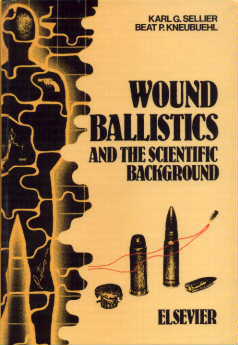
 Wound Ballistics and the Scientific Background, 1stEdition, by Karl G. Sellier and Beat P. Kneubuehl (translated into English by Ruth Rufer and Jack Hawley). Hard Bound, 6.5" x 9.5".
Elsevier Science B.V., Sara Burgerhartstraat 25, P.O. Box 211, 1000 AE Amsterdam, The Netherlands. Publication Date 1994. xxii + 479 pages, ISBN 0-444-81511-2. Price $150.00, Euro 150.00
 |
|
x = x0 + v0 . t +1/2a.t2
T = m . a . r
RSP = p . A . f
Surprised, amused or simply stunned! If your answer was none of these then answer these questions:
What is D'Alembert's Principle?
What is Haupt's formula?
What is Mach number?
What is Reynold's number?
Have these questions got the grey cells of your brain working? If not then sample a few more:
Do you remember the Bernoulli's theorem?
Or can you use the calculus as easily as you can speak English?
Or do you remember the physical properties of gases?
Or the Poisson's formula and the Young's modulus?

|
Don't take this to be some sort of an exam. These are just a few of the many questions that one has to answer before one starts using this book. But the other side of the coin is that you won't be required to read this book, (at least not in your professional life) if you are not aware of these terms. If you have forgotten some or all of these terms and are too lazy (like me) to open your high school books, the authors have described the required basics of physics and mathematics in chapter 2. And the good part is that they have not explained everything at one place. They have gone on to describe the terms in future chapters as and when they have been encountered and the need for their explanation has arisen. So the reader is not burdened by reading things that he might feel are not relevant to him.
Stephen W. Hawking in his A brief history of time says someone told him that each equation included in his book would halve the sales. There are a lot of equations in this book and the author feels apologetic for it because of the reference cited above. With due respect to Stephen W. Hawking I presume (my presumptions and predictions have been proved horribly wrong earlier) that applying this principle would mean that no book of physics and mathematics would ever be sold and that would mean that Prof. Hawking would not have been what he is today. So I think the inclusion of all these equations is an integral part of this book without which the book would not have been what it is now.
The chapter on the historical background of ballistics and their development is highly informative. Its utility is all the more relevant in a third world country like India (where I reside) as the developments being made in the developed countries reach here at least a decade late if not more. So we do encounter those outdated guns and missiles in our daily practice that are no more used in the western nations. The description of the various international treaties tells us both the utility and the futility of these treaties.
A good thing that I noticed in this book was the use of examples. Every time the authors have described something new, they have given a suitable that too by giving their usage in ballistics. Many times it is seen that examples are given but they are totally out of context. In this book nothing of that sort has happened. Also photographs have been put as and when they are required. The photograph on page 110 regarding special mention. This photograph describes 'gas flow at a muzzle having just fired a shot'. It describes what the author wants to say clearly and in great detail. One thing that I found absent here was the technique of taking such a photograph so that we can use it at our institute.
An important feature of this book has been its ability in dispelling misconceptions. I would like to give just a couple of examples. Firstly the authors have shown that the wounds caused by ballistics are not sterile (page 184). This they have done both by showing it mathematically and experimentally. Secondly they have also shown, using the same methods, that the missiles do not cause any burning (another misconception widely prevalent in general public and medical fraternity alike). Another misconception that the authors have tried to dispel is regarding the role of momentum in causing the effects of the missiles. And I must say they have been pretty successful in proving their point. Another aspect that I found has been described beautifully is the difference between effectiveness and effect of missiles (page 240-41). Its relevance lies in the fact that the earlier developments and the future research depends on these points and their difference should be known to all and sundry involved in the R & D of ballistics.
 ...I would like to say that this is the most comprehensive, up to date, unbiased and scientific description of ballistics that I have come across. This book
according to me is a must keep for all those people who deal with ballistics in any way, be that as forensic scientists, forensic
pathologists, crime scene investigators, students, people working in R & D for development of new and more improved
designs or the students hoping to be involved in any of these fields... ...I would like to say that this is the most comprehensive, up to date, unbiased and scientific description of ballistics that I have come across. This book
according to me is a must keep for all those people who deal with ballistics in any way, be that as forensic scientists, forensic
pathologists, crime scene investigators, students, people working in R & D for development of new and more improved
designs or the students hoping to be involved in any of these fields...
|
I am a forensic pathologist. So I have a basic idea about the properties of ballistics. I do know the various types of guns and projectiles. I am aware how the mass and velocity of the projectile affect its effect. I also know about the range of missiles, their caliber, their penetrating power etc. But I know all this with respect to their effects on the human body. Also I know them in the form of comparisons i.e. such and such thing is better than the other or that this is more penetrating than the other. I was not aware of the absolute figures about the properties of the guns and the bullets. I was also not aware of their physical and mathematical properties. These are the things that I have learnt from this book.
The only drawback of this book, if I dare call it a drawback, is that at some places one feels that the equations mentioned have been just mentioned and their derivation i.e. how one got them has not been explained. A basic principle in physics is learning by doing. At many places when I encountered a new equation, I wanted to know how that result came. And when I was not able to find an answer in the book, I had to look up at other places. As I have already mentioned about my laziness, I found it a really harrowing experience. So I think a little more of detail in some equations would have been like icing on the cake.
A word about the conversion tables mentioned at the end of the book. These, I think, are the high point of the book. Although these tables can be found in most standard textbooks of physics and mathematics, all of them are usually not seen in a single book. Also the examples and their usage is something that is rarely seen in modern textbooks.
In the end I would like to say that this is the most comprehensive, up to date, unbiased and scientific description of ballistics that I have come across (being a forensic pathologist my experience, although not great, is of some standing). This book according to me is a must keep for all those people who deal with ballistics in any way, be that as forensic scientists, forensic pathologists, crime scene investigators, students, people working in R & D for development of new and more improved designs or the students hoping to be involved in any of these fields.
Before I close just a passing remark about the title of the book. The authors have mentioned that wound ballistics is just a part of terminal ballistics i.e. when the projectile hits the human being. And in this book this aspect covers too little a space for it to be made the title of the book. So I would suggest that the title of the book should be made a bit more appropriate, something that really signifies the real essence of the book.
-Puneet Setia and Avneesh Gupta
Department of Forensic Medicine and Toxicology,
Maulana Azad Medical College,
New Delhi, India
|
|
|
|
|
 Order Elsevier Publications Books by clicking here.

 Request a PDF file of this review by clicking here. (If your screen resolution can not be increased, or if printing this page is giving you problems like overlapping of graphics and/or tables etc, you can take a proper printout from a pdf file. You will need an Acrobat Reader though. You can also create a pdf file yourself by clicking here.)


N.B. It is essential to read this journal - and especially this review as it contains several tables and high resolution graphics - under a screen resolution of 1600 x 1200 dpi or more. If the resolution is less than this, you may see broken or overlapping tables/graphics, graphics overlying text or other anomalies. It is strongly advised to switch over to this resolution to read this journal - and especially this review. These pages are viewed best in Netscape Navigator 4.7 and above.
-Anil Aggrawal

 [ Major links ]
[ Aims and Objectives ] [ FAQ ] [ Editorial Board ] [ Contributing Partners ] [ Sitemap ]
[ Paper/Thesis submission guidelines ] [ Editorials - Cumulative Index ] [ Be our sponsor! ]
[ Cumulative index of Book Reviews sorted by | Publishers | General Interest Books | Technical Books ] [ Animated Reviews ] [ Featured Reviews ]
[ Reviews with Quizzes ] [ Links ] [ Submit books/journals/software/multimedia for review ] [ journal CD ] [ History of the Journal ] [ Interviews ] [ Credits ]
[ Cumulative index of | Theses/dissertations | Online Courses | Awards ] [ Anil Aggrawal's Internet Journal of Book Reviews - Sister Publication ]
[ Cumulative reviews of Software/Multimedia | Books on CD/Audio tapes | Calenders | Models ] [ contact us ]
Books for review must be submitted at the following address.
Professor Anil Aggrawal (Editor-in-Chief)
Anil Aggrawal's Internet Journal of Forensic Medicine and Toxicology
S-299 Greater Kailash-1
New Delhi-110048
India
Click here to contact us.
This page has been constructed and maintained by Dr. Anil Aggrawal, Professor of Forensic Medicine, at the Maulana Azad Medical College, New Delhi-110002. You may want to give me the feedback to make this pages better. Please be kind enough to write your comments in the guestbook maintained above. These comments would help me make these pages better.
 IMPORTANT NOTE: ALL PAPERS APPEARING IN THIS ONLINE JOURNAL ARE COPYRIGHTED BY "ANIL AGGRAWAL'S INTERNET JOURNAL OF FORENSIC MEDICINE AND TOXICOLOGY" AND MAY NOT BE REPOSTED, REPRINTED OR OTHERWISE USED IN ANY MANNER WITHOUT THE WRITTEN PERMISSION OF THE WEBMASTER
Questions or suggestions ? Please use ICQ 19727771 or email to dr_anil@hotmail.com
Page Professor Anil Aggrawal via ICQ

|