

|



|
|
|
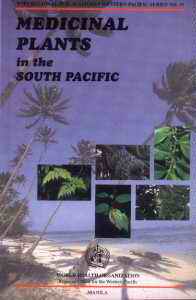
 Medicinal Plants in the South Pacific - Information on 102 commonly used medicinal plants in the South Pacific (WHO Regional Publications-Western Pacific Series No 19) , Paperback, 5.5" x 8.5".
World Health Organization Regional Office for the Western Pacific, Manila, Publication Date 1998, i-xvii and 254, ISBN 92-9061-119-7: Price: Sw.fr. 33.- Price for Developing Countries : Sw.fr. 23.10
 WHO's Catalogue of Publications
 |
This book is one of the series of books on medicinal plants published by the World Health Organisation regional office for the Western Pacific. Other volumes in the series include medicinal plants of Vietnam, Korea and China.
The WHO regional office in Manila is one of six regional offices throughout the world, each with its own programme geared to the particular health problems of the countries or areas it serves. This publication covers Pacific Islands as well as Papua New Guinea.
Living in a region with abundant natural resources, people of the South Pacific have traditionally used the plants growing around them as medicine. Herbal medicine continues to play a role in this region in spite of the availability of modern medicine partly as a result of strong cultural beliefs and partly as a result of easy availability.
The knowledge of medicinal plants and their uses traditionally has been passed down orally from one generation to the other. However, the isolation of the Pacific Islands has restricted inter-island transfer of information, even between neighbouring islands. People of other parts of the world are even less familiar with medicinal plants of the South Pacific.
 |
The aim of this book, as with the other books in the series, is to record information on medicinal plants and to disseminate it.
The book describes 102 medicinal plants from the South Pacific. This apparently is only a small selection of the vast number of medicinal plants in this region. For example, Fiji alone is known to have 2500 species of vascular plants. Fiji is somewhat unique in respect of the use of medicinal plants because of the Indian influence. Indians comprise 45% of the population of Fiji and have introduced the rich herbal system of the Indian sub-continent.
The use of herbal remedies was officially discouraged during the colonial period. This policy is apparently changing now with doctors and scientists and traditional healers working together. Tahiti has a traditional healer group and recently regional workshops of women healers have been organised by a group calling themselves WAINIMATE.
 Some familiar plants described in this book Some familiar plants described in this book
As the subtitle of this book mentions, this book gives information on 102 commonly used medicinal plants in the South Pacific. Many of these have been discussed here in this review by Dr. Gyan Fernando. Some other medicinal plants of note mentioned in the book are:
|
The most important cultural and medicinal plant to emerge from the Pacific Region has been Kava (Piper methysticum), which has been developed into an antianxiety drug.
This book follows a similar format as the other books in this series. Each plant is allocated one page of text and one page of illustrations. The book is illustrated with colour photographs. The plants are listed in alphabetical order based on their Latin binomials or botanical names. The local names and the common English names are listed. There then follows a botanical description of the plant, its habitat, distribution, constituents, biological activity and traditional uses. This formula is repeated for each plant. References for each plant are provided at the end of the book.
The book opens with a short introductory section, a map of the region covered and a section listing the geographical distribution of each plant. There then follows the main section.
For the reviewer it was a delight to review this book. This was mostly because of his familiarity with 31 of the plants included. Indeed some of the plants are so well known that most in the western world would have at least heard of them. Other plants are not so familiar and a number of plants are limited to this region. Another interesting feature about the plants is that a large number are edible in one form or the other and indeed form part of the standard diet of this region. For example, taro, coconut, manihot, sugar cane, breadfruit and banana are all included in this book.
The following is a selection of plants chosen partly on the basis of the reviewer's familiarity with the species. Altogether there are 102 plants in this volume.
Adenanthera pavonina is the red bead tree the bright red seeds of which have been a delight to generations of children in the Indian sub continent. The bark is used in the Solomon Islands to treat leprosy.
 |
 |
Aloe vera is well known in the west. The plant is used as a purgative and the sap is used to treat sunburns, rashes and x-ray burns. (It is not clear from the book how one sustains x-ray burns in the Pacific!) In Tahiti, Cook Islands, Tonga and Samoa; the plant is used in treating cuts, burns and stomachache.
Anona muricata is the soursop. The fruit (technically a syncarp) of this plant is fleshy, green and spiky. The flesh is slightly sour, sweet and juicy. In Tonga an infusion of the leaves is used to treat stomach ailments.
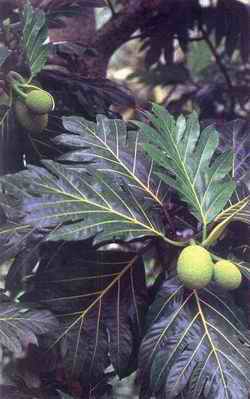
Artocarpus altilis is the familiar breadfruit associated with Admiral Bligh and the Mutiny on the Bounty. The sap of the leaves, bark, roots and other parts are used in treating a variety of differing ailments. For example Tahitians use the sap for sprains contusions and dislocations whilst Samoans and Tongans use the bark to treat stomachaches and digestive tract problems.
Azadirachta indica is margosa, which has well known antiseptic properties and is commonly used in the Indian sub-continent for this purpose.
Carica papaya is the familiar papaya or paw-paw, which is a source of papain.
Cocos nucifera is the coconut. (see box)
Ipomea indica is the well-known morning glory. The plant is used as a laxative in Tonga and Fiji.
Mikania micrantha is a rapidly growing common weed (English name: mile-a-minute) considered a nuisance by gardeners. Apparently it is used as a haemostatic and to treat gastritis, insect bite and skin irritations.
Momordica charantia is the biiter gourd or Karela (Indo-Fijian) the fruit of which is a well-known vegetable in the Indian sub-continent. The extracts of the fruit have well-established antihyperglycemic properties.
THE COCONUT
The coconut is romantically associated with the South Pacific. Swaying coconut palms and sunsets are part of that magical image. The coconut is obviously more than that to the natives. Almost every part of the coconut tree is used for some purpose or the other. The medicinal uses mentioned in the book include:
|
Psidium guajava is the gauva a common fruit found throughout tropical Asia. The leaves are used in Fiji for treating diarrhoea, stomachache and coughs. In the Cook Islands new mothers are bathed in a warm infusion of the leaves.
Sansevieria trifasciata is the mother-in-law's tongue a well-known ornamental plant with fleshy leaves. In Fiji the plant is used to treat ringworm and fungal diseases.
Thespesia populnea is known as Miro in Tahiti.( Pitcairn Islanders make ornaments out of its wood) It is a familiar tree in tropical Asia. In Tonga a drink made of the leaves and bark is given to children who are teething.
The book is of the same format as the other books in this series and measures 14 x 21.5 CMS. Each plant is illustrated with the help of a single, full-page colour photograph, which successfully manages to record the essential features of the plant. The photographs are of a very good quality. The photographs originate from various sources but the ones of the Fijian plants are credited to Dr Michael Doyle. Dr Doyle is the Director of the South Pacific Herbarium of the University of the South Pacific, Suva Fiji who was also responsible for the final editing of the book whilst the data collection and compilation was co-ordinated by Professor Subramaniam Sotheeswaran of the University of the South Pacific.
An index of local names completes the book.
The printing and colour reproduction is of very good quality and as far as print quality goes this is the best book in the series.
The book is recommended to ethno botanists, phytochemists, pharmacologists and other scientists interested in traditional medicine. Environmentally aware tourists to the pacific islands might find this book interesting.
 |
-Gyan Fernando Dr Gyan C. A. Fernando is a native of Sri Lanka and is familiar with plants used in Ayurvedic remedies. He now works as a Forensic Pathologist in Devon, England. |
Order this book by clicking here
or via telephone: (41 22) 791 24 76, or Facsimile (fax): (41 22) 791 48 57
or via the website http://bookorders.who.int
or via mail at this address: WHO, Marketing and Dissemination, 1211 Geneva 27, Switzerland

 Request a PDF file of this review by clicking here. (If your screen resolution can not be increased, or if printing this page is giving you problems like overlapping of graphics and/or tables etc, you can take a proper printout from a pdf file. You will need an Acrobat Reader though.)
N.B. WHO publications can be purchased in Rupees, at a very low price, through WHO's Regional Office in New Delhi at the following address:
World Health Organization
Regional Office for South-East Asia
World Health House
Indraprastha Estate
Mahatma Gandhi Road
NEW DELHI 110002
Contact : Mr Dixit, RDOC/Sales
email : dixitr@whosea.org
N.B. It is essential to read this journal - and especially this review as it contains several tables and high resolution graphics - under a screen resolution of 1600 x 1200 dpi or more. If the resolution is less than this, you may see broken or overlapping tables/graphics, graphics overlying text or other anomalies. It is strongly advised to switch over to this resolution to read this journal - and especially this review. These pages are viewed best in Netscape Navigator 4.7 and above.
-Anil Aggrawal
Reviews by Gyan Fernando of these books [ China ]
[ Vietnam and Korea ]
Reviews by V.V.Pillay of India[ China, Vietnam, Korea and South Pacific Medicinal Plants ]
[ Major links ]
[ Aims and Objectives ] [ FAQ ] [ Editorial Board ] [ Contributing Partners ] [ Sitemap ]
[ Paper/Thesis submission guidelines ] [ Editorials - Cumulative Index ] [ Be our sponsor! ]
[ Cumulative index of Book Reviews sorted by | Publishers | General Interest Books | Technical Books ] [ Animated Reviews ] [ Featured Reviews ]
[ Reviews with Quizzes ] [ Links ] [ Submit books/journals/software/multimedia for review ] [ journal CD ] [ History of the Journal ] [ Interviews ] [ Credits ]
[ Cumulative index of | Theses/dissertations | Online Courses | Awards ] [ Anil Aggrawal's Internet Journal of Book Reviews - Sister Publication ]
[ Cumulative reviews of Software/Multimedia | Books on CD/Audio tapes | Calenders | Models ] [ contact us ]
Books for review must be submitted at the following address.
Professor Anil Aggrawal (Editor-in-Chief)
Anil Aggrawal's Internet Journal of Forensic Medicine and Toxicology
S-299 Greater Kailash-1
New Delhi-110048
India
Click here to contact us.
This page has been constructed and maintained by Dr. Anil Aggrawal, Professor of Forensic Medicine, at the Maulana Azad Medical College, New Delhi-110002. You may want to give me the feedback to make this pages better. Please be kind enough to write your comments in the guestbook maintained above. These comments would help me make these pages better.
 IMPORTANT NOTE: ALL PAPERS APPEARING IN THIS ONLINE JOURNAL ARE COPYRIGHTED BY "ANIL AGGRAWAL'S INTERNET JOURNAL OF FORENSIC MEDICINE AND TOXICOLOGY" AND MAY NOT BE REPOSTED, REPRINTED OR OTHERWISE USED IN ANY MANNER WITHOUT THE WRITTEN PERMISSION OF THE WEBMASTER
Questions or suggestions ? Please use ICQ 19727771 or email to dr_anil@hotmail.com

|


