|
|
|
|
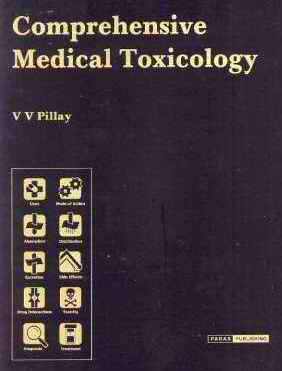
 Comprehensive Medical Toxicology, 1stEdition, by V V Pillay. Hardback, 11" x 8.5".
Paras Medical Publisher, 5-1-473, Jambagh Road, P.O.Box No. 544, Hyderabad - 500 095, India. Publication Date January 2003. 650 pages, ISBN 81-88129-86-0. Price Indian Rupees 750, US $40
 |
|
This is a new book from V.V.Pillay the author of "Modern Medical Toxicology" and the Professor of Forensic Medicine & Toxicology of the Amrita Institute of Medical Sciences & Research, Cochin, Kerala, India. It is a single author book and according to the preface the work began in 1997. During those six years the complexity of the task seems to have taken the author aback! So what is the result of six years of hard work?
As the title implies this is not a handbook or medical students' guide but a comprehensive large format book which covers all aspects of medical toxicology. It is a reference manual and as the title suggests, is meant to be a comprehensive work. How comprehensive is the book?
The book follows the traditional style of books on toxicology and is divided into five sections.
Section I is on General Toxicology. There then follows, in traditional fashion sections on Chemical Toxicology and Pharmaceutical Toxicology (Sections II and III). The last two sections are on Biotoxicology and Sociomedical Toxicology.
Under General Toxicology there is a standard introduction to Toxicology complete with a historical overview (chapter 1) going as far back as the time of Dioscorides (AD 40-80). The historical aspects unfortunately end in 1848 and there is no mention of latter day poisoners or poisoning by medical men such as Palmer! (Do not despair though! Elsewhere in the text there are numerous anecdotes, amusing quotations and case reports including the 1978 Glibenclamide homicide from Sri Lanka. There is also an account of the Georgi Markov case and ricin.)
 |
Chapter 2 is a discourse on diagnosis and management which is now the province of clinical toxicologists and I must confess, that as a pathologist, my limited experience of clinical toxicology dates back several years to the days of my Internship! This section would be useful for practitioners of clinical forensic medicine and accident and emergency physicians. All aspects of diagnosis and treatment are discussed in some detail.
I found myself on more familiar territory in Medicolegal Considerations (chapter 3) which amongst other topics discusses post-mortem examinations in cases of poisoning including the collection and preservation of specimens. Although at first sight this section seems rather basic, autopsy findings are discussed further under individual poisons. The section on collection of specimens is complete and the author stresses the need to use a nylon bag to preserve the lung (e.g. in cases of solvent abuse.) I was rather amused to read about the use of sealing wax to seal the bags and containers. This took me back to my early days as a forensic pathologist in Sri Lanka. These days I enjoy the luxury of using tamper-proof plastic bags!
|
A chapter on Analytical Toxicology (chapter 4) follows and covers the general principles of toxicological analysis touching upon ultraviolet spectrophotometry, gas chromatography, high performance liquid chromatography, mass spectrometry, radio-immuno assay, enzyme mediated immuno assay technique, atomic absorption spectrophotometry and neutron activation analysis. This is a well written and informative chapter giving the basics of the procedures involved in analysis.
With Section II we are into poisons themselves and the layout again starts off in the traditional manner with Caustics followed by Inorganic Elements, the so-called Heavy Metals, Alcohols, Hydrocarbons and Pesticides and Toxic Gases. A caustic of course includes acids.
The chapter on Alcohols discusses clinical examination for drunkenness in some considerable detail. This is probably important where laboratory facilities are limited or unreliable but in my personal view there is very little place for such detailed clinical examination where a "Breathalyser" is available or where laboratory services exist.
The chapter on alcohol also discusses Methanol and Glycols.
In the chapter on Hydrocarbons and Pesticides (chapter 9) Organophosphorus poisoning is discussed in some detail, no doubt reflecting the widespread use and misuse of these agents on the Indian sub-continent.
Section III covers pharmaceutical agents under seven chapters: Analgesics and Antihistamines, Anti-Infectives, Neuropsychotoxicology, Narcotic Analgesics-Anaesthetics-Muscle Relaxants, Cardiovascular Toxicology, Gastrointestinal and Endocrinal Drugs and Miscellaneous Drugs.
 ...I found the chapter on heavy metals one of the more enjoyable chapters maybe because of my forensic upbringing in Sri Lanka. I did initially raise an eyebrow on reading the following autopsy feature of arsenic poisoning: "Subendocardial haemorrhages are often seen in the heart" but was reassured by the accompanying footnote! (There are a number of more common conditions, which cause subendocardial haemorrhages). .... ...I found the chapter on heavy metals one of the more enjoyable chapters maybe because of my forensic upbringing in Sri Lanka. I did initially raise an eyebrow on reading the following autopsy feature of arsenic poisoning: "Subendocardial haemorrhages are often seen in the heart" but was reassured by the accompanying footnote! (There are a number of more common conditions, which cause subendocardial haemorrhages). .... |
Biotoxicology (Section IV) discusses Poisonous Plants, Food Poisoning and Venomous Bites and Stings. This section is certainly appropriate for the Indian sub-continent and developing countries.
The Final section (Section V) entitled Sociomedical Toxicology covers substance abuse.
Old Fashioned Poisons?
With the number of man made poisons such as pharmaceutical agents increasing day by day is there a place for traditional poisons such as arsenic? For all intents and purposes arsenic poisoning has disappeared from the Western world. But what about the cases of Guillain-Barré and other neuropathies? Are they ever investigated toxicologically? A sobering thought!
It is the reviewer's opinion that there is still a place for studying, understanding and being aware of agents such as arsenic, mercury and antimony. In any case mercury poisoning really never went away but now takes the form of ingestion of button batteries.
I found the chapter on heavy metals one of the more enjoyable chapters maybe because of my forensic upbringing in Sri Lanka. I did initially raise an eyebrow on reading the following autopsy feature of arsenic poisoning: "Subendocardial haemorrhages are often seen in the heart" but was reassured by the accompanying footnote! (There are a number of more common conditions, which cause subendocardial haemorrhages).
|
There is no doubt that the author loves historical landmark cases and these spice up the text frequently although some are anecdotal (e.g. The poisoning of Napoleon Bonaparte).
Medical Poisons
Pharmaceutical Toxicology deals with traditional agents such as salicylates but does also cover relatively new agents such as H2 receptor antagonists. These chapters carry extensive tables of Indian trade names for the various agents. As is to be expected this is the biggest section of the book. The list of agents is impressive and up to date. It even includes Sildenafil (better known as ViagraT)
Plants and Snakes
The section that fascinated me for personal reasons was the section on Biotoxicology. The familiar plant poisons and venomous snakes were all there!
Pillay classifies the plants under several logical headings: Irritant Plants (e.g. Caladium), Cardiotoxic Plants (e.g. Oleander), Neurotoxic Plants (e.g. Strychnos), Hepatotoxic Plants (e.g. Margosa), Dermal Irritant Plants (e.g. Cashew) and Miscellaneous Toxic Plants/Plant Products (e.g. Areca nut, clove oil).
The section on venomous snakes and snakebite is well written and includes identification of snakes. This of course is essential before treatment commences.
The chapter on Food Poisoning (chapter 19) is comprehensive but one wonders about the usefulness of this chapter, as it is far more comprehensively covered in microbiology texts and in any case is now in the realm of the Microbiologists.
|
The section on Sociomedical Toxicology is on substance abuse and dependence. In addition to comprehensive accounts of the standard drugs such as Cocaine and LSD it covers such topics as Body Packing, Body Stuffing and Designer Drugs as well as Glue Sniffing but I could not find any reference to RohypnolT.
RohypnolT or Flunitrazepam is referred to as the "Date Rape Drug" in the Western world and is administered to the unsuspecting victim dissolved in a drink causing the victim to lose consciousness. A few fatalities have been reported but I presume that its use, or rather its misuse, is yet to reach India!
The Book
Each chapter is backed up by comprehensive references in some cases exceeding two hundred. There are of course numerous and informative footnotes and text boxes of relevant case histories. The book is undoubtedly well researched and the reviewer was pleased to find one of his own obscure papers quoted in the references!
The appendices consist of seven pages and consist of scoring systems such as the Glasgow Coma Scale, Poisoning Severity Score, Beck's Depression Scale and a list of Forensic Science Laboratories in India.
There is a traditional index as well as a "Brand" Index (an index of trade names).
A large number of tables make the book easy to refer to and as has been said before the layout is logical.
 Quick Notes Quick Notes& The book is undoubtedly well researched... & For a new book on Toxicology, Pillay's book is quite impressive and should find its own niche. & With the number of man made poisons such as pharmaceutical agents increasing day by day is there a place for traditional poisons such as arsenic? For all intents and purposes arsenic poisoning has disappeared from the Western world. But what about the cases of Guillain-Barré and other neuropathies? Are they ever investigated toxicologically? A sobering thought! |
The book is well illustrated and the illustrations range from line drawings through hand drawn colour plates to colour photographic plates. The colour photographs are mostly those of poisonous plants. The quality of the illustrations is variable the best being the colour photographs. Some of the line drawings would benefit from being redrawn or re screened in a future edition of this book. Some of the colour photographs, especially those of plant seeds, would benefit from the inclusion of a scale. As the plates are printed on ordinary (i.e. uncoated) paper the colour plates are not brilliantly reproduced but nevertheless, illustrative.
The print quality and paper is adequate for a book from this part of the world. Any improvements in print and paper quality would no doubt cause the price to rocket beyond the range of most pockets. Incidentally the book is priced at Rupees (Indian) 700 and $40 which should be quite affordable. The book is certainly worth the price. The binding is of good quality and quite robust.
It is difficult to review a book of this nature and not draw comparisons with other works on the same subject. A book that immediately springs to mind is Ellenhorn's magnum opus (Medical Toxicology, Matthew J. Ellenhorn, Williams & Wilkins, 2nd Ed. 1997. 2043pp) In a way it is unfair to compare Pillay's single-handed effort with an established multi-author work from America. In any case Pillay's book is aimed at the Indian subcontinent where price is a major consideration. Ellenhorn retails at $150.
For a new book on Toxicology, Pillay's book is quite impressive and should find its own niche. It is to be hoped that the author will continue to update and improve this useful book. He might consider drawing in other Indian toxicologists and experts to make it a truly comprehensive and encyclopaedic multi-author treatise on Toxicology.
 |
-Gyan Fernando Gyan Fernando carried out his first autopsy in his native Sri Lanka. In 1978 he moved to Britain and has worked as a forensic pathologist across the whole length of Britain from London through Manchester to Scotland. He has successfully investigated many cases of homicidal poisonings. He now lives in rural Devon. Readers wishing to contact Dr. Fernando may want to click here. |
 Review 3 by Wayne Jones, Sweden
Review 4 by John Trestrail, USA
 Order this book by clicking here.
 Request a PDF file of this review by clicking here. (If your screen resolution can not be increased, or if printing this page is giving you problems like overlapping of graphics and/or tables etc, you can take a proper printout from a pdf file. You will need an Acrobat Reader though.)
N.B. It is essential to read this journal - and especially this review as it contains several tables and high resolution graphics - under a screen resolution of 1600 x 1200 dpi or more. If the resolution is less than this, you may see broken or overlapping tables/graphics, graphics overlying text or other anomalies. It is strongly advised to switch over to this resolution to read this journal - and especially this review. These pages are viewed best in Netscape Navigator 4.7 and above.
-Anil Aggrawal

 [ Major links ]
[ Aims and Objectives ] [ FAQ ] [ Editorial Board ] [ Contributing Partners ] [ Sitemap ]
[ Paper/Thesis submission guidelines ] [ Editorials - Cumulative Index ] [ Be our sponsor! ]
[ Cumulative index of Book Reviews sorted by | Publishers | General Interest Books | Technical Books ] [ Animated Reviews ] [ Featured Reviews ]
[ Links ] [ Submit books/journals/software/multimedia for review ] [ journal CD ] [ History of the Journal ] [ Interviews ] [ Credits ]
[ Online Courses ] [ Awards ] [ Anil Aggrawal's Internet Journal of Book Reviews - Sister Publication ]
[ Cumulative reviews of Software/Multimedia | Books on CD/Audio tapes ] [ contact us ]
Books for review must be submitted at the following address.
Professor Anil Aggrawal (Editor-in-Chief)
Anil Aggrawal's Internet Journal of Forensic Medicine and Toxicology
S-299 Greater Kailash-1
New Delhi-110048
India
Click here to contact us.
This page has been constructed and maintained by Dr. Anil Aggrawal, Professor of Forensic Medicine, at the Maulana Azad Medical College, New Delhi-110002. You may want to give me the feedback to make this pages better. Please be kind enough to write your comments in the guestbook maintained above. These comments would help me make these pages better.
 IMPORTANT NOTE: ALL PAPERS APPEARING IN THIS ONLINE JOURNAL ARE COPYRIGHTED BY "ANIL AGGRAWAL'S INTERNET JOURNAL OF FORENSIC MEDICINE AND TOXICOLOGY" AND MAY NOT BE REPOSTED, REPRINTED OR OTHERWISE USED IN ANY MANNER WITHOUT THE WRITTEN PERMISSION OF THE WEBMASTER
Questions or suggestions ? Please use ICQ 19727771 or email to dr_anil@hotmail.com
Page Professor Anil Aggrawal via ICQ

|