


|
|
|
|
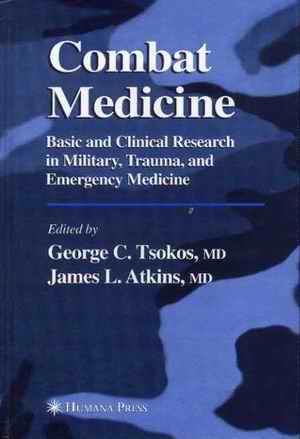
 Combat medicine - Basic and Clinical Research in Military, Trauma, and Emergency Medicine, 1stEdition, Edited by George C. Tsokos and James L. Atkins. Hardcover 6" x 9".
Humana Press Inc., 999 Riverview Drive, Suite 208, Totowa, New Jersey 07512; Publication Date July, 2003. xii + 426 pages, ISBN 1-58829-070-0 (acid-free Paper). E-ISBN 1-59259-407-7. Price $125.00
 Official Site:Click here to visit
 Free contents: Click here to visit.
 |
The ever-changing theatre of war has constantly required the development of modern methods in combat medicine. Any possible scenario requires careful planning for, together with the use of set protocol for appropriate treatment regimes. For example, combat could result in blunt force trauma, incised wounds, projectile injuries (both primary and secondary), blast-related injuries, hypovolaemic insults, chemical insults, burns or exposure to nuclear or biological agents. Even the setting for the combat may produce increased risks for those fighting within the region; persons fighting within the Persian Gulf theatre have an increased risk of heat-stress related illnesses.
 |
The golden hour in which to stabilise an injured soldier remains fundamental to treatment. Improved means of evacuation to nearby hospital bases, or hospital ships, has ensured that many wounded receive surgical treatment and resuscitation within six hours of injury infliction, as was documented during the 1980's Falkland Island conflict, though the difficult terrain and weather often hampered this. Despite the increased trend towards "remote control warfare" from a distant battle centre, the need for a ground force to secure areas continues. This, as amply demonstrated by recent conflicts, can result in the continued occurrence of casualties despite the apparent end of hostilities. The incidents of 1993 depicted in "Black Hawk Down", during which attack helicopters were attacked in Somali, has also resulted in changes to the treatment protocols of injured soldiers. Training scenarios now incorporate the effects of hostile gunfire and continued attacks whilst trying to assist and treat injured parties. Individuals are instructed to retaliate with gunfire to allow treatment to continue and ensure the ultimate evacuation. However, rotary wing evacuation itself poses potential risks; the altitude at which helicopter safely travel may worsen a pneumothorax, a common complication of thoracic injuries in both civilian and combatant injured alike.
|
The rapid use of surgical debridement, together with the development and application of prophylactic broad-spectrum antibiotics has resulted in fewer deaths from wounds over the decades. Whereas Clostridium spp. posed a great risk during the First World War, causing the death of up to 17% of those killed during the war and resulting in 90% of gas gangrene cases, cases in warfare have decreased subsequently, though knowledge of the environment in which the battles occurs may reveal increased risks; during the summer months, human excrement was often applied to the agricultural fields of Korea as a fertiliser. Thus the risk of Clostridium wound infections during combat within such areas was abnormally increased.
"Combat Medicine", a textbook of articles edited by Tsokos and Atkins, aims to bring together all aspects of the pathophysiology of warfare together with information regarding accepted treatment protocols. It details the history of infectious agents causing wound infections through the conflicts of the last three millennia, together with information regarding novel research and future treatments or diagnostic instruments. The potential for an extensive and authoritarian text upon the subject is great, with many workers within the medical profession prospective purchasers of such reading matter. Unfortunately, the emphasis with which it places its main focus appears obscure, resulting in a disappointing collection of papers.
The book, though admittedly subtitled as "Basic and Clinical Research in Military, Trauma and Emergency Medicine", focuses too much upon molecular and subcellular processes that are better covered in separate dedicated pathological texts. Notable aspects include the chapters devoted to the emerging understanding of apoptosis and nitric oxide, which, though related to trauma medicine peripherally, add little to the actual recognition and treatment of injuries or diseases in a clinical setting. With much to discuss, the inclusion of such material appears somewhat distracting.
The opportunity for describing novel techniques or diagnostic instruments is also lost within the text. Though some aspects are described well, such as the development of a portable microwave detector to assist in the diagnosis of perforated viscera or pneumothorax thus limiting the risks associated with helicopter evacuation, there remains little discussion of future technology. One interesting research aspect that is well described, however, is the potential for induced hypothermic suspended animation. Tested on porcine models through aortic injury based exsanguinations, the animals were rapidly cooled to temperatures below 10ºC and the injury repaired under cardiopulmonary bypass with hyperkalaemic infusion solutions. The resultant recovery rate is interesting, together with the absence of any appreciable neurological disturbances; its potential application, not only to the field of combat medicine, is therefore vast.
Some aspects prove illuminating reading, such as the close association of the U.S. army with the development of red blood cell storage, created in an attempt to minimise waste and maximise transportation to mobile army surgical hospitals, and the modern recommendations for the treatment of acute respiratory distress syndrome with the patient in a prone position. The drawing together of some research also enlightens the reader, including the realisation that it is not purely the concentration of carboxyhaemoglobin in smoke inhalation deaths that results in fatality; animals exsanguinated and perfused with carboxyhaemoglobin poisoned blood produced no adverse effects at concentrations of 64%.
|
However, the text is disjointed and very sparsely illustrated, with only a few poorly reproduced black and white images (many of which the reader will find difficult identifying the abnormality upon) and only a small number of line diagrams to assist in understanding the information provided. Interestingly, the editors have decided to only include bioterrorism in the final 27 pages of the text. Though the history of bioterrorism is detailed, including the use of arrowheads coated in faeces or the projection of venomous snakes or plague-infected cadavers into military strongholds, the modern aspects and future possibilities of biological agents are only glossed over in low detail. Few clinical images are provided and no histological photographs are used, which could aid in the diagnosis of diseases by clinicians unsuspecting of such outbreaks.
Incredibly, given the modern political climate, no reference is made to the potential risks of radiological agents, including the so-called "dirty bomb" scenario. There is also no indication of decontamination issues in exposure to nuclear, biological or chemical warfare of patients and health care professionals, despite the knowledge that many politically separate regimes possess such weapons. Though possibly not appropriate for this text, the application of all this knowledge within a protocol for the development of mass disaster planning for such scenario would have been a welcome addition for physicians involved in such events.
Overall the text fails to live up to its potential, with too little applicable information reproduced for use by those that may be exposed to the effects of terrorist warfare, which increasingly is being focused more upon a civilian population, and too much contents devoted instead to molecular matters dealt with better elsewhere.
 |
-Benjamin Swift Dr. Benjamin Swift is on the editorial board of Anil Aggrawal's Internet Journal of Forensic Medicine and Toxicology. Click image to have more information about him. |
 Review 1 by Jason Payne-James, UK
Review 2 by Benjamin Swift, UK
Review 3 by Dr. Puneet Setia of India and Dr. Avneesh Gupta of USA
-Anil Aggrawal
[ Aims and Objectives ] [ FAQ ] [ Editorial Board ] [ Contributing Partners ] [ Sitemap ]
[ Paper/Thesis submission guidelines ] [ Editorials - Cumulative Index ] [ Be our sponsor! ]
[ Cumulative index of Book Reviews sorted by | Publishers |
General Interest Books |
Technical Books ] [ Animated Reviews ] [ Featured Reviews ]
[ Links ] [ Submit books/journals/software/multimedia for review ] [ journal CD ] [ History of the Journal ] [ Interviews ] [ Credits ]
[ Online Courses ] [ Awards ] [ Anil Aggrawal's Internet Journal of Book Reviews - Sister Publication ]
[ Cumulative reviews of Software/Multimedia | Books on CD/Audio tapes ] [ contact us ]
Questions or
suggestions ? Please use ICQ 19727771
or email to
dr_anil@hotmail.com
Order Humana Press Books by clicking here.
Request a PDF file of this review by clicking here. (If your screen resolution can not be increased, or if printing this page is giving you problems like overlapping of graphics and/or tables etc, you can take a proper printout from a pdf file. You will need an Acrobat Reader though.)
N.B. It is essential to read this journal - and especially this review as it contains several tables and high resolution graphics - under a screen resolution of 1600 x 1200 dpi or more. If the resolution is less than this, you may see broken or overlapping tables/graphics, graphics overlying text or other anomalies. It is strongly advised to switch over to this resolution to read this journal - and especially this review. These pages are viewed best in Netscape Navigator 4.7 and above.


 [ Major links ]
Books for review must be submitted at the following address.
Professor Anil Aggrawal (Editor-in-Chief)
[ Major links ]
Books for review must be submitted at the following address.
Professor Anil Aggrawal (Editor-in-Chief)
Anil Aggrawal's Internet Journal of Forensic Medicine and Toxicology
S-299 Greater Kailash-1
New Delhi-110048
India
Click here to contact us.
 This page has been constructed and maintained by Dr. Anil Aggrawal, Professor of Forensic Medicine, at the Maulana Azad Medical College, New Delhi-110002. You may want to give me the feedback to make this pages better. Please be kind enough to write your comments in the guestbook maintained above. These comments would help me make these pages better.
 IMPORTANT NOTE: ALL PAPERS APPEARING IN THIS ONLINE JOURNAL ARE COPYRIGHTED BY "ANIL AGGRAWAL'S INTERNET JOURNAL OF FORENSIC MEDICINE AND TOXICOLOGY" AND MAY NOT BE REPOSTED, REPRINTED OR OTHERWISE USED IN ANY MANNER WITHOUT THE WRITTEN PERMISSION OF THE WEBMASTER

home
> Volume 5, Number 2, July - December 2004
> Reviews
> Technical Books
> Page 12: Combat medicine - Basic and Clinical Research in Military, Trauma, and Emergency Medicine
> page 12b: Combat medicine (Review by Benjamin Swift of UK) (you are here)
Navigation ribbon


