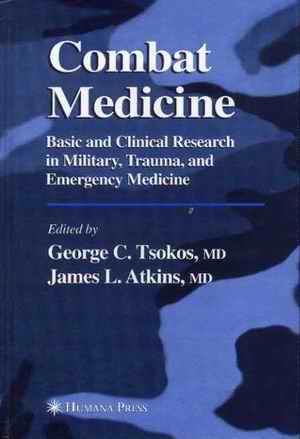
Combat medicine - Basic and Clinical Research in Military, Trauma, and Emergency Medicine, 1stEdition, Edited by George C. Tsokos and James L. Atkins. Hardcover 6" x 9".
Humana Press Inc., 999 Riverview Drive, Suite 208, Totowa, New Jersey 07512; Publication Date July, 2003. xii + 426 pages, ISBN 1-58829-070-0 (acid-free Paper). E-ISBN 1-59259-407-7. Price $125.00
In modern times, combat medicine is a very important topic. With the number of conflicts increasing with each passing day, the number of injuries and casualties are increasing exponentially. That means more research should be undertaken in this subject so that we are able to minimize the number of deaths. Majority of these conflicts occur in the developing world. With limited resources, and even those spent more on fighting the diseases of poverty like infectious disease, it is simply not possible to undertake research in this field on a priority basis in these countries. So effort has to come from the developed world to find the means of improving the management of those injured in battlefields and passing on the results to the areas where it is needed most. The present book appears to be an effort in the same direction.
The authors have mentioned that the book is "not intended to be an exhaustive review; rather it is an introduction to key principles of this field". But we felt, after going through the book, that it is not just an introduction to the key principles. The concepts that have been touched upon in the book have been dealt with pretty effectively and in quite detail. The authors have given in-depth analysis of all the relevant subjects that have been described in the book.
This book has been divided into two parts: Part I, describing basic mechanisms and Part II, describing current concepts. The first part deals with the various pathological and histochemical mechanisms that are involved in the body's response to injury and repair. Also described are the various mediators that are used like nitrous oxide, adhesion molecules, complement system etc. The second part describes the clinical features and the management of various entities like shock, infection, inhalation injury etc. How the knowledge gained about the various mediators (in the first part) is helpful in improving the management of these disease processes has also been dealt with in the second part.
"...The book has been written in a simple, easy to understand language. This can be judged from the fact that such a difficult topic could be understood by us with consummate ease. That we think is the biggest achievement of the authors in the present text.
..."
Having seen how the book has been arranged, lets see how it has been written. The first thing that comes to notice on going through the book is the way this difficult topic has been dealt with. The use of various tables, diagrams, flow-charts etc. has made understanding this topic very easy. Absence of coloured diagrams is considered a handicap for many books. But in the present one, not even once did we feel that there were no colored diagrams. The good quality of the diagrams means that the reader is able to understand the written text quite comfortably. Another important thing is that all the diagrams, flow-charts etc. have been complementary to the text. They have all been placed at the right place. Their presence tell that the authors are aware of their relevance and also know which tables and other appendages have to be included and at what place.
The book has been written in a simple, easy to understand language. This can be judged from the fact that such a difficult topic could be understood by us with consummate ease. That we think is the biggest achievement of the authors in the present text. By making proper use of the technical terms, they have written the book in such a way that it never occurs to the reader that he is going through a highly specialized topic. That makes reading the book not just informative, but also enjoyable.
Combat medicine is one topic that we have always felt has never received its due importance. It has always been given step motherly treatment by scientists all over the world. With this book, we feel, that this trend may be reversed and people will start taking this subject more seriously and will start working on it. And we feel that this book has the necessary ingredients to make people work in this direction.
-Puneet Setia and Avneesh Gupta
Dr. Puneet Setia is working as a resident doctor in the department of Forensic Medicine and Toxicology at Maulana Azad Medical College (MAMC), New Delhi. His research interests include Forensic Radiology, especially the use of radiology in demonstrating coronary narrowing at the post-mortem examination. He is associated with Anil Aggrawal's Internet Journal of Forensic Medicine and Toxicology as a writer and book reviewer. He can be contacted at puneetsetia@rediffmail.com
Dr. Avneesh Gupta qualified as a forensic pathologist from India with honors and is now working as a fellow of forensic pathology in Wayne County, Detroit. He has to his credit a number of publications in leading journals around the world. His landmark thesis on "Cranial Cerebral Damage In Fatal Road Traffic Accidents With Special Reference to Circle Of Willis" can be accessed by clicking here. He is associated with Anil Aggrawal's Internet Journal of Forensic Medicine and Toxicology as a journal associate, writer and book reviewer. He can be contacted at avneeshgupta2000@yahoo.com. During his spare time, he enjoys meeting friends and traveling.
Request a PDF file of this review by clicking here. (If your screen resolution can not be increased, or if printing this page is giving you problems like overlapping of graphics and/or tables etc, you can take a proper printout from a pdf file. You will need an Acrobat Reader though.)
N.B. It is essential to read this journal - and especially this review as it contains several tables and high resolution graphics - under a screen resolution of 1600 x 1200 dpi or more. If the resolution is less than this, you may see broken or overlapping tables/graphics, graphics overlying text or other anomalies. It is strongly advised to switch over to this resolution to read this journal - and especially this review. These pages are viewed best in Netscape Navigator 4.7 and above.
Books for review must be submitted at the following address.
Professor Anil Aggrawal (Editor-in-Chief)
Anil Aggrawal's Internet Journal of Forensic Medicine and Toxicology
S-299 Greater Kailash-1
New Delhi-110048
India
This page has been constructed and maintained by Dr. Anil Aggrawal, Professor of Forensic Medicine, at the Maulana Azad Medical College, New Delhi-110002. You may want to give me the feedback to make this pages better. Please be kind enough to write your comments in the guestbook maintained above. These comments would help me make these pages better.
IMPORTANT NOTE: ALL PAPERS APPEARING IN THIS ONLINE JOURNAL ARE COPYRIGHTED BY "ANIL AGGRAWAL'S INTERNET JOURNAL OF FORENSIC MEDICINE AND TOXICOLOGY" AND MAY NOT BE REPOSTED, REPRINTED OR OTHERWISE USED IN ANY MANNER WITHOUT THE WRITTEN PERMISSION OF THE WEBMASTER



 Combat medicine - Basic and Clinical Research in Military, Trauma, and Emergency Medicine, 1stEdition, Edited by George C. Tsokos and James L. Atkins. Hardcover 6" x 9".
 Official Site:Click here to visit
 Free contents: Click here to visit.

 Review 1 by Jason Payne-James, UK


 [ Major links ]
 This page has been constructed and maintained by Dr. Anil Aggrawal, Professor of Forensic Medicine, at the Maulana Azad Medical College, New Delhi-110002. You may want to give me the feedback to make this pages better. Please be kind enough to write your comments in the guestbook maintained above. These comments would help me make these pages better.
 IMPORTANT NOTE: ALL PAPERS APPEARING IN THIS ONLINE JOURNAL ARE COPYRIGHTED BY "ANIL AGGRAWAL'S INTERNET JOURNAL OF FORENSIC MEDICINE AND TOXICOLOGY" AND MAY NOT BE REPOSTED, REPRINTED OR OTHERWISE USED IN ANY MANNER WITHOUT THE WRITTEN PERMISSION OF THE WEBMASTER


