

|

|
|
|
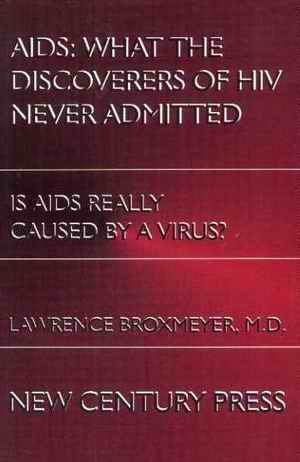
 AIDS: What the Discoverers of HIV Never Admitted - Is AIDS really caused by a virus, 3rd edition, by Lawrence Broxmeyer, MD, Softcover, 5.5" x 8".
New Century Press, 1055 Bay Boulevard, Suite C, Chula Vista, CA 91911, phone: (800) 519-2465, (619) 476-7400, www.newcenturypress.com. E-mail:MEDAMERICA1@cs.com: Publication Date 2003. vi + 81 pages, ISBN 1-890035-29-7. Price $11.95
 |
"Once upon a time, a small group of politically powerful scientists rammed a flawed theory on the origin and cause of AIDS down America's and then the world's throat.." Thus begins the back cover blurb of this amazing little book packed with red hot lowdown on the alleged games and schemes that go on behind the scenes of AIDS research. The information that is presented has a no-holds barred, in-your-face kind of approach that really rocks you back a little. At the end, you are left wondering, is all this really true? If so, how was it kept so successfully under wraps from public and scientific gaze for the last 10 years or more?
AIDS, the undisputed global scourge No.1 of the last century that has spilled into the new millennium, began to make its presence known in a treacherously insidious manner in the early 1980s, when doctors in the USA were confronted with a puzzling new disease that was infecting a large number of male homosexuals. It was characterized by a crippling of the immune system that exposed the victims to rarely encountered lethal afflictions such as Kaposi's sarcoma and Pneumocystis carinii pneumonia. With nothing working against this rampage, doctors watched helplessly as wave after wave of anguished victims succumbed relentlessly to the unknown marauder. Soon it was realized that not only homosexuals, but also other people were at increased risk of acquiring the deadly disease: needle sharing drug addicts, hemophiliacs who required periodic transfusions of blood products, prostitutes, and heterosexually promiscuous individuals. The disease was provided with a number of names by investigators in quick succession until the acronym AIDS (Acquired Immune Deficiency Syndrome) finally met with universal approval. As in the case of many other diseases whose exact etiology is unclear, the causative agent of AIDS too was presumed to be a virus. This led to frenetic research in virological laboratories around the world, and a series of sightings of this mysterious virus came forth from various investigators culminating in the "successful" identification of the actual virus by Luc Montagnier: the HIV (Human Immune Deficiency) retrovirus.
 ...The information that is presented has a no-holds barred, in-your-face kind of approach that really rocks you back a little. At the end, you are left wondering, is all this really true? If so, how was it kept so successfully under wraps from public and scientific gaze for the last 10 years or more? ... ...The information that is presented has a no-holds barred, in-your-face kind of approach that really rocks you back a little. At the end, you are left wondering, is all this really true? If so, how was it kept so successfully under wraps from public and scientific gaze for the last 10 years or more? ...
|
Retroviruses have a chequered history. In 1904, Ellermann and Bang while searching for an infectious bacterial cause for chicken leukemia succeeded in its transfer from one fowl to another by injecting cell-free tissue infiltrates. They were looking for a bacterium, but since the responsible agent passed easily through a filter that filtered out bacteria, it was presumed to be a virus. That same year, the first lentivirus, related to HIV, was isolated as an equine infectious agent by Valle and Carre at the Pasteur Institute. But Roux, an authority on "invisible microbes" shrugged it off as "small bacteria". In fact even today not everybody is convinced that all the diseases ascribed to viruses are actually viral in nature. For instance, while many investigators are confident that some tumors have a viral etiology, a few feel that most of these are actually caused by tiny mycobacteria that can cross conventional filters. It is this concept that is explored by Lawrence Broxmeyer in the book under review, as a highly probable explanation for AIDS. His arguments are very persuasive backed as they are by a plethora of authentic references. He quotes extensively from the controversies surrounding cancer to buttress his argument that AIDS is actually caused by a mycobacterium, and is in fact nothing but an atypical form of tuberculosis that is transmitted sexually! Broxmeyer points out that while only a small minority (about 4%) of males afflicted with AIDS have demonstrable HIV in their semen samples even with the use of PCR analysis, tubercular mycobacteria are invariably found in these samples. Before you can even think of countering this argument by reminding Broxmeyer that both typical TB (due to Mycobacterium tuberculosis) and atypical TB (due to Mycobacterium avium) are among the commonest infections superimposing on AIDS, he says that these very organisms are actually causing the entire syndrome of AIDS, and do not represent opportunistic pathogens at all!
...if HIV did not cause Kaposi's Sarcoma, the most frequent cancer in AIDS, then what did? According to Broxmeyer, evidence began to point to Mycobacterium avium. In fact he even goes to the extent of saying that in Africa where HIV was first hailed as the cause of AIDS, it was proved in the early 1990s that not only over 65% of African AIDS patients were HIV negative, but, of those that tested positive, data suggested that the antigens in HIV-1 Elisa and Western Blots were actually cross reacting with mycobacteria...
|
As long ago as 1952, Dr. Edgar T. Peer had suggested that TB could be transmitted sexually. This has since been proved to be true by several investigators. Ironically, in 1972, five years before homosexuals started dying in the USA, Rolland wrote "Genital Tuberculosis, a forgotten disease?" that was sadly ignored. In 1984, viral proponents of AIDS suffered an embarrassment of sorts when it was shown that Kaposi's sarcoma cells were not infected with HIV. After all, a key reason the retroviral theory of AIDS was brought forward to begin with was that HIV was the sole cause of early opportunistic infections such as Pneumocystis carinii pneumonia and Kaposi's sarcoma (KS) in previously healthy persons. The question arose, if HIV did not cause KS, the most frequent cancer in AIDS, then what did? According to Broxmeyer, evidence began to point to Mycobacterium avium. In fact he even goes to the extent of saying that in Africa where HIV was first hailed as the cause of AIDS, it was proved in the early 1990s that not only over 65% of African AIDS patients were HIV negative, but, of those that tested positive, data suggested that the antigens in HIV-1 Elisa and Western Blots were actually cross reacting with mycobacteria.
...On the plus side, this book is compact, of pocket book size, and the printing is of good quality with large, easy-to-read fonts. Each chapter is extensively referenced, though the format does not seem to conform to any of the standard systems of referencing. Incidentally, Broxmeyer's name figures in just one of the 120 odd references cited ...
|
Another widely-held "myth" that Broxmeyer strives to dispel is the ability of the HIV virus to destroy CD4 (T cell) lymphocytes, key to the body's resistance against infection. As the CD4 count falls, the individual becomes more and more susceptible to deadly opportunistic infections. Broxmeyer says that HIV does not kill T-cells such as CD4 directly, but instead it is the virulent TB microbes that do this by nitric oxide secretion. He goes on to add that CD4 count could (and does) shrink only due to TB even in the absence of HIV.
Broxmeyer has a lot to say about other widely held concepts in AIDS including the rationale for AIDS drugs which he claims is flawed. He backs most of what he says with seemingly authentic references. And yet at the end of it all, one is really not sure whether he is barking up the wrong tree. It is after all well known that scientific researchers are often divided in their opinions on many matters, and some issues are unfortunately perpetually embroiled in controversies. While a few of the points raised in this book are disturbing, some of Broxmeyer's claims appear to be a case of whistling in the dark.
On the plus side, this book is compact, of pocket book size, and the printing is of good quality with large, easy-to-read fonts. Each chapter is extensively referenced, though the format does not seem to conform to any of the standard systems of referencing. Incidentally, Broxmeyer's name figures in just one of the 120 odd references cited (on page 74 of the book)! This is a little disconcerting, since when one is at the vanguard of criticizing established research studies, one must oneself have enough backing in the form of adequate published papers in peer reviewed journals to substantiate the criticism. At the same time, it is perhaps pertinent to point out that Dr. Broxmeyer has no qualms about his name figuring prominently on virtually every page of the book, which to this reviewer at least is not very aesthetic in taste. Reverting to the printing, there are some errors that need to be corrected, one of the more intriguing ones being the spelling of "Foreword", which is spelt as "Forward". It is not clear as to whether this has been deliberately done with some particular intention, or it is an inadvertent mistake.
Finally, for a book that is just 80 pages in pocket book size, 12 dollars is a little too expensive.
 |
-V.V.Pillay
Dr. Pillay is one of the foremost exponents of medicine in the Asian continent. He has authored two books on toxicology, besides a Comprehensive textbook on Forensic Medicine. He is currently the Chief of Poison Control Centre, at the Department of Forensic Medicine & Toxicology, Amrita Institute of Medical Sciences, Cochin - 682 026. His Phone number is 0484 - 339080 |
 Order this Book by clicking here.
Interview with Dr. Lawrence Broxmeyer.


Contact Dr. Lawrence Broxmeyer, the author of this book by clicking here.

 Request a PDF file of this page by clicking here. (If your screen resolution can not be increased, or if printing this page is giving you problems like overlapping of graphics and/or tables etc, you can take a proper printout from a pdf file. You will need an Acrobat Reader though.)
Featured books appearing in the previous issue.
Featured books appearing in the next issue.
Cumulative index of ALL featured books appearing in this journal.
N.B. It is essential to read this journal - and especially this review as it contains several tables and high resolution graphics - under a screen resolution of 1600 x 1200 dpi or more. If the resolution is less than this, you may see broken or overlapping tables/graphics, graphics overlying text or other anomalies. It is strongly advised to switch over to this resolution to read this journal - and especially this review. These pages are viewed best in Netscape Navigator 4.7 and above.
-Editor-in-Chief

 [ Major links ]
[ Reviews with Quizzes ] [ Journal CD ] [Interviews] [ Editorials - Cumulative Index ]
[ Cumulative index of Book Reviews sorted by | Publishers | Subjects | Multimedia Reviews (cumulative) ]
[ Links ] [ Submit books/journals/software/multimedia for review ] [ Reviewers' Panel ] [ Featured Reviews ] [ Audio books ] [ My Books ]
[ Anil Aggrawal's Internet Journal of Forensic Medicine and Toxicology - Sister Publication ] [ contact us ]
Books for review must be submitted at the following address.
Professor Anil Aggrawal (Editor-in-Chief)
Anil Aggrawal's Internet Journal of Book Reviews
S-299 Greater Kailash-1
New Delhi-110048
India
Click here to contact us.
 You are Visitor No:
|
This page has been constructed and maintained by Dr. Anil Aggrawal, Professor of Forensic Medicine, at the Maulana Azad Medical College, New Delhi-110002. You may want to give me the feedback to make this pages better. Please be kind enough to write your comments in the guestbook maintained above. These comments would help me make these pages better.
 IMPORTANT NOTE: ALL REVIEWS APPEARING IN THIS ONLINE JOURNAL ARE COPYRIGHTED BY "ANIL AGGRAWAL'S INTERNET JOURNAL OF BOOK REVIEWS" AND MAY NOT BE REPOSTED, REPRINTED OR OTHERWISE USED IN ANY MANNER WITHOUT THE WRITTEN PERMISSION OF THE WEBMASTER

|


