

|



|
|
|
 Medicinal Plants in China - A selection of 150 commonly used species, Compiled by The Institute of Chinese Material Medica, China Academy of Traditional Chinese Medicine, Paperback, 5.5" x 8.5".
World Health Organization Regional Office for the Western Pacific, Manila, Publication Date 1998 (2nd impression 1997), i- xv and 331 pages, ISBN 92-9061-102-2: Price: Sw.fr. 50.00
 WHO's Catalogue of Publications
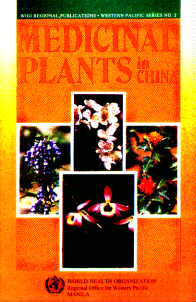 |
This book not only discusses 150 medicinal plants of China, but gives high quality photographs of each of them along with a short description of the plant, its botanical name, its Chinese and English names, the parts used as medicines, its natural habitat and distribution. Major indications
 |
The photographs appear on the left page of the book, while the accompanying description appears on the right page. The format is more or less like that of an atlas. On the left page, beside the picutre of the plant, the picture of the medicine that is derived from it (usually some part of the plant or some modification of it) is also given below each plant.
We decided to give a sampling of what this book has to offer the readers. Here are four select images from the book, and the short description that follows it.
| Image | Description |
|---|---|
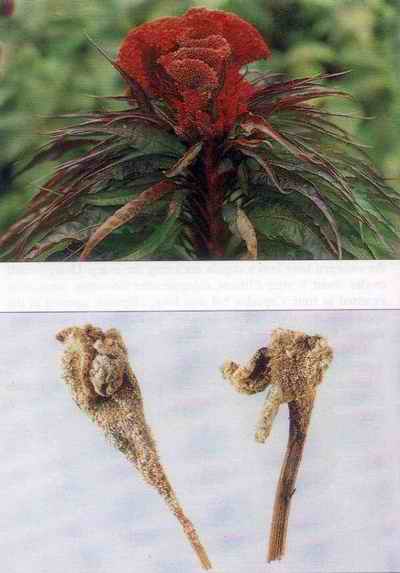 |
[From pages 68-69. Plant #34 ] Celosia cristata L. Amaranthaceae Celosia argentea var., cristata (L.) O. Kuntze Chinese name : English name : Cockscomb Parts used . Inflorescence. Description . A cultivated sport of C. argentea L. Leaves often broad, sometimes up to 23 cm long by 5 cm wide. Flowers from July to September. The spikes are flattened, truncate, often 15 cm wide and irregularly laciniate at the top, thus resembling a cock's crest. Colour varieties exist, such as yellow, whitish and bright purple. The purple spikes are officinal. Habitat . Commonly cultivated as an ornamental plant. Distribution . Burma, China, India, Japan, Malaysia, Mexico, Philippines . Indications . 1. Epistaxis; haemoptysis; haematemesis; haemorrhoidal bleeding; haematuria; functional uterine bleeding 2. Diarrhoea 3. Leucorrhoea 4. Urinary tract infection. Dosage . 6-12 g. |
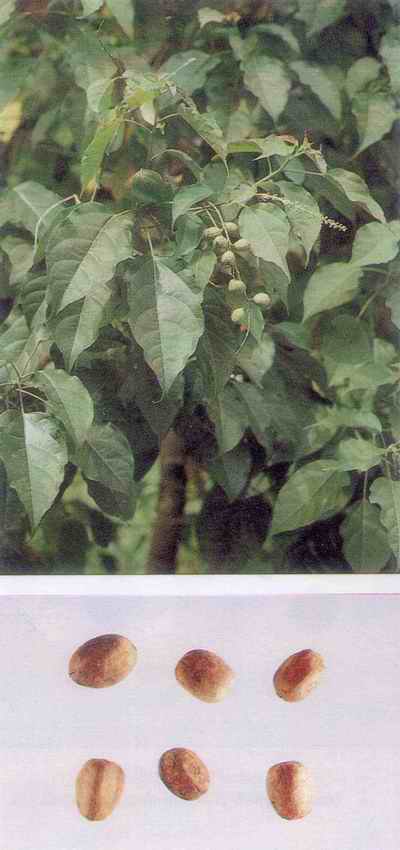 |
[From pages 94-95. Plant #47]
Croton tiglium L. Euphorbiaceae Chinese name : English name : Purging croton
Parts used . Seeds.
Description . An evergreen tree, 2-7 m high. Leaves alternate, long-petiolate, stipulate, ovate or elliptic-ovate, rarely oblong, 7-17 cm long by 3-7 cm wide; apex long-acuminate; base broadly cuneate; margin sparsely serrulate, sometimes glandular beneath; nerves 2-3 pairs above the basal. Racemes, terminal in summer. Flowers unisexual, dioecious, small. Male flower; pedicels with stellate hairs; sepals nearly glabrous; tips bearded; petals narrow; stamens glabrous; receptacle villous; disc-glands 5, small. Female flower: sepals villous at the base within; disc obscure, annular; ovary oblong. Capsule white, turbinately obovoid, obtusely trigonous.
The seeds are 12 mm long by 8 mm wide, oblong, trigonous, rounded at the two extremities, with 2 faces, the dorsal face more convex than the ventral, the latter being marked with an awn; epidermis brownish; albumen oleaginous and voluminous; cotyledons foliaceous. Poisonous.
Habitat . On slopes and the banks of streams.
Distribution . Burma , China , Laos , Malaysia , Viet Nam . Indications . 1. Meteorism; ascites 2. Abundant expectoration 3. ileus (external use). Dosage . 0.1-0.3 g. |
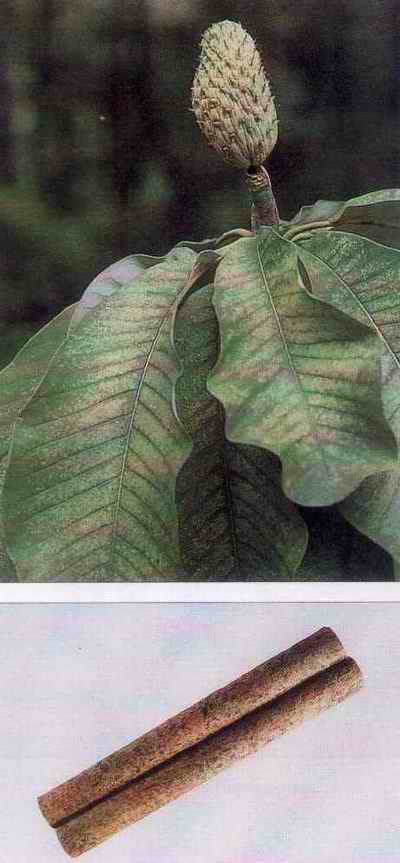 |
[From pages 176-177. Plant #88] Magnolia officinalis Rehd. et Wils. Magnoliaceae Chinese name : English name : Officinal magnolia Parts used . Bark. Description . A deciduous tree, large, up to 22 m high. Bark smooth, light rusty-ash colour and aromatic. Branchlets light-green or yellowish. Leaves very large, elliptic-obovate, up to 35 cm long and 17-18 cm wide. Flowers large, fragrant, in May; creamy-white. Petals 9-15, outer 3 pale-green tinged pink on the outside, chartaceous, 5-6 cm in length by 3 cm in breadth, inner 6-12 creamy-white, 8-10 cm in length by 3 cm in breadth, fleshy. Fruit cones 10-12 cm in length, oblong, apex truncate and base rounded. Carpels rounded at the base. Seeds single. The drug consists of the rough, thick bark, rolled into large, tight cylinders. The outer surface is greyish-brown, roughened with tubercles and marked with lichenous growths. The inner surface is smooth and reddish-brown. The bark tastes aromatic and pungent. Habitat . In mountains. Distribution . China. Indications . 1. Sensation of fullness in the chest and abdomen; indigestion 2. Diarrhoea 3. Cough and sputum. Dosage . 3-9 g. Notes . Magnolia biloba Rehd. et Wils. is similarly employed. |
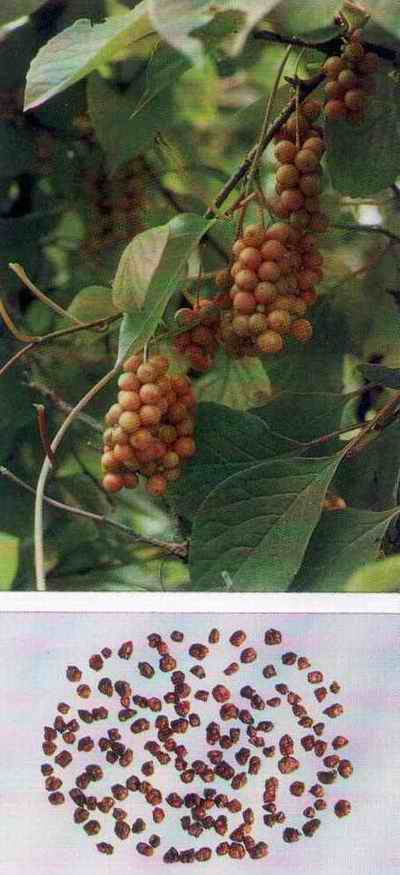 |
[From pages 258-259. Plant #129] Schizandra chinensis (Turczaninow) Baillon Magnoliaceae Maximowiczia sinensis Rupr. Chinese name : English name : Chinese magnolia vine Parts used . Fruit. Description . A deciduous woody climbing vine, about 8 m long. Leaves alternate, petiolate, ovate or oblong-obovoid, 5-11 cm long and 3-7 cm wide, apex acute or acuminate; base cuneate or broadly cuneate, membranous. Inflorescence a few-flowered axillary cluster, unisexual, dioecious; May-June. Flowers have many pistils on the round receptacle, which grows long and hangs like an ear when the fruit ripens. Fruit globose, red, of different sizes. The skin and pulp of the fruit are sweet and sour, the kernels pungent and bitter; the whole has a salty taste. This has given rise to the Chinese name "five flavours fruit". Habitat . In thickets and woods. Distribution . China , Korea . Indications . 1. Neurasthenia 2. Perspiration from no apparent cause; night sweats; seminal emissions 3. General fatigue. Dosage. 2-6 g. Notes. Schizandra sphenanthera Rehd. et Wils., the orange magnolia vine, is similarly employed. |
Order this book by clicking here
or via telephone: (41 22) 791 24 76, or Facsimile (fax): (41 22) 791 48 57
or via the website http://bookorders.who.int
or via mail at this address: WHO, Marketing and Dissemination, 1211 Geneva 27, Switzerland

 Request a PDF file of this review by clicking here. (If your screen resolution can not be increased, or if printing this page is giving you problems like overlapping of graphics and/or tables etc, you can take a proper printout from a pdf file. You will need an Acrobat Reader though.)
N.B. WHO publications can be purchased in Rupees, at a very low price, through WHO's Regional Office in New Delhi at the following address:
World Health Organization
Regional Office for South-East Asia
World Health House
Indraprastha Estate
Mahatma Gandhi Road
NEW DELHI 110002
Contact : Mr Dixit, RDOC/Sales
email : dixitr@whosea.org
N.B. It is essential to read this journal - and especially this review as it contains several tables and high resolution graphics - under a screen resolution of 1600 x 1200 dpi or more. If the resolution is less than this, you may see broken or overlapping tables/graphics, graphics overlying text or other anomalies. It is strongly advised to switch over to this resolution to read this journal - and especially this review. These pages are viewed best in Netscape Navigator 4.7 and above.
-Anil Aggrawal
Reviews by Gyan Fernando of these books [ China ]
[ Vietnam and Korea ]
[ South Pacific ]
Reviews by V.V.Pillay of India[ China, Vietnam, Korea and South Pacific Medicinal Plants ]
 [ Major links ]
[ Aims and Objectives ] [ FAQ ] [ Editorial Board ] [ Contributing Partners ] [ Sitemap ]
[ Paper/Thesis submission guidelines ] [ Editorials - Cumulative Index ] [ Be our sponsor! ]
[ Cumulative index of Book Reviews sorted by | Publishers | General Interest Books | Technical Books ] [ Animated Reviews ] [ Featured Reviews ]
[ Reviews with Quizzes ] [ Links ] [ Submit books/journals/software/multimedia for review ] [ journal CD ] [ History of the Journal ] [ Interviews ] [ Credits ]
[ Cumulative index of | Theses/dissertations | Online Courses | Awards ] [ Anil Aggrawal's Internet Journal of Book Reviews - Sister Publication ]
[ Cumulative reviews of Software/Multimedia | Books on CD/Audio tapes | Calenders | Models ] [ contact us ]
Books for review must be submitted at the following address.
Professor Anil Aggrawal (Editor-in-Chief)
Anil Aggrawal's Internet Journal of Forensic Medicine and Toxicology
S-299 Greater Kailash-1
New Delhi-110048
India
Click here to contact us.
This page has been constructed and maintained by Dr. Anil Aggrawal, Professor of Forensic Medicine, at the Maulana Azad Medical College, New Delhi-110002. You may want to give me the feedback to make this pages better. Please be kind enough to write your comments in the guestbook maintained above. These comments would help me make these pages better.
 IMPORTANT NOTE: ALL PAPERS APPEARING IN THIS ONLINE JOURNAL ARE COPYRIGHTED BY "ANIL AGGRAWAL'S INTERNET JOURNAL OF FORENSIC MEDICINE AND TOXICOLOGY" AND MAY NOT BE REPOSTED, REPRINTED OR OTHERWISE USED IN ANY MANNER WITHOUT THE WRITTEN PERMISSION OF THE WEBMASTER
Questions or suggestions ? Please use ICQ 19727771 or email to dr_anil@hotmail.com
Page Professor Anil Aggrawal via ICQ

|





