|
|
|
|
 Forensic Pathology Reviews, Vol. 1, Edited by Michael Tsokos. Hard Bound, 6" x 9".
Humana Press Inc., 999 Riverview Drive, Suite 208, Totowa, New Jersey 07512; Publication Date 15 April, 2004. xii + 365 pages, ISBN 1-588-29-414-5. Price $99.50
 Official Site:Click here to visit
 |
Just when one thought forensic pathology as an art (more than a science) was dying out with instrumental and technical wizardry taking precedence over painstaking dissection in the autopsy room, along comes a book that firmly reinstates classical pathological approach to its deserving status. For a change, we learn (with some relief) that recent advances in forensic pathology do not necessarily revolve around DNA analysis or cutting edge laboratory technology, but can mean taking a fresh look at common pathological conditions, redefining time honoured concepts, and refining basic laboratory methodologies.
Michael Tsokos does a splendid job editing this first volume of Forensic Science Reviews comprising critical surveys of common forensic entities (and a few not-so-common ones) with help from some eminent forensic pathologists from around the world. Does it come as a surprise that the list of contributors has not a single name from the Indian sub-continent? A country where, perhaps the maximum number of forensic autopsies are performed as compared to the rest of the world? But then we are talking of quality and not just quantity, where-in the issue is one of advancement (as opposed to stagnation) in the practice of forensic pathology.
 |
In the West, over the last decade, there has been tremendous advancement in the entire field of forensic science including the critical sub-specialty of forensic pathology, which has seen the rapid emergence of new autopsy and laboratory techniques. The old, traditional guard is making way to a new breed of technology-savvy professionals who make no bones about critically re-examining long held beliefs and opinions relating to forensic situations, using if necessary, newer equipment and laboratory techniques to substantiate such a revision of concepts. This new breed of forensic pathologists favors a transverse, multi-organ approach that combines autopsy, histopathology, immunohistochemistry, microbiology, toxicology, and even DNA analysis to tackle unnatural fatalities of every kind. Such an approach has facilitated a better understanding and interpretation of many pathological findings, a clearer recognition of injury causality, and a more satisfactory resolution of obscure fatalities.
 |
Michael Tsokos and his team attempt in this book to provide the reader up-to-date knowledge on varied topics, focusing closely on the dynamic evolution of forensic pathology as a whole. Individual chapters discuss these topics in a problem-oriented manner, providing new insights into conventionally accepted concepts. Chapter 1 takes a re-look at death due to burns and offers explicit guidance on interpretation of both gross as well as microscopic changes characteristic of thermal injury. Various methods of classifying total body destruction by burns are discussed, as well as the consequences of tissue shrinkage resulting from exposure to heat, giving rise to for instance, "crows feet" around the eyes, and "puppet organs" within the body cavities.
Chapters 2 and 3 focus on deaths due to mechanical trauma, providing interesting new insights into barbaric homicides involving kicking and trampling, as well as an overview of new immunohistochemical markers relating to traumatic brain injury. Chapter 4 was of particular interest to this reviewer (who is known for his weakness for toxicology!), since it deals extensively with the pathological changes in the central nervous system consequent to drug abuse. This profusely illustrated chapter would have been rendered even more effective with incorporation of at least a few colour photographs, though the B&W pictures reproduced here are not by any means unclear or unsatisfactory.
Chapter 5 deserves to be photocopied and made available in every mortuary undertaking forensic autopsies as it provides a comprehensive look at sudden cardiac death, with exquisitely detailed descriptions of heart dissection and interpretation of histopathological findings. Chapters 6 and 7 discuss medico legal problems associated with the distressing issues of neonaticide and sudden infant death, while chapters 8 and 9 delve into two terribly neglected disease entities that actually have profound medico legal import: mycoplasma pneumonia and Waterhouse-Friderichsen syndrome.
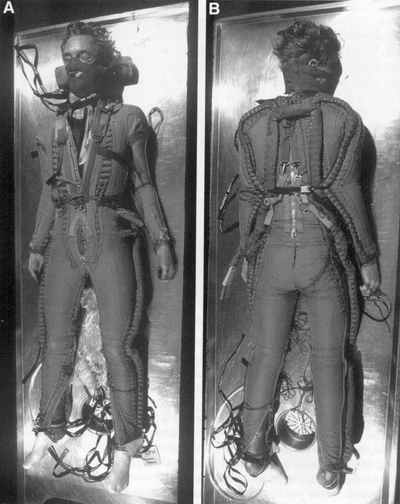
Chapter 10 may not be of special interest to Indian forensic pathologists since it deals with an area that is not commonly encountered in this country: death due to autoeroticism (please see picture above and to the right). However, the detailed descriptions of the various macabre methodologies employed by the practitioners of this kind of sexual deviation are perversely fascinating, and make for compulsive reading to all pathologists regardless of which part of the world they may be engaged in practice. Chapter 11 examines the peculiar issues of paradoxical undressing and "hide-and-die" syndrome characteristic of hypothermic deaths, while chapter 12 discusses the pathological features of a little-known entity - HELLP syndrome that can cause unexpected death in a pregnant woman, raising the possibility of medical negligence allegations. Chapter 13 deals with the confounding issue of injuries resulting from resuscitative procedures which can cause perplexing artifacts in a dead body.
Chapter 14 represents an exhaustive review of medico legal considerations in postmortem alcohol interpretation and re-examines the validity of the famous Widmark equation. Chapter 15 winds up this excellent treatise by a discussion of the relatively uncommon, though extremely important pathological finding of iliopsoas haemorrhage, and how to interpret it correctly.
In the final analysis, this book (which hopefully is a forerunner of many more similar reviews) is a profoundly interesting and educative book on some recent concepts of forensic pathology, excellently supported by relevant references, that must be deemed a necessary addition to every hospital or medical institute undertaking autopsies.
|
-V.V.Pillay MD, DCL
Professor, Dept. of Forensic Medicine & Toxicology Chief, Dept of Analytical Toxicology (Incl. Poison Information Service), Amrita Institute of Medical Sciences & Research, Cochin 682026, South India Phones: 0484-2804852 (O); 0484-2807055 (R), 9895282388 (Cell) Email: toxicology@medical.amrita.edu Dr.V.V.Pillay has been in the vanguard of the movement among medical professionals in India to develop the neglected field of Toxicology. He has published extensively in both the scientific and lay press on matters relating to Toxicology, as well as his chosen discipline - Forensic Medicine. Dr.Pillay has authored 6 books on Forensic Medicine and Toxicology, and has received an award for one of them (Modern Medical Toxicology), generally considered to be a trend setter among books on the subject in India. He has reviewed several books on Toxicology for the Internet Journal of Forensic Medicine and Toxicology. Dr.Pillay received a scroll of honour in appreciation of work done in the field of Toxicology from the Medicolegal Society, All India Institute of Medical Sciences, New Delhi. He has established a state-of-the-art Poison Control Centre, recognized by the World Health Organization at the institute where he is currently employed (AIMS, Cochin). Among his most sought-after publications is a 700 page reference work on Toxicology. |
 Review 1 by Erik Edston, Sweden
Review 3 by Benjamin Swift, UK
Review 4 by Ronald Wright, USA
An Exclusive interview with Michael Tsokos
Other reviews of this book:
Order Humana Press Books by clicking here.
or via telephone: (973) 256-1699 or Fax: (973) 256-8341 or Email:humana@humanapr.com
 Request a PDF file of this review by clicking here. (If your screen resolution can not be increased, or if printing this page is giving you problems like overlapping of graphics and/or tables etc, you can take a proper printout from a pdf file. You will need an Acrobat Reader though.)
N.B. It is essential to read this journal - and especially this review as it contains several tables and high resolution graphics - under a screen resolution of 1600 x 1200 dpi or more. If the resolution is less than this, you may see broken or overlapping tables/graphics, graphics overlying text or other anomalies. It is strongly advised to switch over to this resolution to read this journal - and especially this review. These pages are viewed best in Netscape Navigator 4.7 and above.
-Anil Aggrawal


 [ Major links ]
[ Aims and Objectives ] [ FAQ ] [ Editorial Board ] [ Contributing Partners ] [ Sitemap ]
[ Paper/Thesis submission guidelines ] [ Editorials - Cumulative Index ] [ Discussion ] [ Chat room ] [ Be our sponsor! ]
[ Cumulative index of Book Reviews sorted by | Publishers | General Interest Books | Technical Books ] [ Animated Reviews ] [ Featured Reviews ]
[ Reviews with Quizzes ] [ Links ] [ Submit books/journals/software/multimedia for review ] [ journal CD ] [ History of the Journal ] [ Interviews ] [ Credits ]
[ Cumulative index of | Theses/dissertations | [ Online Courses ] [ Awards ] [ Anil Aggrawal's Internet Journal of Book Reviews - Sister Publication ]
[ Undergraduate section | Postgraduate section ]
[ Cumulative reviews of Software/Multimedia | Books on CD/Audio tapes ] | Calenders | Models ] [ contact us ]
Books for review must be submitted at the following address.
Professor Anil Aggrawal (Editor-in-Chief)
Anil Aggrawal's Internet Journal of Forensic Medicine and Toxicology
S-299 Greater Kailash-1
New Delhi-110048
India
Click here to contact us.
This page has been constructed and maintained by Dr. Anil Aggrawal, Professor of Forensic Medicine, at the Maulana Azad Medical College, New Delhi-110002. You may want to give me the feedback to make this pages better. Please be kind enough to write your comments in the guestbook maintained above. These comments would help me make these pages better.
 IMPORTANT NOTE: ALL PAPERS APPEARING IN THIS ONLINE JOURNAL ARE COPYRIGHTED BY "ANIL AGGRAWAL'S INTERNET JOURNAL OF FORENSIC MEDICINE AND TOXICOLOGY" AND MAY NOT BE REPOSTED, REPRINTED OR OTHERWISE USED IN ANY MANNER WITHOUT THE WRITTEN PERMISSION OF THE WEBMASTER
Questions or suggestions ? Please use ICQ 19727771 or email to dr_anil@hotmail.com
Page Professor Anil Aggrawal via ICQ

|