

|

|
|
|
 Parkinson's- another look - Is Parkinson's disease caused by a bacteria, 3rd edition by Lawrence Broxmeyer, MD, Softcover, 5.5" x 8".
New Century Press, 1055 Bay Boulevard, Suite C, Chula Vista, CA 91911, phone: (800) 519-2465, (619) 476-7400, www.newcenturypress.com. E-mail:MEDAMERICA1@cs.com: Publication Date 2002. ii + 82 pages, ISBN 1-890035-26-2. Price $11.95
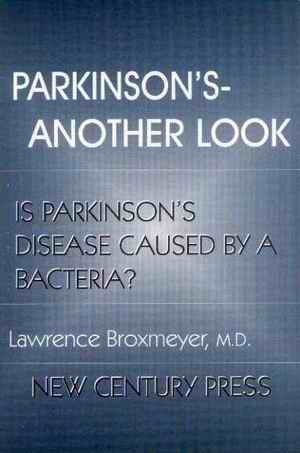 |
I read the book "Parkinson's - Another Look" by Dr.Lawrence Broxmeyer with great interest and deeply appreciated it. The book, comprising 12 chapters, assesses the cause of Parkinson's disease from an entirely different aspect.
The books contents have primarily been put forth from the historical, statistical and medical point of view. I have decided to give my assessment by reviewing certain selected chapters.
 |
Contains a number of historical events linking tuberculosis with Parkinson's, including the world-famous discovery of the TB bacillus by Koch. Draws an ever increasing thread between the two diseases, including and reconfirming that it was a tuberculous mass, found in the brain's substantia nigra that was behind Parkinson's disease in the first Parkinson's autopsy ever.
Lends itself to the anatomical localization of Parkinson's which coincides with that found in CNS involvement in atypical and typical mycobacterial diseases such as tuberculosis. Painstakingly laid out in detail, Broxmeyer unquestionably puts both diseases on the same page anatomically through autopsy observation. The startling comparative pathology and microcosmic brain changes of the two diseases shows larger than life similarities. On pages 15-17, Dr.Levy-Valensi's pursuit and diagnosis of tuberculosis in a young French Parkinson's victim, and how he validated this, ought to be just the kind of diagnostic thinking that should be applied rapidly to today's clinical medicine.
Again pounds away at anatomically confirmed cases in which tuberculosis and the mycobacteria were linked by one investigator after another to Parkinson's. Of particular notoriety is how Sitig in 1914 pointed out that Parkinson's like changes occurred "in even the smallest ganglia and ganglions of the brain", a message that today's practitioners of neurodegenerative diseases should take to heart.
 ...Being a doctor has only made me more aware of the presence of the Almighty and how dreaded epidemics will be solved only at the time when he thinks it necessary to do so. Apparently, this higher force has decided to unravel the true cause of von Economo's through Broxmeyer's writing at this time. For both myself and the colleagues that I have shared this book with this is what we have surmised and we also took great interest in the information of Adolph Hitler's probable Parkinson's as a result of his earlier bouts with tuberculosis ... ...Being a doctor has only made me more aware of the presence of the Almighty and how dreaded epidemics will be solved only at the time when he thinks it necessary to do so. Apparently, this higher force has decided to unravel the true cause of von Economo's through Broxmeyer's writing at this time. For both myself and the colleagues that I have shared this book with this is what we have surmised and we also took great interest in the information of Adolph Hitler's probable Parkinson's as a result of his earlier bouts with tuberculosis ... |
It is a certainty that many of the diseases we automatically treat today with no afterthought might have caused epidemics and pandemics in years past. Such is the relationship made here between the dreaded von Economo's epidemic of yesteryear and today's CNS tuberculosis, both typical and atypical.
Being a doctor has only made me more aware of the presence of the Almighty and how dreaded epidemics will be solved only at the time when he thinks it necessary to do so. Apparently, this higher force has decided to unravel the true cause of von Economo's through Broxmeyer's writing at this time. For both myself and the colleagues that I have shared this book with this is what we have surmised and we also took great interest in the information of Adolph Hitler's probable Parkinson's as a result of his earlier bouts with tuberculosis, provided on pages 28-30.
In 1982 Nova televised "The Frozen Addicts", showing that although fortunately rare, MPTP, a "designer drug" used by addicts, could cause Parkinson's. Along with this, chlorpromazine, a major tranquilizer and manganese could also cause Parkinson's. But the interesting and necessary fact that Broxmeyer brings up is that although many chemical and biologic agents are presently thought to cause Parkinson's, they might simply be contributory to an underlying degenerative disease process. To bolster this he cites the relatively recent Parkinson's DATATOP study, in which, unknowingly, Deprenyl, an MAO inhibitor, improved Parkinson's patients symptomatology and well-being. MAO inhibitors, however, were first created as anti-tuberculosis drugs. It is important that clinical physicians realize this.
The chapter cites many microbiologic studies, among them, those done by Kohbata and Shimokawa (1991), Kobata and Beaman (1991) and others which pointed towards a summary that Parkinson's is indeed a disease stemming from the actinomycetales, and that cross-reactivity among this groups occupants, namely nocardia and the mycobacteria such as tuberculosis, could not be denied. In 1994 Gao and Raine showed a relationship between the mycobacteria and Parkinson's patients using serological methods.
Basically this title describes itself. A linkage between Parkinson's and TB through cure using anti-TB antibiotics. On Page 48 is an exemplary case history:
"Solanki and Kothari (1977) reported two ceases of full-blown parkinsonism developing in a 30-year old Indian housewife and a 32-year old male laborer, both of whom were being treated for CNS tuberculosis and both of whom lost their Parkinson's with continued anti-tubercular medicines".
...It soon became evident the Chamorros of Guam in the southernmost Marianas had an inordinate number of Parkinson's-like neurodegenerative diseases in their midst. By the same token, Mulder and Kurland acknowledged that TB is a leading cause of death on Guam and that TB meningitis is frequently seen in its hospital, a situation not incomparable to the Philippines from which many of the Chamorros trace their lineage... |
Mentioned here is that according to Roberts (2000), fully one-third of the World's population or 2 billion people have tuberculosis. I agree with this statement. And at the same time I would like to mention that these statistics are mostly generated by societies which find themselves in difficult social and economic situations. Harrison (1998) mentions that 8.5 million are infected with both HIV and T.B. but at the same time, Berenguer and Moreno report that there is reason to believe that Mycobacteria tuberculosis is the commonest CNS pathogen in HIV-infected people.
Furthermore, although other AIDS related opportunistic infections can cause CNS involvement, in Bishburg's (1986) study, T.B. preceded these infections by from one to 10 months. Is it any wonder then that AIDS is linked to Parkinson's through mycobacterial disease?
It soon became evident the Chamorros of Guam in the southernmost Marianas had an inordinate number of Parkinson's-like neurodegenerative diseases in their midst. By the same token, Mulder and Kurland acknowledged that TB is a leading cause of death on Guam and that TB meningitis is frequently seen in its hospital, a situation not incomparable to the Philippines from which many of the Chamorros trace their lineage.
Broxmeyer cites Jancovic and Tolosa (1998) (p.61) in relating that if Parkinson's was of a genetic cause, it would cluster primarily within people with at-risk gene lineage, but that this has not been the case in general and therefore it is unlikely that genetics plays a major role in Parkinson's.
In Conclusion, I would like to thank Professor Anil Aggrawal for bringing this important book out and at the same time assure both himself and Dr.Broxmeyer that the Azerbaijani medical establishment will be duly informed of all the findings included therein.
To Dr.Lawrence Broxmeyer, I would simply like to relate that your important, scientific, and historical book made me reassess all that I have been taught and what, as a Doctor of Forensic Pathology, I have seen, and from this point on, your book will be my standard for assessing probes regarding neurodegenerative diseases of the brain.
Also, I would like to mention that the knowledge acquired by all of us - thanks to you and Professor Anil Aggrawal - will be used in the everyday practice of Azerbaijani medicine and we are very grateful to both of you for sharing this with us.
-Vugar Huseynov
 |
-Vugar Huseynov Dr. Vugar K. Huseynov is a Forensic medicine and Pathology specialist from Baku, Azerbaijan Republic. He is a freelance reviewer of books attached with Anil Aggrawal's Internet Journal of Book Reviews. He can be contacted at vugargoyche@yahoo.com. His own website is at www.vugargoyche.bz.tc |
 Order this Book by clicking here.
Interview with Dr. Lawrence Broxmeyer.


Contact Dr. Lawrence Broxmeyer, the author of this book by clicking here.

 Request a PDF file of this page by clicking here. (If your screen resolution can not be increased, or if printing this page is giving you problems like overlapping of graphics and/or tables etc, you can take a proper printout from a pdf file. You will need an Acrobat Reader though.)
N.B. It is essential to read this journal - and especially this review as it contains several tables and high resolution graphics - under a screen resolution of 1600 x 1200 dpi or more. If the resolution is less than this, you may see broken or overlapping tables/graphics, graphics overlying text or other anomalies. It is strongly advised to switch over to this resolution to read this journal - and especially this review. These pages are viewed best in Netscape Navigator 4.7 and above.
-Editor-in-Chief


 [ Major links ]
[ Reviews with Quizzes ] [ Journal CD ] [Interviews] [ Editorials - Cumulative Index ]
[ Cumulative index of Book Reviews sorted by | Publishers | Subjects | Multimedia Reviews (cumulative) ]
[ Links ] [ Submit books/journals/software/multimedia for review ] [ Reviewers' Panel ] [ Featured Reviews ] [ Audio books ] [ My Books ]
[ Anil Aggrawal's Internet Journal of Forensic Medicine and Toxicology - Sister Publication ] [ contact us ]
Books for review must be submitted at the following address.
Professor Anil Aggrawal (Editor-in-Chief)
Anil Aggrawal's Internet Journal of Book Reviews
S-299 Greater Kailash-1
New Delhi-110048
India
Click here to contact us.
 You are Visitor No:
|
This page has been constructed and maintained by Dr. Anil Aggrawal, Professor of Forensic Medicine, at the Maulana Azad Medical College, New Delhi-110002. You may want to give me the feedback to make this pages better. Please be kind enough to write your comments in the guestbook maintained above. These comments would help me make these pages better.
 IMPORTANT NOTE: ALL REVIEWS APPEARING IN THIS ONLINE JOURNAL ARE COPYRIGHTED BY "ANIL AGGRAWAL'S INTERNET JOURNAL OF BOOK REVIEWS" AND MAY NOT BE REPOSTED, REPRINTED OR OTHERWISE USED IN ANY MANNER WITHOUT THE WRITTEN PERMISSION OF THE WEBMASTER

|

