

|

|
|
|
 Parkinson's- another look - Is Parkinson's disease caused by a bacteria, 3rd edition by Lawrence Broxmeyer, MD, Softcover, 5.5" x 8".
New Century Press, 1055 Bay Boulevard, Suite C, Chula Vista, CA 91911, phone: (800) 519-2465, (619) 476-7400, www.newcenturypress.com. E-mail:MEDAMERICA1@cs.com: Publication Date 2002. ii + 82 pages, ISBN 1-890035-26-2. Price $11.95
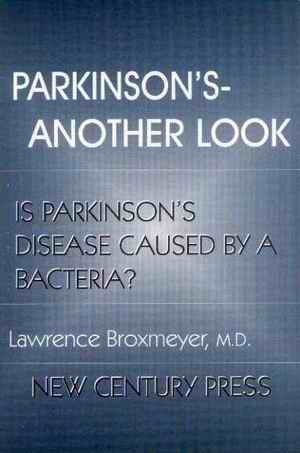 |
This book is very readable both as to style and as to type setting; a slim, neatly presented, inexpensive and, I would hazard, rather hurriedly printed volume. The full title in the outer cover reads: "Parkinson's: another look. Is Parkinson's disease caused by a bacteria?"
While it would be fatuous for any layman to take positions on the strength of this or any other book, everybody with an interest in the subject would do well to read it and, if nothing else, be reminded that all diseases are very complex phenomena in any case.
 |
Without having data on the reaction of the medical community to Dr. Broxmeyer's book, I would guess that he got three main blocks of readers: those that agreed with him, those who rejected his point of view, and those who snorted at the stale news. Certainly, the history of medical findings linking tuberculosis and Parkinson's disease is a long one, and quite a fascinating reading it makes.
On the other hand, and this is one of the points that make the book so mind-stimulating, the fact that one has a neatly described disease with such and such symptoms does not mean that the same symptoms cannot be produced by other causes. Primary epilepsy is due to alteration in the rhythm of cortical brain cells; yet several quite unrelated diseases may cause "epileptoid" seizures. In the same way, just as there is Parkinson's disease there is parkinsonism, which may have causes unrelated to the original Parkinson's. Thus exposition to iron, copper and manganese have been signaled as producing parkinsonism. And yet, adding these substances to a culture of Mycobacteria will increase their cell mass. Is iron an agent of parkinsonism, or is it a stimulant to latent infection?
Time and again, we have all heard or read that health hangs in the balance of susceptibility and exposition to risk. One assumes usually that susceptibility is genetic, and indeed, studies along this trend have been carried on with respect to Parkinson's disease. However, it appears from the abundant information given in this book that susceptibility is caused by previous infection by the germs of tuberculosis, which have a tendency to form a characteristic type of injury at the base of the brain. Parkinson's disease is often developed in elderly males who have suffered T.B. infection at some time of their lives- sometimes an acute lung infection in their youth. Yet children and young people also may develop Parkinson's, and many instances are given in which such symptoms have been linked with tuberculosis both by clinical observation and by autopsy findings. Conversely, several cases are mentioned in which Parkinson's disease remitted after treatment with anti-T.B. antibiotics.
 ...The author piles up an impressive series of findings, all tending to link Parkinson's disease with manifest or dormant tuberculosis infection. As he points out, each one of these cases by itself may be considered anecdotal, but taken together they simply make up too great a bulk of coincidence... ...The author piles up an impressive series of findings, all tending to link Parkinson's disease with manifest or dormant tuberculosis infection. As he points out, each one of these cases by itself may be considered anecdotal, but taken together they simply make up too great a bulk of coincidence...
|
And yet, there is such a thing as genetic predisposition. My mother, who was born in 1913 and grew up in an immigrants' neighborhood ranging from daily laborers to piano teachers, had a favorite story of a largish family wiped off by "phthisis", mother and children, until the only one left alive was the father, "the healthy carrier", as she repeated, in the phrase of the twenties.
Tuberculosis is still one of the big people killers in the world, and unlike malaria, it spreads from person to person. According to one source quoted in the book, no less than one-third of the total human population is infected with T.B. Since this disease may produces obscure injuries, it is rather chilling to think one believes oneself healthy on the strength of positive skin tests and unblemished lung x-rays.
Still more alarming, bacteria of the order Actinomycetales, to which the original Koch bacillus belongs, are much given to interaction through phages. The suggestion is made here that some puzzling pathological cases may be due to infection by a Mycobacterium/Nocardia "hybrid".
The author piles up an impressive series of findings, all tending to link Parkinson's disease with manifest or dormant tuberculosis infection. As he points out, each one of these cases by itself may be considered anecdotal, but taken together they simply make up too great a bulk of coincidence.
I mentioned that the volume appeared to have been rushed into print, which is the more remarkable as this is the third edition. This shows in small mistakes which could have easily been corrected. It is a thousand pities that the phrase "Is Parkinson's disease caused by a bacteria?" should have crept into the cover. Bacterium is a neutral noun; bacteria is the plural. It should have been "caused by a bacterium" or - what may read more natural to the average reader - "caused by bacteria".
The nomenclature of living organisms is subject to international convention. A scientific name is a binomen, or set of two names, of which the first is written always with a capital letter, and the second in lowercase; the whole should be in italics. The first name is the name of the genus; the binomen (not the second name) is the name of the species. Now, I have in front of me a paper by Dr Broxmeyer (Medical Hypotheses (2002) 59(4): 373-377) in which the names of the bacteria are correctly quoted as Mycobacterium tuberculosis, Listeria monocytogenes, and so on.
...a very engrossing, stimulating book written in a straightforward, easily followed style. After the first five minutes of "Goodness! How can I be sure I have not got a latent infection?" one begins to see the broader pattern which applies to any disease...
|
Even when Nocardia is mentioned without precisions as to species, the name is given a capital N and italics, as a generic name should. In the book, however, one finds the names written in different ways, sometimes in italics, sometimes not, and very often "nocardia" in lowercase. A similar lack of unity is shown in the bibliographic references. This could have been, as I said, easily corrected, and would have improved enormously the presentation of the book and the first impression it makes on a reader used to scientific literature.
Another mistake in Nomenclature in which the author falls several times is the loose use of the term "family". Actinomicetales is not a family, it is an order. This matters because there is a taxonomic category - and a very important one - called a family. It would not have mattered if the author had used a loose term like "group", since this is not a book on Bacteriology, but the erroneous use of an existing taxonomic category is a definite mistake.
The general tone of the book is certainly informal. Bacteria may synthesize substances, but they can hardly "manufacture" them!
These small points, however, should not deter any reader with a basic knowledge of Biology from trying a very engrossing, stimulating book written in a straightforward, easily followed style. After the first five minutes of "Goodness! How can I be sure I have not got a latent infection?" one begins to see the broader pattern which applies to any disease. While it is very convenient to have a single pathogen as the sole cause of an illness, and a specific against that pathogen, in real life the patient, the pathogens and the physicians are subjected to an unending shower of variables which affect, modulate, cancel each other. The physician ought to keep an open mind, the patient ought to avoid panicking at each paper which proposes a new theory. As to the pathogenic agents, germs or not, they will go on doing whatever jolly well they like.
Or will they?
"...there is an invisible war going on in which bacteria use phages as viral weapons." (Ch. 7.) The world is a dangerous place even for a parasitical bacterium.
-Adriana Oliva
 |
-Dr. Adriana Oliva Dr. Adriana Oliva is on editorial board of Anil Aggrawal's Internet Journal of Forensic Medicine and Toxicology. More information about her can be obtained by clicking here. |
 Order this Book by clicking here.
Interview with Dr. Lawrence Broxmeyer.


Contact Dr. Lawrence Broxmeyer, the author of this book by clicking here.

 Request a PDF file of this page by clicking here. (If your screen resolution can not be increased, or if printing this page is giving you problems like overlapping of graphics and/or tables etc, you can take a proper printout from a pdf file. You will need an Acrobat Reader though.)
N.B. It is essential to read this journal - and especially this review as it contains several tables and high resolution graphics - under a screen resolution of 1600 x 1200 dpi or more. If the resolution is less than this, you may see broken or overlapping tables/graphics, graphics overlying text or other anomalies. It is strongly advised to switch over to this resolution to read this journal - and especially this review. These pages are viewed best in Netscape Navigator 4.7 and above.
-Editor-in-Chief

 [ Major links ]
[ Reviews with Quizzes ] [ Journal CD ] [Interviews] [ Editorials - Cumulative Index ]
[ Cumulative index of Book Reviews sorted by | Publishers | Subjects | Multimedia Reviews (cumulative) ]
[ Links ] [ Submit books/journals/software/multimedia for review ] [ Reviewers' Panel ] [ Featured Reviews ] [ Audio books ] [ My Books ]
[ Anil Aggrawal's Internet Journal of Forensic Medicine and Toxicology - Sister Publication ] [ contact us ]
Books for review must be submitted at the following address.
Professor Anil Aggrawal (Editor-in-Chief)
Anil Aggrawal's Internet Journal of Book Reviews
S-299 Greater Kailash-1
New Delhi-110048
India
Click here to contact us.
 You are Visitor No:
|
This page has been constructed and maintained by Dr. Anil Aggrawal, Professor of Forensic Medicine, at the Maulana Azad Medical College, New Delhi-110002. You may want to give me the feedback to make this pages better. Please be kind enough to write your comments in the guestbook maintained above. These comments would help me make these pages better.
 IMPORTANT NOTE: ALL REVIEWS APPEARING IN THIS ONLINE JOURNAL ARE COPYRIGHTED BY "ANIL AGGRAWAL'S INTERNET JOURNAL OF BOOK REVIEWS" AND MAY NOT BE REPOSTED, REPRINTED OR OTHERWISE USED IN ANY MANNER WITHOUT THE WRITTEN PERMISSION OF THE WEBMASTER

|


