


|
|
|
|
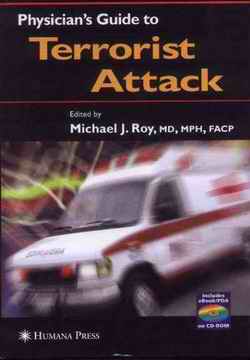
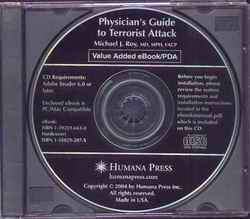
 Physician's Guide to Terrorist Attack, 1 stEdition, (includes eBook/PDA on CD-Rom) Edited by Michael J. Roy. Hard Bound, 7 " x 10".
Humana Press Inc., 999 Riverview Drive, Suite 208, Totowa, New Jersey 07512; Publication Date 27 October, 2003. xvi + 405 pages, ISBN 1-58829-207-X (Hardback, acid-free Paper), E-ISBN 1-59259-663-0. Price $99.50
 |
 |
Michael Roy, editor, dedicates this book "to the survivors of the terrorist attacks that occurred on September 11 2001 and of the anthrax attacks that followed that fall, as well as to the families and friends who lost loved ones as a result of these horrors." There is no doubt that recent events, as well as historical incidents, have focussed the minds of clinicians' involvement on the potential results of terrorist attacks, be they in the form of biological, chemical, nuclear or explosive events.
 |
This book, accompanied by an eBook/PDA on CD Rom, is divided into four parts. Part I Responding to an Incident covers Mass Casualty Events: lessons learned; Hospital Preparation and Response to an Incident; Physician Recognition of Bioterrorism-Related Disease; and, an Introduction to Biological, Chemical, Nuclear and Radiological Weapons with a review of their historical use.
 ...Dr Roy has gathered together an impressive array of contributors to this book and as he concludes in his preface "it would be nice to think that physicians need not know the information that is covered here, the reality is that it is critically important for physicians to prepare themselves by acquiring the knowledge and skills necessary to cope effectively with a major terrorist event now, rather than learning though painful experience... ...Dr Roy has gathered together an impressive array of contributors to this book and as he concludes in his preface "it would be nice to think that physicians need not know the information that is covered here, the reality is that it is critically important for physicians to prepare themselves by acquiring the knowledge and skills necessary to cope effectively with a major terrorist event now, rather than learning though painful experience...
|
Part II covers Biological Agents including chapters on anthrax; plague; tularemia, brucellosis, Q fever; melioidois and glanders; botulinum toxins; ricin toxin; staphylococcal enterotoxin B, mycotoxins; smallpox; viral haemorrhagic fevers; and, viral encephalitides. Reading this section was extremely informative for example melioidosis and glanders are diseases caused by members of the genus Burkholderia and US soldiers died from melioidosis pneumonitis in the Vietnam War. A biological warfare pathogen intended to inflict massive panic, incapacitation and ultimately death would have many of the properties characteristic of Francisella tularensis, the causative agent of tularemia, also known as rabbit fever, deer-fly fever or Ohara disease.
Part III covers Chemical Agents including pulmonary toxic agents; cyanide; vesicants; nerve agents; incapacitating agents; and, riot control agents. In this section there are a number of very useful case vignettes to illustrate how such agents may present. Of particular interest to em in the section on incapacitating agents there is an example given of scopolamine-adulterated heroin presenting with anticholinergic toxicity and responding to therapy with physostigmine.
Part IV Additional Considerations includes chapters on radiation effects, explosives and the psychological impact of terrorist incidents. Bombings throughout the world occur on an almost daily basis and so the section on explosives is most important outlining the different types of injuries that may occur including penetrating and blunt trauma, primary blast injury, crushing injury and thermal trauma. Finally in this section the important psychological impact of terrorist attacks which may result from direct acute neuropsychiatric effects of chemical agents, such as organophosphates resulting in depression, irritability and sleep disturbance, and trying to prevent longer term psychological problems with appropriate rest reassurance and support.
Dr Roy has gathered together an impressive array of contributors to this book and as he concludes in his preface "it would be nice to think that physicians need not know the information that is covered here, the reality is that it is critically important for physicians to prepare themselves by acquiring the knowledge and skills necessary to cope effectively with a major terrorist event now, rather than learning though painful experience." I wholeheartedly agree with his sentiment and so this is an extremely important and valuable book!
 |
-Margaret M. Stark Dr Margaret M Stark LLM DGM DMJ(Clin) DAB is one of the foremost experts in Clinical Forensic Medicine. She has been a registered medical practitioner since 1981 and has worked in the field of clinical forensic medicine since 1989. She is a well-known authority on Clinical forensic medicine and Drugs of abuse. She is the author of the best-selling "Symptoms and signs of Substance misuse" and "A Physician's Guide to Clinical Forensic Medicine". |
 Review 1 by Margaret Stark, UK
Review 2 by Jason Payne James, UK
Review 3 by John Gall, Australia
An Exclusive interview with Michael J. Roy
-Anil Aggrawal
[ Aims and Objectives ] [ FAQ ] [ Editorial Board ] [ Contributing Partners ] [ Sitemap ]
[ Paper/Thesis submission guidelines ] [ Editorials - Cumulative Index ] [ Discussion ] [ Chat room ] [ Be our sponsor! ]
[ Cumulative index of Book Reviews sorted by | Publishers |
General Interest Books |
Technical Books ] [ Animated Reviews ] [ Featured Reviews ]
[ Reviews with Quizzes ] [ Links ] [ Submit books/journals/software/multimedia for review ] [ journal CD ] [ History of the Journal ] [ Interviews ] [ Credits ]
[ Cumulative index of | Theses/dissertations | [ Online Courses ] [ Awards ] [ Anil Aggrawal's Internet Journal of Book Reviews - Sister Publication ]
[ Undergraduate section | Postgraduate section ]
[ Cumulative reviews of Software/Multimedia | Books on CD/Audio tapes ] | Calenders | Models ] [ contact us ]
Questions or
suggestions ? Please use ICQ 19727771
or email to
dr_anil@hotmail.com
Page Professor Anil Aggrawal via
ICQ
 Order Humana Press Books by clicking here.
 Request a PDF file of this review by clicking here. (If your screen resolution can not be increased, or if printing this page is giving you problems like overlapping of graphics and/or tables etc, you can take a proper printout from a pdf file. You will need an Acrobat Reader though.)
N.B. It is essential to read this journal - and especially this review as it contains several tables and high resolution graphics - under a screen resolution of 1600 x 1200 dpi or more. If the resolution is less than this, you may see broken or overlapping tables/graphics, graphics overlying text or other anomalies. It is strongly advised to switch over to this resolution to read this journal - and especially this review. These pages are viewed best in Netscape Navigator 4.7 and above.


 [ Major links ]
Books for review must be submitted at the following address.
Professor Anil Aggrawal (Editor-in-Chief)
Anil Aggrawal's Internet Journal of Forensic Medicine and Toxicology
S-299 Greater Kailash-1
New Delhi-110048
India
Click here to contact us.
This page has been constructed and maintained by Dr. Anil Aggrawal, Professor of Forensic Medicine, at the Maulana Azad Medical College, New Delhi-110002. You may want to give me the feedback to make this pages better. Please be kind enough to write your comments in the guestbook maintained above. These comments would help me make these pages better.
 IMPORTANT NOTE: ALL PAPERS APPEARING IN THIS ONLINE JOURNAL ARE COPYRIGHTED BY "ANIL AGGRAWAL'S INTERNET JOURNAL OF FORENSIC MEDICINE AND TOXICOLOGY" AND MAY NOT BE REPOSTED, REPRINTED OR OTHERWISE USED IN ANY MANNER WITHOUT THE WRITTEN PERMISSION OF THE WEBMASTER

home
> Volume 5, Number 1, January - June 2004
> Reviews
> Technical Books
> Page 9: Physician's Guide to Terrorist Attack
> page 9a: Physician's Guide to Terrorist Attack (Review by Dr. Margaret Stark of UK) (you are here)
Navigation ribbon


