


|
|
|
|
 Forensic Pathology Reviews, Vol. 2, Edited by Michael Tsokos. Hard Bound, 6" x 9".
Humana Press Inc., 999 Riverview Drive, Suite 208, Totowa, New Jersey 07512; Publication Date 9 December, 2005. xvi + 311 pages, ISBN 1-58829-415-3. Price $99.50
 Official Site:Click here to visit
 Amazon link:Click here
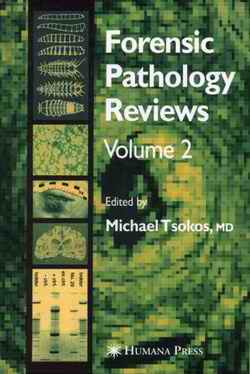 |
This is the second volume in the popular series "Forensic Pathology Reviews" edited by Michael Tsokos of Germany. The first volume was promising with many interesting articles on relevant topics. This volume is more varied in the choice of topics. To me some of the articles fall outside the realm of forensic anatomical pathology. Moreover, some authors have an inclination to rely too much on anecdotal evidence, i.e. case reports, in their presentations, perhaps because hard evidence, i.e. scientific studies are in short supply.
The Editor has chosen to organize each volume into different departments, but a department seldom consists of more than one article. An alternative would have been to build each volume around fewer topics.
To me the key papers of the volume are the following: "Death as a result of starvation" by Burkhard Madea; "Infant and early childhood asphyxial deaths" by Roger Byard and the Editor himself; "Sudden unexpected death related to viral myocarditis" by Reinhard Dettmayer and Burkhard Madea; "Long-Term effects of anabolic-androgenic-steroid abuse" by Roland Hausmann, and "Subendocardial hemorrhages" Stephan Seidl.
Neglected children and young girls with anorexia are typical victims of starvation. In those cases the circumstances and lack of competing causes of death facilitate the diagnosis. On the other hand elderly people who are found dead, emaciated and neglected, who often have one or several chronic diseases are far more difficult to evaluate. Starvation might also mean different types of malnutrition so that the general appearance of the corpse might not be that of extreme emaciation. The paper by Madea clarifies many of these points with many references and tables that could be used in the practical work.
 |
 |
By far the most extensive article is about the diametrically opposite problem, "Obesity epidemic in the United States" by Hunsaker and Hunsaker. Being of great interest per se, I find this article a little beside the context of forensic pathology.
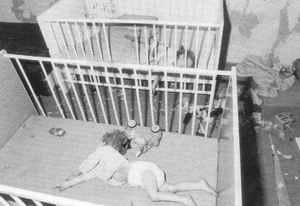
A highly relevant paper is that by Byard and Tsokos on asphyxial deaths among infants and young children. These are cases of foremost forensic importance. These cases often display vague or ambiguous autopsy findings, and sometimes none at all. The authors point to the great importance of inspection at the death scene and early examination of the body with which I fully agree. The autopsy and histopathological findings in relation to the cause (asphyxia) are discussed in detail. Unfortunately, the conclusion might be that petechiae, pulmonary congestion, Tardieu spots etcetera are no reliable indicators of asphyxia per se.
The article on complex and occupation-related suicides are lists of curiosities. Unfortunately, the really difficult cases are always unique and these articles, despite their extensive reference list might be of little help in cases where the differential diagnoses are homicide or accident.
Identification of virus in autopsy specimens are seldom performed routinely, not even in cases of sudden unexpected death without apparent cause. The paper on viral myocarditis by Dettmayer and Madea makes a convincing case for that both immunohistochemical and molecular analyses should be done regularly in such cases. The inflammatory infiltrate might be inconspicuous and the Dallas criteria for myocarditis may not be fulfilled, but still indirect evidence for viral presence in the myocardium can be demonstrated with immunohistochemistry and the virus genome can be found by PCR. This has been shown in several studies. However, what is needed to confirm those case by case findings is a larger prospective study including control cases.
 |
I was fascinated by the review of forensic applications of entomology by Mark Benecke, "Arthropods and Corpses" . He gives us 10 golden rules for collection of arthropod evidence, which make this article very useful in practical work. Most of us are acquainted with post-mortem artifacts caused by insects (and vertebrates) but that the common bullet hole lesions are caused by Silphid beetles and not the maggots might not be common knowledge.
The paper on "Practical Toxicology for the Forensic Pathologist" by James R Gill is difficult to fully appreciate. There are many useful facts and the tables are useful as a reference. However, as a whole the space is too limited, to cover all issues and therefore not so useful as a reference work. The really pertinent facts are those of the last sections dealing with "Club"- and "Date Rape" drugs.
The forensic anatomic pathology of anabolic-androgenic-steroid abuse is the topic of the next chapter. It is a short and concise review of the present knowledge of the subject written by Roland Hausmann. The knowledge is based on a few animal experiments but mostly on case studies of body builders and other athletes.
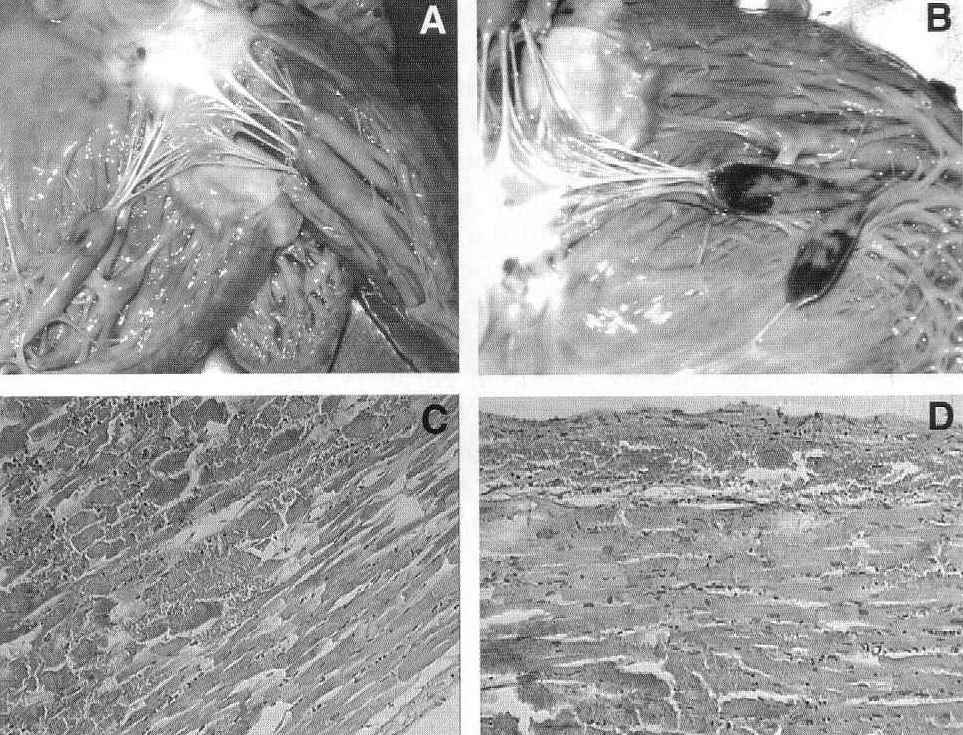
At last a review of Subendocardial Hemorrhages" by Stephan Seidl. I think that this kind of article is the "raison d´être" for a book series on forensic anatomical pathology. Subendocardial hemorrhages are commonly seen, often overlooked, and its meaning sometimes neglected. Here is a valuable summary of what is known of the etiology, pathogenesis and morphology of this phenomenon. The figure on the left depicts the quality of pictures that appear in this chapter.
As a whole, reading this volume, was rewarding in that it contains both new knowledge and refreshes old knowledge. It is not a perfect resource text-book (and probably not intended to be so) but for example a useful source for those who teach forensic medicine. I look forward to read further volumes of Forensic Pathology Reviews.
 |
-Erik Edston Dr. Erik Edston is on the editorial board of Anil Aggrawal's Internet Journal of Forensic Medicine and Toxicology. Click image to have more information about him. |
 Review 1 by Erik Edston, Sweden
Review 3 by Ronald Wright, USA
An Exclusive interview with Michael Tsokos
Review of Forensic Pathology Reviews (vol 1) appearing in this journal [Vol 5, no. 2 (July - December 2004)]
Other reviews of this book:
Order Humana Press Books by clicking here.
or via telephone: (973) 256-1699 or Fax: (973) 256-8341 or Email:humana@humanapr.com
Request a PDF file of this review by clicking here. (If your screen resolution can not be increased, or if printing this page is giving you problems like overlapping of graphics and/or tables etc, you can take a proper printout from a pdf file. You will need an Acrobat Reader though.)
N.B. It is essential to read this journal - and especially this review as it contains several tables and high resolution graphics - under a screen resolution of 1600 x 1200 dpi or more. If the resolution is less than this, you may see broken or overlapping tables/graphics, graphics overlying text or other anomalies. It is strongly advised to switch over to this resolution to read this journal - and especially this review. These pages are viewed best in Netscape Navigator 4.7 and above.
-Anil Aggrawal


 [ Major links ]
[ Aims and Objectives ] [ FAQ ] [ Editorial Board ] [ Contributing Partners ] [ Sitemap ]
[ Paper/Thesis submission guidelines ] [ Editorials - Cumulative Index ] [ Discussion ] [ Chat room ] [ Be our sponsor! ]
[ Cumulative index of Book Reviews sorted by | Publishers | General Interest Books | Technical Books ] [ Animated Reviews ] [ Featured Reviews ]
[ Reviews with Quizzes ] [ Links ] [ Submit books/journals/software/multimedia for review ] [ journal CD ] [ History of the Journal ] [ Interviews ] [ Credits ]
[ Cumulative index of | Theses/dissertations | [ Online Courses ] [ Awards ] [ Anil Aggrawal's Internet Journal of Book Reviews - Sister Publication ]
[ Undergraduate section | Postgraduate section ]
[ Cumulative reviews of Software/Multimedia | Books on CD/Audio tapes ] | Calenders | Models ] [ contact us ]
Books for review must be submitted at the following address.
Professor Anil Aggrawal (Editor-in-Chief)
Anil Aggrawal's Internet Journal of Forensic Medicine and Toxicology
S-299 Greater Kailash-1
New Delhi-110048
India
Click here to contact us.
This page has been constructed and maintained by Dr. Anil Aggrawal, Professor of Forensic Medicine, at the Maulana Azad Medical College, New Delhi-110002. You may want to give me the feedback to make this pages better. Please be kind enough to write your comments in the guestbook maintained above. These comments would help me make these pages better.
 IMPORTANT NOTE: ALL PAPERS APPEARING IN THIS ONLINE JOURNAL ARE COPYRIGHTED BY "ANIL AGGRAWAL'S INTERNET JOURNAL OF FORENSIC MEDICINE AND TOXICOLOGY" AND MAY NOT BE REPOSTED, REPRINTED OR OTHERWISE USED IN ANY MANNER WITHOUT THE WRITTEN PERMISSION OF THE WEBMASTER
Questions or suggestions ? Please use ICQ 19727771 or email to dr_anil@hotmail.com
Page Professor Anil Aggrawal via ICQ

|


