|
|
|
 Forensic Pathology Reviews, Vol. 2, Edited by Michael Tsokos. Hard Bound, 6" x 9".
Humana Press Inc., 999 Riverview Drive, Suite 208, Totowa, New Jersey 07512; Publication Date 9 December, 2005. xvi + 311 pages, ISBN 1-58829-415-3. Price $99.50
 Official Site:Click here to visit
 Amazon link:Click here
 |
This is one of those rare high quality books, that won critical acclaim from all three of our reviewers. The fact that they come from three different continents, confirms that this book has a global appeal. The board of editors decided to run some excerpts from this immensely useful book, so one could judge what a valuable addition to forensic literature this book has been.
 |
The book comprises of 13 chapters all relating to vastly different topics, covering almost the entire gamut of forensic pathology. One of the chapters that I liked most was the sixth entitled Complex suicides [written by Michael Bonhert of the Institute of Forensic Medicine, University Hospital of Freiburg, Germany]. This could perhaps be because I saw several cases of complex suicide during my postgraduation period and I was quite fascinated by this phenomenon. The term "complex suicide" refers to suicides in which more than one suicide method is applied. I distinctly remember having seen a case in which a person first tried to kill himself by slashing his wrists. When he did not die, he consumed some poison, but perhaps the poison was adulterated! Finally out of frustration he hanged himself with a rope!!
The case above was of course an example of "unplanned complex suicide", where the victim did not intend all the methods from the very beginning. He had to resort to these methods only because earlier methods failed. In "planned complex suicides", the victim arranges for two or more methods from the very beginning in order to ensure that death does occur. In planned complex suicides, typically ingestion of some hypnotic with slashing of wrists and lying down in a tub of water is employed. While ingestion of hypnotic serves to keep the victim's nerves calm, the slashing of wrists makes the radial artery bleed very fast. Lying down in the tub prevents any possible clotting around the cut, as the water drains away the blood quickly.
Here is what Bonhert has to say on typical combinations of methods applied to planned complex suicides (pages 128-132)...
INTRODUCTIONThe term "complex suicide" refers to suicides in which more than one suicide method is applied. On the one hand, this refers to those cases in which the simultaneous combination of several methods of suicide is employed to guarantee one will at least succeed. The purpose of the second suicide method employed - and any further method that may be employed, too - is to serve as a safeguard in case that the first method fails. However, the term "complex suicide" is also used for those cases in which the methods of suicide are not applied simultaneously, but one after the other. This may be the case if the first method chosen did not cause death, if death occurs too slowly, or this method causes too much pain. Contrary to the aforementioned cases, those suicides have to be distinguished in which the suicidal individual uses the same tool several times successively, because the first injury did not cause death immediately or at least did not induce immediate incapacitation. This may be the case especially when firearms or sharp tools are used to commit suicide. For a better differentiation, it has been suggested to distinguish between primary combined or planned complex suicides and secondary combined or unplanned complex suicides. Pollak called those suicides in which "the success is to be guaranteed by a planned coincidence or mutual acceleration of two or more methods of suicide" primary combined suicides. In contrast to the aforementioned group, secondary combined suicides are those in which the suicidal individual uses one or several other forms of inflicting damage to him or herself directly after the unintentional failure of a first attempt in one and the same course of action. Hofmann and Herber recommended using the term "prolonged suicide" instead of "secondary combined suicide," as one cannot speak of a combination of different methods of suicide in the proper sense of the word. In the American literature, the emphasis is put more on the dichotomy of planned complex vs unplanned complex instead of primary combined vs secondary combined. Here, the distinction between simple and complex suicides that was first made by Marcinkowski is preferred, with the latter group being subdivided again into planned and unplanned suicides. During the last 25 years, numerous reports have dealt with complex suicides. Almost all of them are case reports and accordingly systematic investigations concerning the frequency of complex suicides are rare. In many publications on the epidemiology of suicide, complex suicides are not mentioned at all or only on the fringe. According to the literature, complex suicides account for 1.5 to 5% of all completed ("successful") suicides. From the criminological point of view, the presence of several different. injuries found on a deceased are especially suspicious for homicide. Careful inspection of the death scene, a thorough investigation of the surroundings of the deceased, and a full autopsy are necessary to elucidate the correct mode of death in such cases. Additionally, the objective of these investigations must be to allow a precise reconstruction of the sequel of events prior to death.
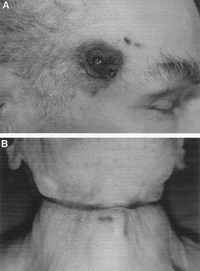
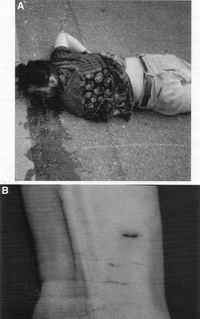
PLANNED COMPLEX SUICIDESGeneralThe most obvious reasons why several methods of suicide are applied simultaneously are to guarantee death, accelerate death, or cause less pain to the suicidal individual by a planned combination of methods. The latter is especially true when hypnotics or other sedative medications are taken. According to Pollak, the combination of different methods may also be designed in such a way that the second method is only activated when the first method has failed, but then automatically. The individual methods used for complex suicides do not differ from those used in "simple" suicides (in the sense of employing only one suicide method). An international comparison shows at best the typical, regionally different frequencies in the use of the various methods of suicide. For example, firearms are used more frequently in the United States than in European countries. Accordingly, reports on complex suicides using firearms are more often published by US authors. There is hardly any combination of suicide methods that is not imaginable. However, certain combinations are seen more often than others, which are only rarely employed. For example, sharp-force injuries are relatively rarely seen in planned complex suicides. They are seen more frequently in unplanned complex suicides in which they are the suicide method of first choice but then given up in favor of another method. Since the mid-1990s, numerous reports have been published concerning the combination of ingesting toxic substances and then putting a plastic bag over one's head, mainly in connection with assisted suicide. To what extent all these cases were categorized correctly remains questionable. The number of unrecorded cases of assisted suicide is probably very high. Typical Combinations of Methods Applied to Planned Complex SuicidesA typical feature of primary complex suicides is the simultaneous application of two methods of suicide. Since the early 1980s, only one case report on a planned complex double suicide in which more than two methods were applied at the same time has appeared. Common combinations are ingestion of hypnotics or other medicaments and hanging, ingestion of hypnotics or other medications and drowning, ingestion of hypnotics or other medications and suffocation by a plastic bag put over the head, use of firearms and hanging (Fig. 1 A,B - above right), and use of firearms and drowning. The methods used for committing a planned complex suicide reflect the spectrum of the classical methods of suicide. That the ingestion of hypnotics or other sedative drugs is so common in planned complex suicides seems to be attributable to the fact that this continues to be one of the most frequently used methods of suicide in general. One motive for the use of hypnotics or other sedative drugs in primary complex suicides may be the suicidal person's intention to avoid painful suffering as soon as the second method is activated. This appears plausible from the suicidal individual's point of view especially when so-called "hard" methods of suicide (e.g., use of firearms, hanging, jumping from a height) are combined as second method. On the other hand, it seems also worth discussing whether, especially in combination with drowning or suffocation in a plastic bag, the primary intention may have been even death by intoxication per se, with the second method serving merely as a safeguard in case that the first method has failed.
In deaths resulting from suffocation by use of a plastic bag, the combination with previous intake of drugs that affect the central nervous system (CNS) is the most common variation in general. This method of suicide was and still is often recommended by organizations for assisted suicide. Especially in the United States, but also in Switzerland, a considerable rise in the number of suicides committed in this way has been reported. Firearms are used almost exclusively by males, both as sole method of suicide and in combination with other methods. Apart from firearms (in the strict sense of this term), several cases of complex suicides using slaughterer's guns have been reported. In the majority of cases, the shot was fired against the head. Typically, this method is often combined with another hard method of suicide such as hanging, traffic accidents, or jumping from a height. 3. ATYPICAL COMBINATIONS OF METHODS APPLIED TO PLANNED COMPLEX SUICIDES Atypical planned complex suicides represent not only rare combinations of means of suicide, but also the simultaneous use of more than two suicide methods. The case reports published so far focus mainly on atypical constellations. A survey of the cases published since the early 1980s, with partly unusual combinations of the methods applied, is presented in Table 1. Those cases in which suicidal individuals inflicted injuries on themselves by firing several firearms at the same time are worth mentioning. In such cases, the postmortem examination of the deceased must be performed with special attention to the attribution of every single gunshot wound to one of the weapons involved. Moreover, the weapons and the hands firing the shots and, if necessary, also the firing devices specifically constructed, have to be investigated in order to allow reconstruction of the sequel of events. Another rare combination includes self-incineration. Publications of cases of self-incineration are of more recent date; in the earlier literature no information is presented on this subject. Complex suicides in road traffic also seem to be very rare. Although injuries caused by an additional mechanical blunt impact will normally be detected at autopsy, it might be very difficult or even impossible to distinguish especially the fatal combination of ingestion of drugs and trauma in traffic accidents from real accidents. Anyway, it has to be assumed that a high number of suicides in road traffic remains undetected. |
||
I am sure you find this as interesting and informative as I did. Well, take my advice and read the whole book. It is full of nuggets like these.
 Review 1 by Erik Edston, Sweden
Review 3 by Ronald Wright, USA
An Exclusive interview with Michael Tsokos
Review of Forensic Pathology Reviews (vol 1) appearing in this journal [Vol 5, no. 2 (July - December 2004)]
Other reviews of this book:
Order Humana Press Books by clicking here.
or via telephone: (973) 256-1699 or Fax: (973) 256-8341 or Email:humana@humanapr.com
Request a PDF file of this review by clicking here. (If your screen resolution can not be increased, or if printing this page is giving you problems like overlapping of graphics and/or tables etc, you can take a proper printout from a pdf file. You will need an Acrobat Reader though.)
N.B. It is essential to read this journal - and especially this review as it contains several tables and high resolution graphics - under a screen resolution of 1600 x 1200 dpi or more. If the resolution is less than this, you may see broken or overlapping tables/graphics, graphics overlying text or other anomalies. It is strongly advised to switch over to this resolution to read this journal - and especially this review. These pages are viewed best in Netscape Navigator 4.7 and above.
-Anil Aggrawal

 [ Major links ]
[ Aims and Objectives ] [ FAQ ] [ Editorial Board ] [ Contributing Partners ] [ Sitemap ]
[ Paper/Thesis submission guidelines ] [ Editorials - Cumulative Index ] [ Discussion ] [ Chat room ] [ Be our sponsor! ]
[ Cumulative index of Book Reviews sorted by | Publishers | General Interest Books | Technical Books ] [ Animated Reviews ] [ Featured Reviews ]
[ Reviews with Quizzes ] [ Links ] [ Submit books/journals/software/multimedia for review ] [ journal CD ] [ History of the Journal ] [ Interviews ] [ Credits ]
[ Cumulative index of | Theses/dissertations | [ Online Courses ] [ Awards ] [ Anil Aggrawal's Internet Journal of Book Reviews - Sister Publication ]
[ Undergraduate section | Postgraduate section ]
[ Cumulative reviews of Software/Multimedia | Books on CD/Audio tapes ] | Calenders | Models ] [ contact us ]
Books for review must be submitted at the following address.
Professor Anil Aggrawal (Editor-in-Chief)
Anil Aggrawal's Internet Journal of Forensic Medicine and Toxicology
S-299 Greater Kailash-1
New Delhi-110048
India
Click here to contact us.
This page has been constructed and maintained by Dr. Anil Aggrawal, Professor of Forensic Medicine, at the Maulana Azad Medical College, New Delhi-110002. You may want to give me the feedback to make this pages better. Please be kind enough to write your comments in the guestbook maintained above. These comments would help me make these pages better.
 IMPORTANT NOTE: ALL PAPERS APPEARING IN THIS ONLINE JOURNAL ARE COPYRIGHTED BY "ANIL AGGRAWAL'S INTERNET JOURNAL OF FORENSIC MEDICINE AND TOXICOLOGY" AND MAY NOT BE REPOSTED, REPRINTED OR OTHERWISE USED IN ANY MANNER WITHOUT THE WRITTEN PERMISSION OF THE WEBMASTER
Questions or suggestions ? Please use ICQ 19727771 or email to dr_anil@hotmail.com
Page Professor Anil Aggrawal via ICQ

|