|
|
|
|
 Forensic Pathology Reviews, Vol. 2, Edited by Michael Tsokos. Hard Bound, 6" x 9".
Humana Press Inc., 999 Riverview Drive, Suite 208, Totowa, New Jersey 07512; Publication Date 9 December, 2005. xvi + 311 pages, ISBN 1-58829-415-3. Price $99.50
 Official Site:Click here to visit
 Amazon link:Click here
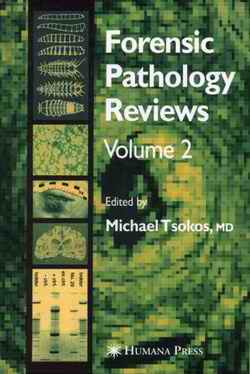 |
This is the second volume in the ongoing series of reviews in forensic pathology being brought forth by Humana Press. This reviewer had already read and commented on the first volume, which dealt with the pathology of death from burns, and kicking and trampling injuries, the clinical and pathological features of Mycoplasma pneumoniae respiratory infection, medicolegal problems associated with complex issues of neonaticide and sudden infant death syndrome, and some interesting aspects of death scene investigation, besides a host of other fascinating topics. The second volume of the series is a smooth continuation of volume 1, and as in the case of the latter, has contributions from several leading national and international forensic pathologists who discuss in depth, some other topics from the fields of forensic pathology and death scene investigation which were not discussed in the earlier volume. These critical reviews focus on common and uncommon situations likely to be encountered in daily forensic practice, as well as on more unusual, even bizarre conditions encountered in the autopsy room. The authors of the various chapters explore new vistas of forensic pathology, including starvation deaths of neglected children, head injuries inflicted by glass bottles, biomechanical and pathological features of primary cerebral neoplasms, medicolegal implications and complications of obesity, and the intricacies of infant asphyxial deaths. Other topics covered include complex suicides, viral myocarditis in sudden death cases, curious death scene phenomena (hiding, covering, and undressing), forensic entomology, the interpretation of toxicological findings, anabolic-steroid abuse, and autopsy findings of subendocardial hemorrhages. An invaluable list of references is given at the end of each chapter.
 |
Chapter 1 delves into the forensic aspects of death due to starvation in infants, who have been deliberately deprived of food and nutrients. This distressing and heinous offence, that has not been dealt with in detail by conventional treatises on forensic pathology has been starkly highlighted in this book, with guidance on how an expert opinion may be formed on the degree and duration of starvation by applying different classification systems of protein-energy malnutrition to such cases. Chapter 2 takes a detailed look at the mechanics and pathology of head injuries inflicted by glass bottles. The descriptions of the pathognomonic findings in such cases are buttressed by exquisite biomechanical data, and valuable guidelines are outlined for practical casework. Sample an interesting case below.
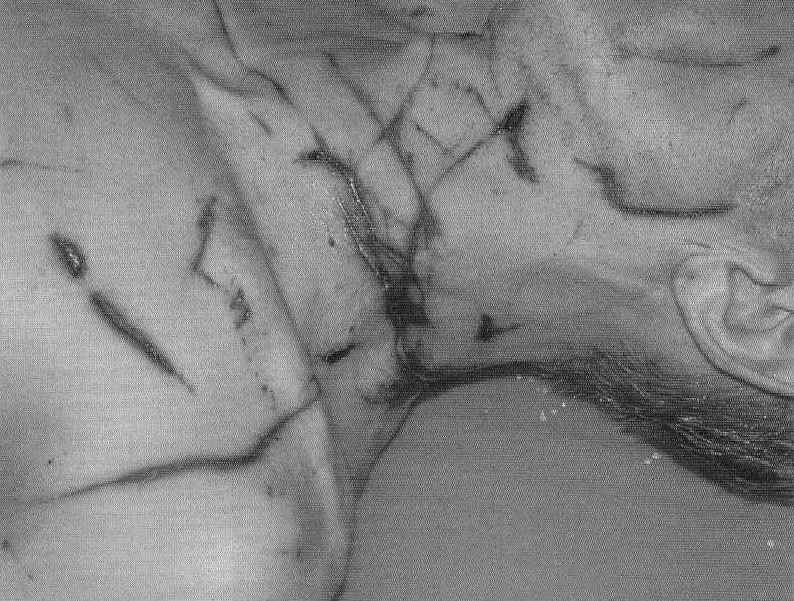 |
During homosexual intercourse, a 52-year-old man (the eventual victim) demanded further bizarre sexual activities from his partner, who refused. Thereupon, the man tried to hit his partner's head with a beer bottle. The partner escaped this assault and subsequently repeatedly hit the victim's head with a beer bottle. The bottle burst into pieces but the victim did not lose consciousness. During the fight that followed, the victim sustained several stab wounds. At autopsy, exsanguination caused by several stab wounds and incised wounds of the thorax and the neck (Fig on the right) was determined as cause of death. The incised wounds were attributable to assaults with a knife derived from glass splinters, too. In addition to the incised wounds that were caused by the glass splinters, lacerations of the scalp that were attributed to the blow with the beer bottle were observed. These injuries comprised large-sized hematomas with several short and angled lacerations, as well as streaky impressions of the tabula externa accompanied by subarachnoidal hemorrhage.
In Chapter 3, attention is devoted to current forensic concepts of primary cerebral neoplasms and their implications as per the World Health Organization's classification scheme. It is well known that such tumors can cause sudden, unexpected death in individuals not manifesting any warning symptoms, and therefore can be extremely important to elucidate in certain cases of undiagnosed death. Chapter 4 may not be as relevant to the Indian sub-continent as it certainly is to the Western world, dealing as it does with obesity, a problem that has assumed alarming proportions in these countries. For instance, in the USA alone, hundreds and thousands of deaths occur annually due to direct or indirect complications of obesity. This chapter provides an exhaustive review of the obesity epidemic, with detailed descriptions of definitions and measurements of obesity, as well as its critical pathological and forensic aspects.
 |
 |
Chapter 5 is a valuable monograph on infant and (early) childhood asphyxial deaths. The differential diagnosis between deliberately induced and accidental asphyxias has been lucidly discussed, with interesting descriptions of airway obstruction from natural causes, foreign body impaction, and the vexatious issue of sudden infant death syndrome (SIDS). Chapters 6 and 7 deal with unconventional forms and aspects of suicide that are fascinating in a bizarre way. Chapter 6 deals with complex suicides, i.e., suicides in which more than one method has been resorted to. In addition to an exhaustive review of existing literature on this topic, the criminological and forensic issues pertaining to these cases have been dissected threadbare. Chapter 7 presents the unusual scenario of occupation-related suicides, with a detailed discussion of medicolegal issues, and a list of practical guidelines for error-free forensic casework.
Sudden, unexpected death is the eternal bugbear of forensic pathologists around the world, and viral myocarditis is but one of a myriad causes that can stump even the most experienced expert. It has been suggested that myocarditis accounts for up to 20% of all such cases, and therefore constitutes a very important etiological factor. Unfortunately, it is not an entity that can be easily diagnosed on the basis of gross or microscopic findings. This chapter can be of great help in resolving such cases, since it outlines immunohistochemical and molecular-pathological techniques that can pinpoint myocarditis with a high degree of certainty.
Chapter 9 concerns itself with some unusual behaviour indulged in by a dying person that is occasionally encountered in forensic autopsy practice: hiding, covering, undressing. This kind of peculiar antemortem behaviour may evoke suspicion of foul play, and therefore a clear grasp of the causes for such phenomena is vital to the elucidation of perplexing cases. These curious behavioural actions have their roots in agonizing circumstances, when the conscious, rational mind is giving way to confused insensibility, and a knowledge of such behavioural pattern therefore can be vital to all those involved in unnatural death investigation.
Chapter 10 deals with a topic that is close to the heart of this reviewer: forensic entomology. It was something that started it all for me; the beginning of an arduous but highly enriching experience as a forensic pathologist spanning nearly two decades. Forensic entomology was a fledgling subject when I chose it as a topic for my MD dissertation, a far cry from the vital and dynamic specialty that it has grown into in the present day. This fascinating, though macabre subject has tremendous potential in crime investigation, some of which is yet to be tapped. Forensic arthropod evidence is not only useful for the determination of the postmortem interval, but also to the elucidation of cause of death when it is drug-related (entomotoxicology), and can even help provide proof of neglect of elderly individuals and children who have died a lonely death, besides many more areas of application. It is a field of study that should engage the attention of all forensic pathologists, when in fact the sad truth is that it is grossly neglected, especially in countries such as India, and much of the Third World.
Chapter 11 is one more jewel in the crown, and deals with another area that is of current interest to this reviewer (who is incidentally, presently heading a Poison Control Center located in South India): toxicology. This chapter is a veritable treasure house of critical information relating to the toxicological aspects of an unnatural death investigation, and includes a comprehensive discussion of common pitfalls that must be avoided. Chapter 12 deals with a related issue that is increasing in importance each day: the chronic effects of anabolic steroid abuse, and their associated complications. Chapter 13 rounds off the whole book with an excellent discourse on subendocardial haemorrhages, a feature noticed in many forensic autopsies, and yet among the least understood as far as causes are concerned.
All in all, Forensic Pathology Reviews, Volume 2 can be best described as a collection of incisive and exhaustive essays on a wide range of topics of interest to the average forensic specialist, dealt with in an impeccable, authoritative manner by eminent experts, offering investigators a rich storehouse of information on the latest medical and scientific advances applicable to current forensic medical practice.
|
-V.V.Pillay MD, DCL
Professor, Dept. of Forensic Medicine & Toxicology Chief, Dept of Analytical Toxicology (Incl. Poison Information Service), Amrita Institute of Medical Sciences & Research, Cochin 682026, South India Phones: 0484-2804852 (O); 0484-2807055 (R), 9895282388 (Cell) Email: toxicology@medical.amrita.edu Dr.V.V.Pillay has been in the vanguard of the movement among medical professionals in India to develop the neglected field of Toxicology. He has published extensively in both the scientific and lay press on matters relating to Toxicology, as well as his chosen discipline - Forensic Medicine. Dr.Pillay has authored 6 books on Forensic Medicine and Toxicology, and has received an award for one of them (Modern Medical Toxicology), generally considered to be a trend setter among books on the subject in India. He has reviewed several books on Toxicology for the Internet Journal of Forensic Medicine and Toxicology. Dr.Pillay received a scroll of honour in appreciation of work done in the field of Toxicology from the Medicolegal Society, All India Institute of Medical Sciences, New Delhi. He has established a state-of-the-art Poison Control Centre, recognized by the World Health Organization at the institute where he is currently employed (AIMS, Cochin). Among his most sought-after publications is a 700 page reference work on Toxicology. |
 Review 1 by Erik Edston, Sweden
Review 3 by Ronald Wright, USA
An Exclusive interview with Michael Tsokos
Review of Forensic Pathology Reviews (vol 1) appearing in this journal [Vol 5, no. 2 (July - December 2004)]
Other reviews of this book:
Order Humana Press Books by clicking here.
or via telephone: (973) 256-1699 or Fax: (973) 256-8341 or Email:humana@humanapr.com
Request a PDF file of this review by clicking here. (If your screen resolution can not be increased, or if printing this page is giving you problems like overlapping of graphics and/or tables etc, you can take a proper printout from a pdf file. You will need an Acrobat Reader though.)
N.B. It is essential to read this journal - and especially this review as it contains several tables and high resolution graphics - under a screen resolution of 1600 x 1200 dpi or more. If the resolution is less than this, you may see broken or overlapping tables/graphics, graphics overlying text or other anomalies. It is strongly advised to switch over to this resolution to read this journal - and especially this review. These pages are viewed best in Netscape Navigator 4.7 and above.
-Anil Aggrawal


 [ Major links ]
[ Aims and Objectives ] [ FAQ ] [ Editorial Board ] [ Contributing Partners ] [ Sitemap ]
[ Paper/Thesis submission guidelines ] [ Editorials - Cumulative Index ] [ Discussion ] [ Chat room ] [ Be our sponsor! ]
[ Cumulative index of Book Reviews sorted by | Publishers | General Interest Books | Technical Books ] [ Animated Reviews ] [ Featured Reviews ]
[ Reviews with Quizzes ] [ Links ] [ Submit books/journals/software/multimedia for review ] [ journal CD ] [ History of the Journal ] [ Interviews ] [ Credits ]
[ Cumulative index of | Theses/dissertations | [ Online Courses ] [ Awards ] [ Anil Aggrawal's Internet Journal of Book Reviews - Sister Publication ]
[ Undergraduate section | Postgraduate section ]
[ Cumulative reviews of Software/Multimedia | Books on CD/Audio tapes ] | Calenders | Models ] [ contact us ]
Books for review must be submitted at the following address.
Professor Anil Aggrawal (Editor-in-Chief)
Anil Aggrawal's Internet Journal of Forensic Medicine and Toxicology
S-299 Greater Kailash-1
New Delhi-110048
India
Click here to contact us.
This page has been constructed and maintained by Dr. Anil Aggrawal, Professor of Forensic Medicine, at the Maulana Azad Medical College, New Delhi-110002. You may want to give me the feedback to make this pages better. Please be kind enough to write your comments in the guestbook maintained above. These comments would help me make these pages better.
 IMPORTANT NOTE: ALL PAPERS APPEARING IN THIS ONLINE JOURNAL ARE COPYRIGHTED BY "ANIL AGGRAWAL'S INTERNET JOURNAL OF FORENSIC MEDICINE AND TOXICOLOGY" AND MAY NOT BE REPOSTED, REPRINTED OR OTHERWISE USED IN ANY MANNER WITHOUT THE WRITTEN PERMISSION OF THE WEBMASTER
Questions or suggestions ? Please use ICQ 19727771 or email to dr_anil@hotmail.com
Page Professor Anil Aggrawal via ICQ

|