


|
|
|
|
 Clinical Forensic Medicine - A Physician's Guide, 2ndEdition, Edited by Margaret M. Stark. Hard Bound, 6" x 9". [Includes eBook/PDA on CD-ROM]. Foreword by Sir John Stevens, former Commissioner of the Metropolitan Police Service, London, UK
Humana Press Inc., 999 Riverview Drive, Suite 208, Totowa, New Jersey 07512; Publication Date: 11 April 2005. xvii + 438 pages, ISBN 1-58829-368-8, E-ISBN 1-59259-913-3. List price US $99.50 (10% discount with online order).
 Amazon Link: Click here to visit
 |
I received the electronic edition of this book for review. First a word about this format; e-books are increasingly entering the world of publishing for several reasons. First, a reasonably large portable computer can hold about 10,000 text books of the size of Clinical Forensic Medicine. This is calculated from the availability of a portable computer of 23 gigabytes of free hard disk or storage. Clinical Forensic Medicine in PDF format is 2.36 megabytes. I downloaded my copy to my Treo combination phone and PDA and it took 2.73 megabytes of 21 megabytes available on this device. I just completed a trip around the Southeastern parts of the United States by airplane and found that reading the work on my Treo was pleasant and efficient. In addition, although the work has a very extensive index, using the search features of Adobe PDF allows one to search and read anything in the book rapidly and quickly.
Oddly, for reasons which are not explicable to me, the cost of the hard copy is the same as the cost for the e-document. Considering the cost of binding and printing, the cost of the hard copy should be significantly more. Apparently, the price demand curve works in such a way that the e-book costs as much as the hard back.
The book itself is indeed a guide for physicians who work in the field of forensic medicine. For readers in the United States, where forensic medicine is not a generally recognized practice, the practice entails general practice with emphasis upon assisting law enforcement personnel in their duties. If one looks over this book one sees the following chapters:
 ...I recommend this book highly to those who have made forensic medicine a career as well as all emergency medicine practitioners, those working as medical directors for jails or prisons, general practitioners doing out-patient wound care as well as forensic pathologists. All of these practitioners urgently need the information contained within this book... ...I recommend this book highly to those who have made forensic medicine a career as well as all emergency medicine practitioners, those working as medical directors for jails or prisons, general practitioners doing out-patient wound care as well as forensic pathologists. All of these practitioners urgently need the information contained within this book...
|
Of the twelve chapters, only one deals with the area of death exclusively, and this concerns deaths in Custody. The other chapters deal primarily with living persons, either persons in custody or individuals who are allegedly injured during the commission of a crime. A textbook of forensic pathology in the United States, or in England deals almost exclusively with issues concerning determination of the causes of death. The information contained in this work is extremely valuable and well organized for the practitioner of forensic medicine, but it is my experience as a forensic pathologist, that in the United States, lacking a recognized specialty of forensic medicine, that the material contained within this book would be of great assistance in filling the needs of law enforcement in dealing with issues which arise with the care of detainees and documenting injuries allegedly occurring in the living.
 |
I recommend this book highly to those who have made forensic medicine a career as well as all emergency medicine practitioners, those working as medical directors for jails or prisons, general practitioners doing out-patient wound care as well as forensic pathologists. All of these practitioners urgently need the information contained within this book.
The history section by Jason Payne-James is worth the price of the book. It is the most thoroughly researched history of forensic medicine I have ever seen. Professor Eckert was perhaps the most famous student of this history in the United States, but none of his works covered the breadth covered by Payne-James. Unfortunately, Eckert's works are not referenced, nor is the role of the United States in the development of forensic medicine, this representing perhaps a reasonable bias based upon the lack of the specialty in the United States.
...The section on Sexual Assault investigation also by Deborah Rogers and Mary Newton is also extremely well done with a presentation of the latest information on the collection of specimens for lubricants, an important item where these are alleged to have been used in condom protected vaginal or anal assault. There are 215 references with the most recent being published in 2003...
|
The section on Sexual Assault investigation also by Deborah Rogers and Mary Newton is also extremely well done with a presentation of the latest information on the collection of specimens for lubricants, an important item where these are alleged to have been used in condom protected vaginal or anal assault. There are 215 references with the most recent being published in 2003.
The chapters on Medical Issues Relevant to Restraint, Care of Detainees, Infectious Diseases and Substance Misuse deal primarily with these issues in a jail or prison population. Again, these chapters are extremely well done and are of importance to not only practitioners of forensic medicine, but to directors of prison and jail medical services as well as to forensic pathologists.
The sections on Injury Assessment, Non-accidental Injury in Children and Traffic Medicine all deal primarily with the proper documentation of injuries and estimations of how the injuries occurred and how long ago. Again, these are important items for all physicians in general practice, emergency medicine as well as practitioners of forensic medicine and pathology.
The Appendices are collections of Drink and Drugs Driving Impairment Assessment, evaluation of head injuries and evaluation of alcohol abuse generally are all important items to have easily at ones fingertips.
...Overall, this is a great work which should be on the shelf (or the computer or PDA) of most English speaking physicians in the World. While oriented to the English, the principles are generic and equally applicable to physicians in the United States, Japan or India...
|
However, the ethical cannons are very important and have been included in the Appendix. The Code of Conduct for Law Enforcement Officials passed by the United Nations General Assembly, the Declaration on the Police by the Council of Europe, the Declaration of Tokyo (on torture and mistreatment of prisoners) by the World Medical Assembly and the Principles of Medical Ethics Relevant to the Role of Health Personnel, Particularly Physicians, in the Protection of Prisoners and Detainees against Torture and Other Cruel, Inhuman or Degrading Treatment or Punishment adopted by the United Nations are all important items which all physicians involved with law enforcement, whether civilian or military, should have available at all times. By including these international rules in this book, it makes ready reference to them easy whether the book is purchased in electronic format or hard back.
Overall, this is a great work which should be on the shelf (or the computer or PDA) of most English speaking physicians in the World. While oriented to the English, the principles are generic and equally applicable to physicians in the United States, Japan or India.
-Dr. Ronald Wright
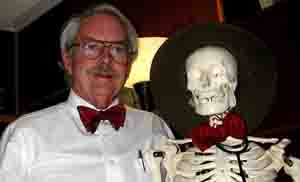 |
-Ronald Wright Dr. Ronald K. Wright is Associate Professor of Pathology and Director of Forensic Pathology Division at Jackson Memorial Hospital Miami, Florida. He can be contacted at rkw@rkwrightmd.com. Dr. Wright is on the left as you look at the photograph. |
Order Humana Press Books by clicking here.
or via telephone: (973) 256-1699 or Fax: (973) 256-8341 or Email: humana@humanapr.com
 Request a PDF file of this review by clicking here. (If your screen resolution can not be increased, or if printing this page is giving you problems like overlapping of graphics and/or tables etc, you can take a proper printout from a pdf file. You will need an Acrobat Reader though.)
N.B. It is essential to read this journal - and especially this review as it contains several tables and high resolution graphics - under a screen resolution of 1600 x 1200 dpi or more. If the resolution is less than this, you may see broken or overlapping tables/graphics, graphics overlying text or other anomalies. It is strongly advised to switch over to this resolution to read this journal - and especially this review. These pages are viewed best in Netscape Navigator 4.7 and above.
-Anil Aggrawal


 [ Major links ]
[ Aims and Objectives ] [ FAQ ] [ Editorial Board ] [ Contributing Partners ] [ Sitemap ]
[ Paper/Thesis submission guidelines ] [ Editorials - Cumulative Index ] [ Discussion ] [ Chat room ] [ Be our sponsor! ]
[ Cumulative index of Book Reviews sorted by | Publishers | General Interest Books | Technical Books ] [ Animated Reviews ] [ Featured Reviews ] [ E-books ]
[ Reviews with Quizzes ] [ Links ] [ Submit books/journals/software/multimedia for review ] [ journal CD ] [ History of the Journal ] [ Interviews ] [ Credits ]
[ Cumulative index of | Theses/dissertations | [ Online Courses ] [ Awards ] [ Anil Aggrawal's Internet Journal of Book Reviews - Sister Publication ]
[ Cumulative reviews of Software/Multimedia | Books on CD/Audio tapes ] | Calenders | Models ] [ contact us ]
[ Undergraduate section | Postgraduate section ] [ Forensic gadgets/toys/other tidbits ]
Books for review must be submitted at the following address.
Professor Anil Aggrawal (Editor-in-Chief)
Anil Aggrawal's Internet Journal of Forensic Medicine and Toxicology
S-299 Greater Kailash-1
New Delhi-110048
India
Click here to contact us.
This page has been constructed and maintained by Dr. Anil Aggrawal, Professor of Forensic Medicine, at the Maulana Azad Medical College, New Delhi-110002. You may want to give me the feedback to make this pages better. Please be kind enough to write your comments in the guestbook maintained above. These comments would help me make these pages better.
 IMPORTANT NOTE: ALL PAPERS APPEARING IN THIS ONLINE JOURNAL ARE COPYRIGHTED BY "ANIL AGGRAWAL'S INTERNET JOURNAL OF FORENSIC MEDICINE AND TOXICOLOGY" AND MAY NOT BE REPOSTED, REPRINTED OR OTHERWISE USED IN ANY MANNER WITHOUT THE WRITTEN PERMISSION OF THE WEBMASTER
Questions or suggestions ? Please use ICQ 19727771 or email to dr_anil@hotmail.com
Page Professor Anil Aggrawal via ICQ

|


