

|

|
|
|
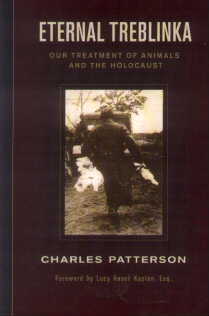
 Eternal Treblinka: Our Treatment of Animals and the Holocaust by Charles Patterson, Paperback, 6" x 9"
Lantern Books, One Union Square West, Suite 201, New York, NY 10003, USA. E-mail:eternaltr@earthlink.net: Publication Date 2002. xvi+296 pages, ISBN 1-930051-99-9. Price $20.00
 |
The author Charles Patterson, Ph.D is a historian in the USA.
This book advocates human rights for the living species popularly referred to animals. It sets out to achieve this objective by arguing that the Holocaust was merely an extension of cruelties perpetrated on animals by Homo sapiens. A chilling analogy of the treatment of animals over the ages and the horrors of treatment of man by fellow man over the years through genocide, wars, pogroms and eugenics is presented in rather convincing arguments.
The book is divided into three parts made up of a total of 8 chapters. In Part I, made up of two chapters and titled 'A fundamental debacle', the author recounts historical including biblical and cultural injunctions asserting the supremacy of man over all other living creatures. Specifically, reference is made to Genesis 1:28 in which man is given dominion over the earth. To effect this dominion, other living things are abused and exploited to gratify various appetites of the Homo sapiens. The Greek philosopher, Aristotle, according to the author, 'maintained that man's dominion over animals extended to slaves and women as well'. Unfortunately for humankind those considered inferior are 'vilified' by terming and treating them as animals. Other humans selected for humiliating exploitation and abuse are first renamed such animals as beasts, wolves, apes, pigs, rats, vermin etc to justify abuses to be visited on them either through wars or outright/naked brigandage.
 ...A chilling analogy of the treatment of animals over
the ages and the horrors of treatment of man by fellow man over the years through genocide, wars, pogroms and eugenics is presented in
rather convincing arguments... ...A chilling analogy of the treatment of animals over
the ages and the horrors of treatment of man by fellow man over the years through genocide, wars, pogroms and eugenics is presented in
rather convincing arguments...
|
Part II is titled 'Master species, master race' and is divided into three chapters. The author presents what amounts to an indictment of America in the Holocaust. First it was America that industrialized the slaughter of animals for food, clothing and other human necessities. This extended to breeding of animals to supply the slaughter industries. Henry Ford adapted the assembly-line mechanics of animal agriculture in America in his motor industry and this was aped by Nazi Germany in the execution of Holocaust. As appetite grows on what it is fed, it was only a simple extension of the slaughter of animals to the slaughter of humans who have been denigrated, categorized and renamed animals. This according to the author is what led to the massacre of conquered, enslaved and ethnic peoples through history. This scenario accounts for the treatment of Hottentots in Africa, natives in the Americas and most recently Jews in Germany and the rest of Europe wherever the German machine under the command of Adolph Hitler could lay its murderous hands on them. The analogy of the animal slaughterhouses and abattoirs of America and the extermination chambers of Nazi Germany's Auschwitz concentration camp is irresistibly convincing. However, that the former is culpable for the later as the author attempts to propose is quite arguable. Yet the cruelty to animals by man over the years whether in the process of the exploitation of animals to satiate the wants of man or for sadistic pleasure is quite clearly brought to sharp focus by juxtaposing these treatments to animals to similar treatments to fellow men by men in the history of humankind.
While the follies of man to man are quite regrettable, this book should be compulsory reading for history and sociology requirements in tertiary institutions so that future leaders can learn the consequences of certain ruthless activities of years past and avoid repetitions in the future. It is instructive how the Christian clergy and laity at one time or the other overlooked clear injunctions in the doctrine to propose, endorse or accommodate or tolerate racism and allied crimes against humanity as stated in the book.
Finally, Part III titled 'Holocaust echoes' is divided into three chapters. The first of these recounts individuals who through personal experience of the Holocaust or by proxy became champions of animal rights. Some of these became vegetarians or vegans.
...While the follies of man to man are quite regrettable, this book should be compulsory reading for history and sociology requirements in tertiary institutions so that future leaders can learn the consequences of certain ruthless activities of years past and avoid repetitions in the future...
|
In the second chapter, the author writes about the 1978 Nobel Prize in Literature winner, Isaac Bashevis Singer (1904-1991). Singer's several books focusing on the abuse of animal rights especially by apparently religious people, Christians and Jews alike, severally alludes to the Holocaust. He laments the sacrifices offered to God in the book of Leviticus. The title of this book Eternal Treblinka is taken from a short story titled The Letter Writer written by Singer: "All other creatures were created merely to provide him with food.. In relation to them, all people are Nazis; for the animals it is eternal Treblinka"
The third and final chapter of Part III chronicles the actions of other animal rights advocates and activists who are of German extraction and who were not Jewish. The aim here is perhaps to give animal rights activism a global non-racial nondenominational outlook. These people were originally carnivorous but later, by circumstances, turned to vegetarianism, some further becoming vegans
There is an 'Afterword' at the end of the text. This may be seen as the Conclusion of the message. 'The sooner we put an end to our cruel and violent way of life, the better it will be for all of us -perpetrators, bystanders, and victims". There is a reference list at the end of the book. This affords readers the opportunity for further foray into the subject under discussion. The numbering and arrangement of the references should have been continuous from the beginning of the book to the end for ease of retrieval.
...This book packs a double mission. It highlights the historical legends of man's cruelty to man. Secondly it postulates that this is an extension of carnivorous man's attitude to other creatures. It then appeals strongly by analogy for the extension of rights applicable to humankind to animals as well ...
|
A bibliography at the end of the book arranged in an alphabetical order makes for ease of reference. The volume of this section together with other references listed in the section titled Notes impressively attests to the scholarship of the research culminating in this book.
The author has graciously acknowledged the inevitable assistance of some of his associates in the end. An index section at the end of the book is welcome and should enable the reader refer to certain sections of interest to him or her.
The division of the text into subheadings is laudable as it helps the reader to grasp the trend of the text and remain in focus. The style of the author is erudite and the arguments in favour of equating man with animals are uncomfortably plausible.
Eternal Treblinka may very well become a strong advocate and testimony for vegetarianism or veganism. But do vegans have no sin over fellow men? Is there any proof that vegans are puritanical? Besides, that a man slaughters animals for food cannot account for the cruelty of one man to a fellow man.
The biological food chain is a natural phenomenon, meaning that it is a divine provision. It certainly is part of the ecosystem which animal rights activists wish preserved. The question when it comes to the 'exploitation' of animals for food is whether it is within the power of man to drastically alter this food chain he inherited.
This book packs a double mission. It highlights the historical legends of man's cruelty to man. Secondly it postulates that this is an extension of carnivorous man's attitude to other creatures. It then appeals strongly by analogy for the extension of rights applicable to humankind to animals as well. The subject of this appeal had earlier been wished. "Nearly five centuries prior to 1958 when the US Congress passed the Humane Slaughter Act to make slaughter of farm animals more humane, Leonardo da Vinci had predicted that the time will come when men such as I will look upon the murder of animals as they now look upon the murder of men".
...Overall the author must be congratulated for this meticulous research into an eternally topical issue that is equally meticulously and brilliantly articulated, producing a thought-provoking masterpiece... |
Some of the advocacies in the book may appear to be hypocritical or at best half measures. A Lutheran pastor Christa Blanke advocated the improvement of the transportation of animals as a first stage in the attempt to abolish the meat trade. "If they (animals) are fated to be slaughtered, it should be done where they are raised.. Thereby saving them the unnecessary suffering incurred during transportation". Her recall of the passivity of the Church in previous transgressions of man on man, the enslavement of blacks, the attempted extermination of Jews and now the silence of the Church in cruelty to animals is worthy of note.
Some detractors may exploit the lack of mention of the irony of the treatment meted out to the Palestinians by their brother and neighbour, the Jews in Israel, survivors of the Holocaust, in this book whose main thrust is the attitude of the strong to the weak regarding human-human and human-animal relationships. The impact of the Holocaust on Jews to the effect of their interest in animal rights should be extended from these animals towards affinity for other human races and groups: be it with Palestinians or blacks. Sadly, Albert Kaplan, son of a Russian Jew, is pessimistic for the lessons of the Holocaust as "the vast majority of Holocaust survivors are carnivores no more concerned about animals' suffering than were the Germans concerned about Jews' suffering".
The linkage between America and Germany in such areas as eugenics, which in turn extended breeding and selection of animals to selective extermination of natives in the Americas, and Jews in Nazi Germany is of concern.
On a philosophical note, the exhortation found in this book concerning important human/world issues can aptly be crystallized in the Three commandments (Page 148):
Thou shalt not be a perpetrator
Thou shalt not be a victim
Thou shalt not be a bystander.
The African-American philosopher, Paul Robeson's message was that there is only one race, the human race. In Eternal Treblinka, Charles Patterson, Ph.D appears to preach that there is one race, all the creatures.
Overall the author must be congratulated for this meticulous research into an eternally topical issue that is equally meticulously and brilliantly articulated, producing a thought-provoking masterpiece.
-Ndubuisi Eke
 |
-Ndubuisi Eke Dr. Eke works as the Head, Department of Surgery in the University of Port Harcourt, Nigeria and holds the rank of Senior Lecturer. He has reviewed several publications for a number of reputed journals. He can be contacted at ndubuisi_eke@hotmail.com |
 Order this Book by clicking here.
Interview with Charles Patterson.

 Request a PDF file of this review by clicking here. (If your screen resolution can not be increased, or if printing this page is giving you problems like overlapping of graphics and/or tables etc, you can take a proper printout from a pdf file. You will need an Acrobat Reader though.)
N.B. It is essential to read this journal - and especially this review as it contains several tables and high resolution graphics - under a screen resolution of 1600 x 1200 dpi or more. If the resolution is less than this, you may see broken or overlapping tables/graphics, graphics overlying text or other anomalies. It is strongly advised to switch over to this resolution to read this journal - and especially this review. These pages are viewed best in Netscape Navigator 4.7 and above.
-Editor-in-Chief


 [ Major links ]
[ Reviews with Quizzes ] [ Journal CD ] [Interviews] [ Editorials - Cumulative Index ]
[ Cumulative index of Book Reviews sorted by | Publishers | Subjects | Multimedia Reviews (cumulative) ]
[ Links ] [ Submit books/journals/software/multimedia for review ] [ Reviewers' Panel ] [ Featured Reviews ] [ Audio books ] [ My Books ]
[ Anil Aggrawal's Internet Journal of Forensic Medicine and Toxicology - Sister Publication ] [ contact us ]
Books for review must be submitted at the following address.
Professor Anil Aggrawal (Editor-in-Chief)
Anil Aggrawal's Internet Journal of Book Reviews
S-299 Greater Kailash-1
New Delhi-110048
India
Click here to contact us.
This page has been constructed and maintained by Dr. Anil Aggrawal, Professor of Forensic Medicine, at the Maulana Azad Medical College, New Delhi-110002. You may want to give me the feedback to make this pages better. Please be kind enough to write your comments in the guestbook maintained above. These comments would help me make these pages better.
 IMPORTANT NOTE: ALL REVIEWS APPEARING IN THIS ONLINE JOURNAL ARE COPYRIGHTED BY "ANIL AGGRAWAL'S INTERNET JOURNAL OF BOOK REVIEWS" AND MAY NOT BE REPOSTED, REPRINTED OR OTHERWISE USED IN ANY MANNER WITHOUT THE WRITTEN PERMISSION OF THE WEBMASTER

|


