

|

|
|
|
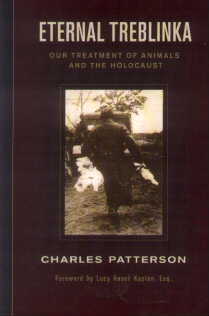
 Eternal Treblinka: Our Treatment of Animals and the Holocaust by Charles Patterson, Paperback, 6" x 9"
Lantern Books, One Union Square West, Suite 201, New York, NY 10003, USA. E-mail:eternaltr@earthlink.net: Publication Date 2002. xvi+296 pages, ISBN 1-930051-99-9. Price $20.00
 |
(Editor's Note: This is one of the two reviews which rated the book at full 10. The other was from Cecil Wingo from USA.)
When I agreed to review this book I had an uneasy feeling. Something I have never experienced when reviewing anything. After all, scientific and professional books and papers are what they are. They can be categorised as maybe good, not so good, bad or indifferent! You might think that I am being a little obvious but forgive me. As someone who has attended many emergency incidents involving humans and animals, I have to say that I have always felt deeply for the animals. That does not mean that I don't feel for the humans. For example, an explanation cannot be given to the animals or their relatives and friends. In almost 36 years of doing what I do, I have attended two incidents at slaughterhouses or abattoirs, as we English prefer to call them. (It is just possible that people might not know what that means! I think it actually means to beat down, to kill). On these two occasions I was shocked and horrified at what I saw. The first time I was young and I imagine I just thought, C'est la vie. (there goes that French again!) The second time was 15 years ago and I was stunned to my boots. I came home to my wife and told her that it was like a concentration camp for animals. Auschwitz for cattle, I said. I stopped eating them from then onwards. Although my wife ridicules my hypocrisy, I still eat chicken and fish and as she reminds me that they are not sung to death!
 ...In almost 36 years of doing what I do, I have attended two incidents
at slaughterhouses or abattoirs, as we English prefer to call them...On these two occasions I was shocked and horrified at what I saw. The first time I was young and I imagine I just thought, C'est la vie... The second time was 15 years ago and I was stunned to my boots. I came
home to my wife and told her that it was like a concentration camp for animals. Auschwitz for cattle, I said. I stopped eating them from then
onwards...Maybe you will now understand my uneasy feeling about this book
... ...In almost 36 years of doing what I do, I have attended two incidents
at slaughterhouses or abattoirs, as we English prefer to call them...On these two occasions I was shocked and horrified at what I saw. The first time I was young and I imagine I just thought, C'est la vie... The second time was 15 years ago and I was stunned to my boots. I came
home to my wife and told her that it was like a concentration camp for animals. Auschwitz for cattle, I said. I stopped eating them from then
onwards...Maybe you will now understand my uneasy feeling about this book
...
|
Maybe you will now understand my uneasy feeling about this book. I could not believe my eyes when I read the quote from Isaac Bashevis Singer, from "The Letter Writer":
In his thoughts Herman spoke a eulogy for the mouse who had shared a portion of her life with him and who, because of him, had left this earth. "What do they know-all these scholars, all these philosophers, all the leaders of the world-about such as you? They have convinced themselves that man, the worst transgressor of all the species, is the crown of creation. All other creatures were created merely to provide him with food, pelts, to be tormented, exterminated. In relation to them all people are Nazis; for the animals it is an eternal Treblinka."
This is one of the most complete and direct statements that I have ever contemplated. It shapes political futures and surely must impact in some way on possible religious views.
Lucy Rosen Kaplan's foreword ends with "All who are not afraid to understand that the suffering that humans have so relentlessly inflicted on animals over the course of our species' history is one and the same with the suffering that humans often inflict on each other, must read and re-read this book."
Freud's view on human supremacy from 1917 opens chapter one. Ironic really, when we stop and look at what we have done in our human world since that time. He called it "human megalomania." Charles Patterson has very cleverly used quotes from many absolutely appropriate and relevant sources. His research for this book must have been extraordinarily complex. 'The great leap forward' puts it all into context. Patterson's draws on Carl Sagan who puts our time into context; "If the fifteen-billion-year lifetime of the universe were compressed into a single year, it would not be until September that the solar system forms (September 9), the earth condenses out of interstellar matter (September 14), and life begins on earth (September 25)." I don't wish to bore you just because I'm a 'quote-aholic' but it goes on to say "All recorded human history not taking place until the last ten seconds of the year". That puts us firmly in our place I think!
Patterson tells us about our domestication of animals, things that we all should know. But do we really? How our forefathers cruelly tortured and killed every imaginable animal just for their own pleasure. The horrors which explain what we do today to our animals to get the best out of them in order to manage them before we kill and eat them. All parts of the world operate some form of animal husbandry in order to achieve the best they can of their animals. The Tuareg prevent their calves from suckling by the use of a stick in the back of their mouths. They also pierce the septum of their calves with a forked stick that makes sucking painful. Many other examples are given including a particularly cruel practice carried out by people in northern New Guinea, as well as some barbaric practises applied by ranchers in the United States. We are all sited in this cruelty and Patterson does not pull his punches. He is not critical or patronising, he just tells it like it is.
..
The book explores that shameful time in our history when human slavery was part of everyday life. It points
out clearly that if we are prepared to do what we do to each other, it is not surprising that we do unspeakable
things to animals. The way the Native Americans were treated is detailed, graphically. Horrendous accounts
of massacres of old people and children and pregnant women
...
|
I was staggered to learn that the USA kills 400,000,000 animals in less than two weeks! I am sure that figure is reflected across the affluent countries of the word in appropriate proportions. I wonder what happens when we die and if you have faith of some kind, where will we go? Will the animals be there as well? Will they forgive us?
The book explores that shameful time in our history when human slavery was part of everyday life. It points out clearly that if we are prepared to do what we do to each other, it is not surprising that we do unspeakable things to animals. The way the Native Americans were treated is detailed, graphically. Horrendous accounts of massacres of old people and children and pregnant women, beggar belief. According to Todorov the Native Americans that were targeted, were thought of as animals for the slaughterhouse. Of course we all knew this didn't we! Patterson tells us that Adolf Hitler did and was a great admirer of their destruction.
The section headed 'Slaves as Domestic Animals' is horrifying and shameful. 'Man's Dominion Over Animals' explores a few issues that might rattle some. Emerging religions "including the Judeo-Christian tradition, sanctified the notion that the world had been created for the human species." The pomposity of some religions astonishes me; Stannard writes that Christian Europe believed that God was always on the Christian side. Indeed that would accord with the Nazi view. I recall that the regular German army uniform belt of the Second World War (leather of course) had a buckle with the words 'Gott Mit Uns' (God is With Us) embossed on it.
The Author tells us about Henry Ford's assembly lines (and his anti-Semitic views, which I was not aware of) and how the inspiration for his assembly lines was born after his visit to a slaughterhouse. I learned that Hitler held Ford in very high esteem and utilised the same assembly line methods for the mass-murder in his concentration camps.
..
This truly is one of those books that you cannot put down. The message is there for us all, and it is haunting. It is a very strong point to say that a book is life changing.
I think this book is just that. It has changed my life. It has also provided me with new authors to read and research. I have not stopped talking about this book. It is truly
a superb work!
...
|
Enter the Nazis. I thought I was widely read on this subject. The format that appears in Eternal Treblinka paints a completely different picture. Of course we were aware that the Nazis used animal terms to vilify and dehumanise their victims. Of course it is clear now! The description of humans treated like animals provide an insight like never before. To treat people as animals, naked, smelly and dirty, made it easier for the killers. The British utilised animal names to describe the Japanese and the Japanese did the same with the Chinese.
The parallel is clear: "America gave the world the slaughterhouse; Nazi Germany gave it the gas chamber." Goldhagen's 'Hitler's Willing Executioners' is quoted and makes the point that the German's often used Jews as playthings. This book has a parallel with 'Eternal Treblinka'. It was not just members of the SS who carried out the atrocities. It was everyday men and women, many of who were too old to fight in the forces, who became the torturers and murderers.
Chapter Four introduces 'Improving The Heard -from animal breeding to genocide.' The Nazis are introduced to eugenics. But did it originate with them? A big surprise is in store for the reader!
Charles Patterson tells us that little has changed in the inhumane way that animals are sent to their deaths, since 1865. Interesting word 'inhumane.' Horse killing as well as "Killing the Young" is the epitome of the use of the word. How can eating a 1-day-old calf be anything else? The author's description of the killing of children by the Nazis will chill your very soul. I have rarely read a book that made me cry. This one did.
In the last part of 'Eternal Treblinka' the focus turns to memories of those who were involved. They were there or their relatives were. The poem "We are the Shoes" by Moyshe Shulshtayn, is quoted. Ruttenburg then asks "Is that ironic or what?" It most certainly is. The outstanding vision of Isaac Singer introduces chapter 7. His journey to America and his initial views. He speaks of hunting, a very popular pastime. It is not just an American issue; it is the same the world over. I have never read Singer but this book has inspired me to do so. It is not one sided. The impact on Germans is explored as well.
This truly is one of those books that you cannot put down. The message is there for us all, and it is haunting. It is a very strong point to say that a book is life changing. I think this book is just that. It has changed my life. It has also provided me with new authors to read and research. I have not stopped talking about this book. It is truly a superb work!
-John Williamson
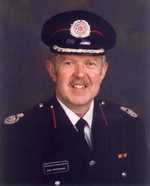 |
-John Williamson John Williamson joined Lancashire Fire and Rescue Service in 1967 and served throughout Lancashire. His special interest is in fatal fire investigation. He is a member of Strathclyde's Technical Support Team. Williamson's interests include Fire Investigation, Technical Fire Safety, Community Fire Safety, Health & Safety, Litigation, Crime & Disorder liaison. His hobbies include Music, (listening & playing) swimming and motorcycling. He is an avid reader and reviewer of books on a wide variety of subjects. Several of his erudite pieces have been published in our sister journal. He can be contacted at Johnnywilliamson@btinternet.com. |
 Order this Book by clicking here.
Interview with Charles Patterson.

 Request a PDF file of this review by clicking here. (If your screen resolution can not be increased, or if printing this page is giving you problems like overlapping of graphics and/or tables etc, you can take a proper printout from a pdf file. You will need an Acrobat Reader though.)
N.B. It is essential to read this journal - and especially this review as it contains several tables and high resolution graphics - under a screen resolution of 1600 x 1200 dpi or more. If the resolution is less than this, you may see broken or overlapping tables/graphics, graphics overlying text or other anomalies. It is strongly advised to switch over to this resolution to read this journal - and especially this review. These pages are viewed best in Netscape Navigator 4.7 and above.
-Editor-in-Chief

 [ Major links ]
[ Reviews with Quizzes ] [ Journal CD ] [Interviews] [ Editorials - Cumulative Index ]
[ Cumulative index of Book Reviews sorted by | Publishers | Subjects | Multimedia Reviews (cumulative) ]
[ Links ] [ Submit books/journals/software/multimedia for review ] [ Reviewers' Panel ] [ Featured Reviews ] [ Audio books ] [ My Books ]
[ Anil Aggrawal's Internet Journal of Forensic Medicine and Toxicology - Sister Publication ] [ contact us ]
Books for review must be submitted at the following address.
Professor Anil Aggrawal (Editor-in-Chief)
Anil Aggrawal's Internet Journal of Book Reviews
S-299 Greater Kailash-1
New Delhi-110048
India
Click here to contact us.
This page has been constructed and maintained by Dr. Anil Aggrawal, Professor of Forensic Medicine, at the Maulana Azad Medical College, New Delhi-110002. You may want to give me the feedback to make this pages better. Please be kind enough to write your comments in the guestbook maintained above. These comments would help me make these pages better.
 IMPORTANT NOTE: ALL REVIEWS APPEARING IN THIS ONLINE JOURNAL ARE COPYRIGHTED BY "ANIL AGGRAWAL'S INTERNET JOURNAL OF BOOK REVIEWS" AND MAY NOT BE REPOSTED, REPRINTED OR OTHERWISE USED IN ANY MANNER WITHOUT THE WRITTEN PERMISSION OF THE WEBMASTER

|

