

|

|
|
|
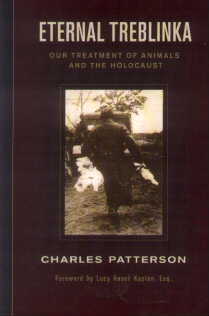
 Eternal Treblinka: Our Treatment of Animals and the Holocaust by Charles Patterson, Paperback, 6" x 9"
Lantern Books, One Union Square West, Suite 201, New York, NY 10003, USA. E-mail:eternaltr@earthlink.net: Publication Date 2002. xvi+296 pages, ISBN 1-930051-99-9. Price $20.00
 |
As a forensic psychiatrist I am confronted with the results of violence every day. Reading Eternal Treblinka by Charles Patterson gives me another perspective of violence and thoughts about "the good and evil guys" were activated. In forensic psychiatry we earlier often discussed whether real evil human beings did exist. Perhaps they do exist but you do not meet them in the forensic psychiatric setting. In his book Charles Patterson goes through history as well as various domains, scrutinizing the reasons for different abuse committed by human beings and high-lights in a very fascinating way connections to our way to treat animals. In spite of the horrible data he presents, the book is very thrilling to read due to comprehensive and clear stylistics.
The book is divided into three parts; A Fundamental Debacle, Master Species, Master Race and Holocaust Echoes. In the first part the a theoretical and historical framework for the human supermacy, the exploitation of animals and for vilifying others as animals - "the enslavement/domestication of animals affected the way related to their captive animals and in turn to each other". One parallell to slave societies is drawn, "slaves as domestic animals". A delineation of how animal names such as wolves, apes and rats, were attributed to human beings or even related to whole cultures in order to justify exploitation of societies outside Europe and U S A.
 ...This is one of the most important books I have ever read, not only because of what is described. The content has deeper implications, implications for all of us with regard to how we look upon each other and how we justify various things we are doing... ...This is one of the most important books I have ever read, not only because of what is described. The content has deeper implications, implications for all of us with regard to how we look upon each other and how we justify various things we are doing...
|
In part two Charles Patterson examines the way in which the industralized slaughter of animals and people became entwined in modern times and as he argues, found fertile soil in Nazi Germany. In one chapter he gives a more detailed background to the reasons for dehumanization of certain human beings and related to the desire to improve the hereditary qualities of the human population. The historical data regarding the eugenics in Germany is very interesting and presented in a cool and objective way, though one sometimes in other parts can perceive the pain and the anger in the author, which sometimes may make him more subjective with a risk of presenting data from only one perspective. However, in this context I can find it valuable as this results in a very clear and distinct, and horrible and logic exlanation behind abuse of others. Patterson gives answers to questions probably asked by millions of people, because we simply can not understand some of the cruelty some people can commit towards others. For me, the most touching chapter of the whole book is "Without the homage of a tear" in which Charles Patterson discusses the "Final Solution" that is the circumstances in the Nazi concentration camps.
In part three of the book, the focus turns to bearers of memories from the Holocaust and whose advocacy of animals has been influenced by the Holocaust. This part also gives a very interesting and psychologically objective view of being a survivor from the Holocaust. This is presented in a respectfully and compassionate though clear and not sentimental way which makes it very fascinating to read.
In summary Eternal Treblinka is one of the most important books I have ever read, not only because of what is described. The content has deeper implications, implications for all of us with regard to how we look upon each other and how we justify various things we are doing. For every human being applications can be found. The dignity and the integrity of another person must always be kept in mind. This is of special importance when you sometimes have to apply coercions e.g. in psychiatry and in the justice system. Violence, maltreatment and deprivation of people is a universal challenge and must be dealt with at different levels and from various perspectives. Charles Patterson dares to touch very complex mediators of collective violence which makes Eternal Treblinka very special and outstanding for anyone. I will conclude by stating that Eternal Treblinka ought to be considered in the light of the definition of Violence by WHO1 - Violence is the intentional use of physical force or power, threatened or actual, against oneself, another person, or against agroup or community, that either results in or has a high likelihood of resulting in injury, death, psychological harm, maldevelopment or deprivation.
-Marianne Kristiansson
|
-Marianne Kristiansson Marianne Kristiansson is a Forensic psychiatrist working in the Dept of Forensic Psychiatry in Stockholm, Sweden. She is a reviewer in our sister publication. She can be contacted at marianne.kristiansson@rmv.se |
 Order this Book by clicking here.
Interview with Charles Patterson.

 Request a PDF file of this review by clicking here. (If your screen resolution can not be increased, or if printing this page is giving you problems like overlapping of graphics and/or tables etc, you can take a proper printout from a pdf file. You will need an Acrobat Reader though.)
N.B. It is essential to read this journal - and especially this review as it contains several tables and high resolution graphics - under a screen resolution of 1600 x 1200 dpi or more. If the resolution is less than this, you may see broken or overlapping tables/graphics, graphics overlying text or other anomalies. It is strongly advised to switch over to this resolution to read this journal - and especially this review. These pages are viewed best in Netscape Navigator 4.7 and above.
-Editor-in-Chief


 [ Major links ]
[ Reviews with Quizzes ] [ Journal CD ] [Interviews] [ Editorials - Cumulative Index ]
[ Cumulative index of Book Reviews sorted by | Publishers | Subjects | Multimedia Reviews (cumulative) ]
[ Links ] [ Submit books/journals/software/multimedia for review ] [ Reviewers' Panel ] [ Featured Reviews ] [ Audio books ] [ My Books ]
[ Anil Aggrawal's Internet Journal of Forensic Medicine and Toxicology - Sister Publication ] [ contact us ]
Books for review must be submitted at the following address.
Professor Anil Aggrawal (Editor-in-Chief)
Anil Aggrawal's Internet Journal of Book Reviews
S-299 Greater Kailash-1
New Delhi-110048
India
Click here to contact us.
This page has been constructed and maintained by Dr. Anil Aggrawal, Professor of Forensic Medicine, at the Maulana Azad Medical College, New Delhi-110002. You may want to give me the feedback to make this pages better. Please be kind enough to write your comments in the guestbook maintained above. These comments would help me make these pages better.
 IMPORTANT NOTE: ALL REVIEWS APPEARING IN THIS ONLINE JOURNAL ARE COPYRIGHTED BY "ANIL AGGRAWAL'S INTERNET JOURNAL OF BOOK REVIEWS" AND MAY NOT BE REPOSTED, REPRINTED OR OTHERWISE USED IN ANY MANNER WITHOUT THE WRITTEN PERMISSION OF THE WEBMASTER

|


