
|

|
|
|
 Review of Radiology, 2nd Edition by Sumer K Sethi, Softcover, 4.5" x 8.5".
Peepee Publishers & Distributors (P) Ltd., 7/31, First Floor, Ansari Road, Daryaganj, New Delhi - 110002, India. Ph: 9811156083, 011-55195868. E-mail:peepee160@yahoo.co.in: Publication Date 2005. 201 pages, ISBN 81-88867-29-2. Price: $6.00, £3.00, Indian Rs 100.00
 Official site: http://www.peepeepub.com/default.asp
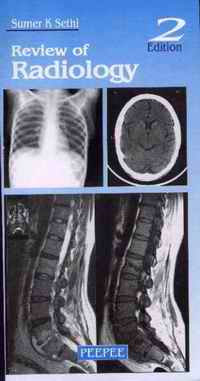 |
This pocket-sized manual is intended to help medical students to prepare for their exams. The text is divided into 4 sections, giving a concise state of the art coverage of fundamentals of radiology.
Section 1, General Radiology, reviews the principles of main radiological techniques which are widely used in the everyday practice (X-ray, computed tomography, magnetic resonance imaging, Doppler ultrasound, radioisotope imaging and functional scanning). This section contains brief explanations of technical aspects of radiological methods. Besides, the strong and the weak sides of each method are presented.
Section 2, Systemic Radiology, highlights imaging modalities used to evaluate respiratory, cardiovascular, skeletal, gastrointestinal, genitourinary systems. Main radiological signs and symptoms related to specific conditions are listed. Special attention is given to radiological findings seen in metabolic and haematological disorders, congenital syndromes.
Section 3, Radiotherapy, deals with the main methods and principles of therapeutic applications of radiation. Adverse effects of radiation are comprehensively discussed.
 ...The author should be congratulated for his attempt to combine the comprehensive coverage of technical questions, radio diagnosis, and radiotherapy in one book. The strength of this book are the mnemonic hints which are used by the author, helping the reader to better memorize important items... ...The author should be congratulated for his attempt to combine the comprehensive coverage of technical questions, radio diagnosis, and radiotherapy in one book. The strength of this book are the mnemonic hints which are used by the author, helping the reader to better memorize important items...
|
Section 4, Commonly Asked Questions, represents a list of 400 multiple-choice questions for self-assessment. Answers with the reference page numbers of the text are given in the end of the section. This chapter is very important as it permits the Reader to reveal and to fill in the gaps in the knowledge. I would call this section "Self-Assessment Tests" as this title would reflect better the contents of this section.
The author should be congratulated for his attempt to combine the comprehensive coverage of technical questions, radio diagnosis, and radiotherapy in one book. The strength of this book are the mnemonic hints which are used by the author, helping the reader to better memorize important items. Another strength of this book is that its author, a Senior Resident in Radiology, has used his own still recent studying experience while writing this book. The author knows well what aspects of radiology are frequently underestimated by medical students and what information is essential for beginners.
However, several suggestions to improve the presentation of data should be made. First, the style of the book, the so-called "point-based approach", resembles very much the notes from the student's note-book. I in no way suggest to refuse from this approach, however I think that some fragments are too schematic and that the use of short sentences instead of abrupt phrases would facilitate learning and assimilating the information.
Second, the book is full of abbreviations. Many of them, such as ILD, SAH, CECT, NCCT (page 5), PVD, HT, IUGR, PIH (page 7) are used throughout the book, but are never spelled out. I am not sure that all the readers will understand the meaning of all of these abbreviations. Furthermore, the abbreviation "CT" is sometimes used for "computed tomography", sometimes for "cardiothoracic" (page 27). I suggest that a key to all abbreviations should be provided at the beginning or in the end of the book.
...Another strength of this book is that its author, a Senior Resident in Radiology, has used his own still recent studying experience while writing this book. The author knows well what aspects of radiology are frequently underestimated by medical students and what information is essential for beginners...
|
Third, there is some confusion in presentation of data in the "Systemic Radiology" section. Disease entities with the lists of relevant radiological symptoms alternate with radiological symptoms followed by the lists of conditions for which they are typical. The latter should be either transferred into the radio semiotics section or, if these conditions are to be considered for differential diagnosis, this should be clearly stated.
Some signs and symptoms are explained, the others are not: the approach to listing signs and symptoms should be more uniform with a short description given for every symptom listed. For example, see page 23-24, Pulmonary Embolism section. One can read the explanations to what is Westermark sign, Hamptons hump, melting sign, while "knuckle sign" is just listed without any explanation. Do all the students know what is the "knuckle sign"? Why not to write that the "knuckle sign" is an abrupt tapering of the distally occluded pulmonary artery ? Fleischner sign and elevated hemidiaphragm are listed as one unit, separated by a comma, so that one might think that Fleischner sign is the elevated hemidiaphragm. However, Fleischner sign is the pulmonary artery enlargement, and this is not clear from the book. Such confusing presentations should be avoided throughout the book. Furthermore, it is sometimes not clear which radiological method can reveal the given symptom. Adding the data on sensitivity and specificity of the symptoms described would strengthen the book.
The structure of subsections should be also more uniform. See, e.g., page 21, fragments on miliary shadowing and honey combing. The structure of these 2 fragments is quite different, while it can be standardized, taking, for example, that of miliary shadowing (which is better) as a standard. This standard should be followed throughout the book.
...I am sure that rapid advances in medical technology will soon necessitate a new, updated edition of this book
...
|
It would be excellent to provide radiological diagnostic algorithms (protocols) for certain conditions (not only for pulmonary embolism presented on page 24). This would give medical students better understanding of which methods and in which sequence are to be used.
Finally, as it is correctly emphasized by the author in the Preface, it is important to read other textbooks, this book can not be a substitute for them. Therefore, a list of references and/or "Suggested Reading" after each of the first 3 sections would be very helpful. It is lacking in the present edition of the book.
I am sure that rapid advances in medical technology will soon necessitate a new, updated edition of this book and that the above comments will be considered in the future editions.
|
-Roman Komorovsky
Research Fellow, Cardiovascular Research Foundation, Ospedale S. Giacomo, Castelfranco Veneto (TV) - Italy Email: roman_komor@yahoo.com Dr. Roman Komorovsky (born on 19/11/1975) received his MD degree at Ternopil Medical Academy, Ukraine, in 1998. After specializing in cardiology in Ukraine, in 2002-03 he was working as a visiting Fellow in the Echocardiography Unit of the Hôpital Européen Georges Pompidou (Paris, France). Since 2003 he is a Research Fellow of the Cardiovascular Research Foundation, Castelfranco Veneto, Italy. Dr. Roman Komorovsky contributed to above 15 scientific papers, including those in the international peer-reviewed journals. |
 Order this Book by clicking here.
Interview with Sumer Sethi.
 Request a PDF file of this review by clicking here. (If your screen resolution can not be increased, or if printing this page is giving you problems like overlapping of graphics and/or tables etc, you can take a proper printout from a pdf file. You will need an Acrobat Reader though.)
N.B. It is essential to read this journal - and especially this review as it contains several tables and high resolution graphics - under a screen resolution of 1600 x 1200 dpi or more. If the resolution is less than this, you may see broken or overlapping tables/graphics, graphics overlying text or other anomalies. It is strongly advised to switch over to this resolution to read this journal - and especially this review. These pages are viewed best in Netscape Navigator 4.7 and above.
-Editor-in-Chief


 [ Major links ]
[ Reviews with Quizzes ] [ Journal CD ] [Interviews] [ Editorials - Cumulative Index ]
[ Cumulative index of Book Reviews sorted by | Publishers | Subjects | Multimedia Reviews (cumulative) ]
[ Links ] [ Submit books/journals/software/multimedia for review ] [ Reviewers' Panel ] [ Featured Reviews ] [ Audio books ] [ My Books ]
[ Anil Aggrawal's Internet Journal of Forensic Medicine and Toxicology - Sister Publication ] [ contact us ]
Books for review must be submitted at the following address.
Professor Anil Aggrawal (Editor-in-Chief)
Anil Aggrawal's Internet Journal of Book Reviews
S-299 Greater Kailash-1
New Delhi-110048
India
Click here to contact us.
This page has been constructed and maintained by Dr. Anil Aggrawal, Professor of Forensic Medicine, at the Maulana Azad Medical College, New Delhi-110002. You may want to give me the feedback to make this pages better. Please be kind enough to write your comments in the guestbook maintained above. These comments would help me make these pages better.
 IMPORTANT NOTE: ALL REVIEWS APPEARING IN THIS ONLINE JOURNAL ARE COPYRIGHTED BY "ANIL AGGRAWAL'S INTERNET JOURNAL OF BOOK REVIEWS" AND MAY NOT BE REPOSTED, REPRINTED OR OTHERWISE USED IN ANY MANNER WITHOUT THE WRITTEN PERMISSION OF THE WEBMASTER

|