

|
 OTHER REVIEWS IN THIS ISSUE OTHER REVIEWS IN THIS ISSUE Pages: |1|
2|
3|
4|
5|
6|
7|
8|
9|
10|
11|
12|
13|
14|
15|
16|
17|
18|
19|
20|
21|
22|
23| Pages: |1|
2|
3|
4|
5|
6|
7|
8|
9|
10|
11|
12|
13|
14|
15|
16|
17|
18|
19|
20|
21|
22|
23|
[Popular Books Section]
[Animated Reviews]
|
 Trauma Secrets, 1st Edition by Gideon P. Naudé, Frederic S. Bongard and Demetrios Demetriades
Hanley & Belfus, Medical Publishers, 210 South 13th Street, Philadelphia, PA 19107; xviii + 297 pages: ISBN 1-56053-256-4. Library of Congress Control No. 98-27476. Publication Date October 1998: Price, $39.95 (US), $44.95 (Foreign).
 |
|
Ask any medical student, how he would like his information to be presented to him: in text form or in question-answer form, and the chances are he would opt for the latter. And there are good reasons for him thinking so. However much information he may acquire, his ultimate aim is to be able to answer all his theory and viva questions and to be able to pass the exams with good grades. Another of his worries is the extremely limited time that he has at his disposal. A graduate student spends most of his time in the school, and a postgraduate student in the hospital. What is top most in his mind is to be able to cover the whole course in shortest possible time.
Books in a question and answer format serve his needs extremely well. Hanley and Belfus has come out with an excellent "secret series", in which authentic information is imparted to the student in a question-answer form. The book under review is one in that series.
 |
Trauma is a subject which encompasses many specialties - surgery, orthopedics, burns, forensic pathology and emergency medicine, being some of them. Students - and even younger doctors - are in dire need of a text which can answer their questions in a jiffy, without them being forced to read excessive text. Written by three experts in their fields, the book under review does this task admirably well. It "trims" lots of unnecessary text so to say, and presents the information in no-nonsense straightforward style.
The book is divided into 48 chapters arranged in fifteen sections. The sections include almost all topics related to trauma. There are sections on trauma basics, head and neck trauma, thoracic trauma, gastrointestinal trauma, endocrinology, surgical issues and so on. I as a forensic pathologist found several chapters of interest. Take for example Chapter 5 entitled "Mechanisms of wounding ballistics", which is full of interesting questions. Sample these questions: What is ballistics? Why must surgeons have a working knowledge of ballistics? What are the three principles of wound ballistics? What makes shotgun injuries so unique? What is the difference between low-velocity and high velocity missiles? And so on..
|
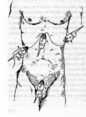
The answers range from just one or two lines to a full length discussion bordering on one full page length. Diagrams, photographs and tables appear at appropriate places. Take for instance question number 15 on page 157 (from Chapter 27 entitled "Vascular Trauma"). The question is: What is the optimal exposure for an injury to the subclavian artery? Its answer runs to almost one full page and includes a diagram too.
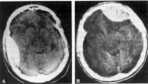 |
On page 46, the authors ask a question: Describe the etiology and radiographic appearance of epidural hematomas? The authors not only give a detailed explanation, but also give two photographs showing epidural hematomas in two different patients. In the first photograph the patient has a right middle fossa (temporal hematoma) and in the second photograph the patient shows left frontal fossa hematoma. Both hematomas are limited in their extension by the coronal suture. Such photographs increase the comprehension, and occur throughout the book.
At other places clear line diagrams appear. On page 260, a question is asked: What is the FAST exam for trauma? FAST actually stands for Focused Abdominal Sonogram for Trauma. It is designed to detect fluid (i.e. blood) in the pericardium or abdomen after trauma. Performing FAST is fast (seems like an interesting pun to me!), generally done in 2-3 minutes by experienced examiners, and involves looking at four areas in the supine trauma patient. The authors go on to explain not only in the text, but give a very clear line diagram, which should be very easy for the students to remember.
Mnemonics appear at several places making the job of the student much easier. Take for example question 42 on page 28 (from Chapter 4 entitled "Shock and Resuscitation"). The question is: What is the initial management of hemorrhagic shock? And the answer is - ABCDE! Intrigued? Well, it translates like this Airway, Breathing, Circulation, Disability and Exposure. Of course the authors gives explanations along with these. But this is a clever way of remembering which the students are going to love.
 |
After giving the answers to some of the questions, the authors give relevant websites too for further exploration in the related areas. Take for example two questions appearing on page 29. The questions are What is ATLS? And What is AAST? ATLS actually is Advanced Trauma Life Support course designed and sponsored by the American College of Surgeons. The authors advise to go to the site http://www.facs.org for further information. Similarly AAST stands for the American Association for the Surgery of Trauma. For further information, the reader is advised to visit their site at http://www.aast.org. The authors have thus tried to rope in the latest web information in their answers too, which is a welcome change.
I think this is an excellent book for students appearing not only for their surgery or orthopedic examinations, but also for several other examinations such as pediatrics, radiology etc. I as a forensic pathologist thoroughly enjoyed this book, and I would imagine even forensic pathologists would find this book very valuable. Besides students appearing for various examinations, the book should be very valuable for young doctors doing the rounds in wards and manning emergency departments. Surely this book would solve several of their questions at odd hours when none of the senior doctors could be contacted immediately. Having this book would be like having a senior surgery advisor at your elbow round the clock!
 Order this Book by clicking here, or by visiting this site
or via telephone: 215-546-7293 . 800-962-1892 or fax: 215-790-9330
 Request a PDF file of this review by clicking here. (If your screen resolution can not be increased, or if printing this page is giving you problems like overlapping of graphics and/or tables etc, you can take a proper printout from a pdf file. You will need an Acrobat Reader though.)
N.B. It is essential to read this journal - and especially this review as it contains several tables and high resolution graphics - under a screen resolution of 1600 x 1200 dpi or more. If the resolution is less than this, you may see broken or overlapping tables/graphics, graphics overlying text or other anomalies. It is strongly advised to switch over to this resolution to read this journal - and especially this review. These pages are viewed best in Netscape Navigator 4.7 and above.
-Anil Aggrawal


 [ Major links ]
[ Paper/Thesis submission guidelines ] [ Editorials - Cumulative Index ] [ Be our sponsor! ]
[ Cumulative index of Book Reviews sorted by | Publishers | General Interest Books | Technical Books ] [ Animated Reviews ] [ Featured Reviews ]
[ Links ] [ Submit books/journals/software/multimedia for review ] [ journal CD ] [ History of the Journal ] [ Interviews ] [ Credits ]
[ Online Courses ] [ Awards ] [ Anil Aggrawal's Internet Journal of Book Reviews - Sister Publication ]
[ Cumulative reviews of Software/Multimedia | Books on CD/Audio tapes ] [ contact us ]
Books for review must be submitted at the following address.
Professor Anil Aggrawal (Editor-in-Chief)
Anil Aggrawal's Internet Journal of Forensic Medicine and Toxicology
S-299 Greater Kailash-1
New Delhi-110048
India
Click here to contact us.
This page has been constructed and maintained by Dr. Anil Aggrawal, Professor of Forensic Medicine, at the Maulana Azad Medical College, New Delhi-110002. You may want to give me the feedback to make this pages better. Please be kind enough to write your comments in the guestbook maintained above. These comments would help me make these pages better.
 IMPORTANT NOTE: ALL PAPERS APPEARING IN THIS ONLINE JOURNAL ARE COPYRIGHTED BY "ANIL AGGRAWAL'S INTERNET JOURNAL OF FORENSIC MEDICINE AND TOXICOLOGY" AND MAY NOT BE REPOSTED, REPRINTED OR OTHERWISE USED IN ANY MANNER WITHOUT THE WRITTEN PERMISSION OF THE WEBMASTER

|