

|
 OTHER REVIEWS IN THIS ISSUE OTHER REVIEWS IN THIS ISSUE Pages: |1|
2|
3|
4|
5|
6|
7|
8|
9|
10|
11|
12|
13|
14|
15|
16|
17|
18|
19|
20|
21|
22|
23| Pages: |1|
2|
3|
4|
5|
6|
7|
8|
9|
10|
11|
12|
13|
14|
15|
16|
17|
18|
19|
20|
21|
22|
23|
[Popular Books Section]
[Animated Reviews]
|

|
HUMAN ANATOMY EXPLAINED... THROUGH CAT'S! |
 Outline of Cat Anatomy with Reference to the Human by Stephen G. Gilbert, Paper, 8.5" x 11"
University of Washington Press, P.O.Box 50096, Seattle, Washington 98145-5096, USA; 96 pages, 84 illus. Glossary, bibliog. index,: ISBN 0-295-97818-X. LC. 99-14036. Publication Date September 2000: Price, $10.00.
 |
|
What is a book on cat anatomy doing in a Journal on forensic medicine and toxicology? That is the first question that would come to everybody's mind. Well, not everybody's, for many know that these days human cadavers are not commonly available for dissection for medical students, and in many universities, dissection of cat is used to teach human anatomy!
The book under review is an excellent dissection guide of the cat. Divided into eight chapters, it gives a number of labeled diagrams, and descriptions of each conceivable anatomical structure found within cat (and humans). The chapters deal with (i)The skeleton (ii) The muscles (iii) The respiratory and digestive systems (iv) the urogenital system (v) The circulatory system (vi) The nervous system (vii) The eye and (viii) the ear.
Practical instructions on dissection are given at the beginning of every chapter. These are followed up by a number of structures which the author asks the students to identify. For instance in chapter 3 (entitled "The respiratory and digestive systems"), the author starts like so:
Use a scalpel and bone clippers to cut through the muscles and costal cartilages on either side of the sternum. Extend the cuts from the region of the diaphragm to the first rib. Then.. .. ..
And completes the instructions like this:
.. ..Cut into the substance of a lung and observe its spongy texture. Identify the following structures.
Now the author goes on to describe a number of structures, which he wishes the students to identify. The structures include bronchi, lungs, mediastinum, pleura, pleural cavity, pulmonary ligament, trachea, and so on.
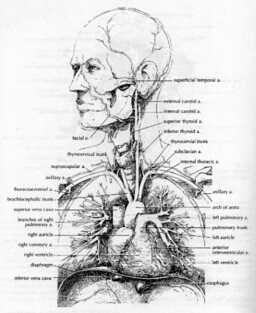 |
This approach is followed throughout the book. This book is actually an abridged and modified version of the author's own Pictorial Anatomy of the Cat, now in its twelfth printing. The book under review, designed as a dissection guide to supplement textbooks used in introductory courses in human and mammalian anatomy, is both affordable and practical for use in one-semester courses. The author gives plenty of line diagrams, but refrains from coloring them in order to cut on costs. Students however are encouraged to color the diagrams themselves and suggestions are given for coloring codes. For instance, the author suggests that in the illustrations of the skull, bones which develop by intramembranous ossification could be colored yellow and bones derived from the chondrocranium could be colored blue. This approach is good and very effective, for when the student is coloring the bones (and other structures) like this, he tends to retain the relevant information longer.
The preface by the author gives a very good and comprehensive history of how cat came to be used as a guide for mammalian anatomy. He informs us that the first book on cat anatomy came as far back as in 1845, when Hercule Straus-Durckheim's Anatomie descriptive et comparative du chat was published. He then goes on to give other important developments in the field. Finally he tells us that currently there are as many as 45 titles on the anatomy of the cat. An internet search told me, that even on the internet there are an amazingly large number of interesting sites on the anatomy of cat. I am giving the links of some of the most interesting sites, that captured my attention.
The author draws our attention to as many as three different systems of nomenclature being used in describing the anatomical structures of the cat. These are (i)Basle Nomina Anatomica, the anatomical terminology adopted by the German Anatomical Society at their meeting in Basel, Switzerland in 1895 (ii) Nomina Anatomica, a list of terms agreed upon by the International Congress of Anatomists for use in human anatomy and (iii)Nomina Anatomica Veterinaria, another set of terms used by veterinary anatomists. This has led to utter confusion in the naming of structures. As an example, the author cites the large muscle mass that lies dorsal to the vertebral column. This muscle mass has as many as five names! Have a sampling: Extensor dorsi communis, erector spinae, common dorsal extensor, sacrospinalis and erector spinae. Of these, the last two names come from two different editions of the same book - Gray's Anatomy! Its American edition calls the muscle sacrospinalis and its British edition erector spinae. Nothing can illustrate the utter confusion better than this sweet example.
The author however has tried to lessen the pain for students, by giving a comparative table at page 23, where he discusses all names currently in vogue for a given structure and tries to remove the confusion a great deal.
All in all, a very valuable book for students of anatomy. I have never dissected a cat in my life (only humans unfortunately!), but after reading this book, I am confident, if ever I were to dissect it, I would do it without a teacher. The book would be enough.
-Anil Aggrawal
[ Paper/Thesis submission guidelines ] [ Editorials - Cumulative Index ] [ Be our sponsor! ]
[ Cumulative index of Book Reviews sorted by | Publishers |
General Interest Books |
Technical Books ] [ Animated Reviews ] [ Featured Reviews ]
[ Links ] [ Submit books/journals/software/multimedia for review ] [ journal CD ] [ History of the Journal ] [ Interviews ] [ Credits ]
[ Online Courses ] [ Awards ] [ Anil Aggrawal's Internet Journal of Book Reviews - Sister Publication ]
[ Cumulative reviews of Software/Multimedia | Books on CD/Audio tapes ] [ contact us ]
 Order University of Washington Press Books by clicking here.
 Request a PDF file of this review by clicking here. (If your screen resolution can not be increased, or if printing this page is giving you problems like overlapping of graphics and/or tables etc, you can take a proper printout from a pdf file. You will need an Acrobat Reader though.)
Contact the author by clicking here
Request a PDF file of this review by clicking here. (If your screen resolution can not be increased, or if printing this page is giving you problems like overlapping of graphics and/or tables etc, you can take a proper printout from a pdf file. You will need an Acrobat Reader though.)
Contact the author by clicking here
 Some Interesting internet sites on the Anatomy of Cat
N.B. It is essential to read this journal - and especially this review as it contains several tables and high resolution graphics - under a screen resolution of 1600 x 1200 dpi or more. If the resolution is less than this, you may see broken or overlapping tables/graphics, graphics overlying text or other anomalies. It is strongly advised to switch over to this resolution to read this journal - and especially this review. These pages are viewed best in Netscape Navigator 4.7 and above.

[ Major links ]
[ Aims and Objectives ] [ FAQ ] [ Editorial Board ] [ Contributing Partners ] [ Sitemap ]
Books for review must be submitted at the following address.
Professor Anil Aggrawal (Editor-in-Chief)
Anil Aggrawal's Internet Journal of Forensic Medicine and Toxicology
S-299 Greater Kailash-1
New Delhi-110048
India
Click here to contact us.
This page has been constructed and maintained by Dr. Anil Aggrawal, Professor of Forensic Medicine, at the Maulana Azad Medical College, New Delhi-110002. You may want to give me the feedback to make this pages better. Please be kind enough to write your comments in the guestbook maintained above. These comments would help me make these pages better.
 IMPORTANT NOTE: ALL PAPERS APPEARING IN THIS ONLINE JOURNAL ARE COPYRIGHTED BY "ANIL AGGRAWAL'S INTERNET JOURNAL OF FORENSIC MEDICINE AND TOXICOLOGY" AND MAY NOT BE REPOSTED, REPRINTED OR OTHERWISE USED IN ANY MANNER WITHOUT THE WRITTEN PERMISSION OF THE WEBMASTER

home
> Volume 2, Number 2, July - December 2001
> Reviews
> Technical Books > page 23: Outline of Cat Anatomy with Reference to the Human (you are here)
Navigation ribbon