

|
 OTHER REVIEWS IN THIS ISSUE OTHER REVIEWS IN THIS ISSUE Pages: |1|
2|
3|
4|
5|
6|
7|
8|
9|
10|
11|
12|
13|
14|
15|
16|
17|
18| Pages: |1|
2|
3|
4|
5|
6|
7|
8|
9|
10|
11|
12|
13|
14|
15|
16|
17|
18|
[Popular Books Section]
[Books on CD/Audio Tapes]
|




|
|
AN EXCELLENT COMPENDIUM OF FORENSIC PHOTOGRAPHS |
 Forensic Pathology - A Color Atlas on CD-ROM by Jay Dix, Publication date: 29 July 1999, 1 CD-ROM in number with a PVC case, Approximately 700 full-colored captioned photographs
CRC Press LLC, , 2000 N.W. Corporate Blvd., Boca Raton, FL 33431, USA. Tel: 800-272-7737, Tel: 561-994-0555 (Canada), Fax: 800-374-3401, Fax: 561-998-9114 (Canada); ISBN 0-8493-0277-3. Price: $129.00
 |
|
One of the best ways to learn Forensic pathology is to look at pictures. No amount of didactic teaching can impart as much education as just a few photographs. Perhaps that is why atlases in Forensic Medicine are very popular. The CD under review is a color atlas of Forensic Pathology; it is actually a whole book on CD. This atlas in book form was reviewed in one of our earlier issues.
Dix is a well-known forensic pathologist all over the world and a prolific writer of books on forensic pathology. He is also an inveterate collector of photographs. He has an astounding collection of good, high quality, instructive color photographs on forensic pathology, which he has compiled together in the form of a number of atlases. Some of those atlases have appeared in the form of CD as well. The current CD is one such atlas.
The CD does not deviate from the original book, and is essentially much the same. But the good thing about the whole book being on CD is that one can use search criteria very easily and effectively.
 |
When you start the CD, you are greeted with two buttons namely "Introduction" and "Contents". Pressing the "Introduction" button provides some basic information about the CD in about 5 screens. The main CD is accessible through the "Contents" Button. The CD includes 15 basic sections and over 700 color photographs (742 to be exact. I actually counted them!). The sections are (i) Time of death/decomposition (75 photographs) (ii) Identification (27 photographs) (iii) Sudden Natural Death (58 photographs) (iv)Firearms (61 photographs) (v) Firearm Cases (35 photographs) (vi) Cutting and stabbing (52 photographs) (vii) Motor Vehicle Injuries (89 photographs) (viii) Asphyxia and Drowning (64 photographs) (ix) Electrical, Drugs, Environment (39 photographs) (x) Blunt Trauma (47 photographs) (xi) Blunt Trauma Cases (40 photographs) (xii) Pediatric Forensic Pathology (54 photographs) (xiii) Pediatric Cases (32 photographs) (xiv) Shotgun (31 photographs) (xv) Thermal (38 photographs).
You can navigate all screens in a linear fashion - you can either go forward or back. There is no way you can reach a photograph in the middle straightaway. To some, it could be a downside, but I believe the author has done it deliberately, because he does not want the reader to skip photographs.
|
Each photograph has an appropriate subtitle. Some of the photographs are rare and very interesting. Take for example the photographs from the section "Time of Death/decomposition". Photograph 6 in this section shows a special case of lividity in which the outline of the deceased's hands has been "imprinted" on his body, which would not go away because the staining is fixed. This reviewer has very rarely seen such interesting and unusual photographs. Undoubtedly, photographs such as these make very useful teaching aids.
Photograph 13 from the same section shows post-mortem staining which looks very much like an injury. The author tells how the young and inexperienced pathologists can differentiate between the two. In fact, the very next slide - number 14 - shows how the pathologist actually made out that it was post mortem staining. A cut has been made in the area, and all that we see is yellow fat, indicating that it is postmortem staining. An injury, say a bruise, would have shown extravasation of blood all round.
The section on Identification is equally interesting and educative. In slide 12, the author shows how a skull was positively identified by matching frontal sinus pattern. This is a useful technique but rarely employed by young and inexperienced pathologists.
In one case, the author is able to identify a person from his eight year old X-ray. His putrefied body was found. An X-ray of the pelvis showed bullet fragments with scar around, indicating that the bullet had been resting in the body for some time. An eight year old X-ray was called for. It showed the same bullet. A match was made for the pelvic bones. A perfect match of pelvic bones, combined with the fact that bullet was found in the same position confirmed the identity of the person.
What are Harris lines? Well, these are the growth lines within the bones. No two individuals have the same pattern. Slide 21 shows us how we can identify a person from these Harris lines.
What is interesting is that Dix does not separate his photographs in watertight compartments. You would find good identification slides in other sections too. For instance, when you are navigating the section on "firearms cases", you read about the murder of a woman, who was murdered because she refused to sell her recently delivered child. The author gives interesting photographs (including a photograph of a hole in her spectacles, showing she had been shot in the eye). Slide 12 however shows that her recently sutured Caesarian section is almost giving away, because of severe bloating of abdomen. This is one of the features which ultimately led to her identification. Thus you find a good instructive slide on identification in the section on "firearm cases". This is not paradoxical; it shows that forensic pathology is essentially an intricate web, in which topics often merge together. In fact the hall mark of an interesting case often is that it highlights several instructive points in several different areas. This CD abounds in such cases.
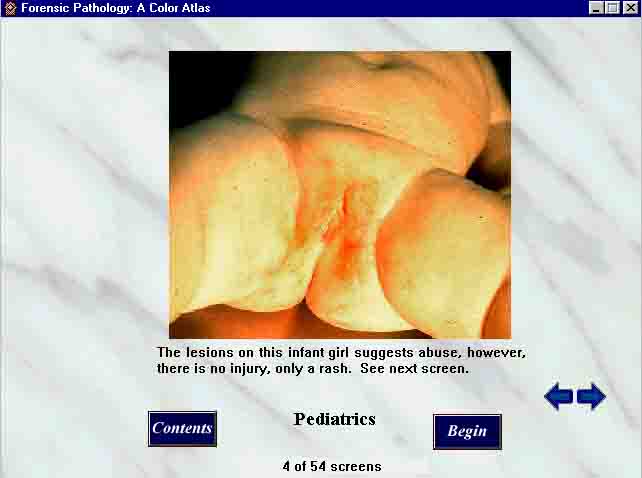 |
The section on "Pediatric Forensic Pathology" presents some interesting slides. Young and inexperienced pathologists are generally too quick to arrive at a diagnosis of sexual abuse. But the author shows some interesting slides which look like sexual abuse cases, but they are not. Take for example, slide number 4, which shows some bruise like lesions around a young girl's vulva. One would be tempted to label this case as one of sexual abuse, but a detailed examination shows that there is only rash around her vulva. There is no true injury. The next slide shows a rash around her neck too. The author reminds us that such cases can be termed as that of neglect, but definitely not that of abuse. This makes a serious legal difference. We are reproducing one of these slides here for the benefit of the readers.
There are a number of other interesting photographs in this CD. In fact every section has some photographs which will astound you completely. The whole CD gives you hundreds of hours of discovery and exploration. This reviewer was engrossed in this CD for almost a week, spending 3 to 4 hours a day, and still could not exhaust the whole of it. This was instructive and entertaining. For a youngster, certainly this CD is equivalent to, perhaps a decade of experience.
Who would benefit from this CD most? Forensic pathologists obviously would find it extremely useful. Other professionals who can use it profitably are death investigators, coroners, Scene of Crime Officers, Police officers and other law enforcement agencies, Undergraduate and postgraduate medical students at various levels of their courses, and in fact anyone who is interested in forensic pathology and the investigation of death. Since the CD includes pictures and the technical jargon is kept at a minimum, even non-technical people would be able to enjoy this CD, if they are interested in Death investigations. Lastly crime writers should also find this CD very valuable!
 Order CRC Press Books and CD (including this one) by clicking here
 Visit all CRC Press Books and CDs reviewed in this journal by clicking here

 Request a PDF file of this review by clicking here. (If your screen resolution can not be increased, or if printing this page is giving you problems like overlapping of graphics and/or tables etc, you can take a proper printout from a pdf file. You will need an Acrobat Reader though. You can also create a pdf file yourself by clicking here.)

N.B. It is essential to read this journal - and especially this review as it contains several tables and high resolution graphics - under a screen resolution of 1600 x 1200 dpi or more. If the resolution is less than this, you may see broken or overlapping tables/graphics, graphics overlying text or other anomalies. It is strongly advised to switch over to this resolution to read this journal - and especially this review. These pages are viewed best in Netscape Navigator 4.7 and above.
-Anil Aggrawal
[ Major links ]
[ Aims and Objectives ] [ FAQ ] [ Editorial Board ] [ Contributing Partners ] [ Sitemap ]
[ Paper/Thesis submission guidelines ] [ Editorials - Cumulative Index ] [ Be our sponsor! ]
[ Cumulative index of Book Reviews sorted by | Publishers |
General Interest Books |
Technical Books ] [ Animated Reviews ] [ Featured Reviews ]
[ Links ] [ Submit books/journals/software/multimedia for review ] [ journal CD ] [ History of the Journal ] [ Interviews ] [ Credits ]
[ Online Courses ] [ Awards ] [ Anil Aggrawal's Internet Journal of Book Reviews - Sister Publication ]
[ Cumulative reviews of Software/Multimedia | Books on CD/Audio tapes ] [ contact us ]
Software/Multimedia for review must be submitted at the following address.
Professor Anil Aggrawal (Editor-in-Chief)
Anil Aggrawal's Internet Journal of Forensic Medicine and Toxicology
S-299 Greater Kailash-1
New Delhi-110048
India
Email: dr_anil@hotmail.com
 This page has been constructed and maintained by Dr. Anil Aggrawal, Professor of Forensic Medicine, at the Maulana Azad Medical College, New Delhi-110002. You may want to give me the feedback to make this pages better. Please be kind enough to write your comments in the guestbook maintained above. These comments would help me make these pages better.
 IMPORTANT NOTE: ALL PAPERS APPEARING IN THIS ONLINE JOURNAL ARE COPYRIGHTED BY "ANIL AGGRAWAL'S INTERNET JOURNAL OF FORENSIC MEDICINE AND TOXICOLOGY" AND MAY NOT BE REPOSTED, REPRINTED OR OTHERWISE USED IN ANY MANNER WITHOUT THE WRITTEN PERMISSION OF THE WEBMASTER
Questions or suggestions ? Please use ICQ 19727771 or email to dr_anil@hotmail.com

|

 of this CD-ROM is a board-certified forensic pathologist, who has been performing autopsies and death-scene investigations for over twenty years. He trained at the University of Missouri-Columbia and the Hamilton County Coroner's Office in Cincinnati, Ohio. He has been the medical examiner for Boone and Callaway Counties in Missouri since 1980, except for a brief stint as the Deputy Chief Medical Examiner for New York City. He has published numerous forensic texts and computer-based atlases. One of the previous issues of this journal (Volume 1, Number 2, July-December 2000) ran a review of his