|
 OTHER REVIEWS IN THIS ISSUE OTHER REVIEWS IN THIS ISSUE Pages: |1|
2|
3|
4|
5|
6|
7|
8|
9|
10|
11|
12|
13|
14|
15|
16|
17|
18| Pages: |1|
2|
3|
4|
5|
6|
7|
8|
9|
10|
11|
12|
13|
14|
15|
16|
17|
18|
[Popular Books Section]
[Books on CD/Audio Tapes]
|



|
|
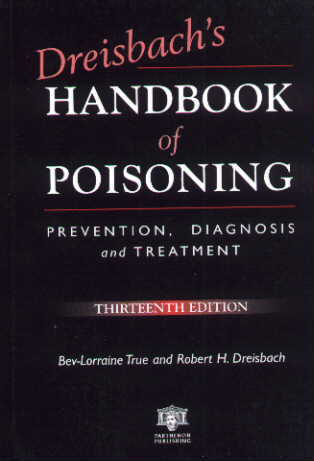
 Dreisbach's Handbook of Poisoning: Prevention, Diagnosis and Treatment, 13thEdition, by Bev-Lorraine True and Robert H. Dreisbach. Softcover, 4.5" x 6.5".
CRC Press-Parthenon Publishers, The Parthenon Publishing Group, 23-25 Blades Court, Deodar Road, London SW15 2NU, UK. Publication Date 11/29/2001. viii + 696 pages, ISBN 1-85070-038-9 (alk. paper). Price $49.95
 |
In an overburdened toxicology ward, the first aim of the physician is to administer the right treatment at the right time. An amazing variety of cases come to these toxicology wards, out-patient departments and poison centers. Many of them are cases of common poisoning, such as poisoning with household poisons, agricultural poisons, lab chemicals etc. But sometimes, a physician may be faced with a rare type of poisoning, say, with beryllium, or, say, aconite. What does he do then? Does he go back to his room, consult some heavy tomes on toxicology, come back to the out-patient department and administer treatment. Or does he fish out some simple, handy book from his drawer, look for the vital points and start straightaway? Undoubtedly most would like to go for the latter option.
|
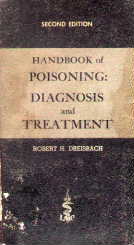
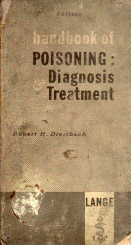
The book under review provides material for just such cases. The first edition of this book - now a classic - was published way back in 1955, when its author Robert H. Dreisbach was a Professor of pharmacology at the Stanford University School of Medicine, Stanford, California. At that time, it was simply called Handbook of Poisoning: Diagnosis and Treatment. The epithet Dreisbach was not there. The latest edition has this epithet added to it; the book had already become known as Dreisbach anyway. There is yet another change in the current edition; the word "prevention" has been added to the title. There is more stress on prevention of poisonings in the current edition.
 |
The book was written by Dreisbach alone for first eleven editions. For the twelfth, we saw Dr. William O. Robertson, Medical Director of the Washington Poison Center as the co-author. And for the current edition, there is a yet another co-author, Bev-Lorraine True of the Washington Poison Center, Seattle.
Since I was thoroughly acquainted with the book already, my main idea was to look for changes. And I did find many. For instance, sections on diagnosis and treatment have been revised and updated to reflect the latest procedures in emergency rooms and poison centers. Sections on management of poisoning have been simplified for easier use in emergencies. New sections have been added in the medicinal chapters to include the enormous expansion of drugs since the last edition. Another new thing that I noticed was that in the References section, there were completely new references. Most of the references were from the last five years, many from 1999 or even 2000. This shows the authors have done their homework well, and have cared to incorporate the latest changes. Keeping in tune with the latest, the book provides not only the latest references, but important websites as references too. For instance on page 37, you read about the website about poison information centers (http://www.aapcc.org); on page 401 you learn about a number of websites which offer help to physicians in providing information about the management of drug addicts. Some websites mentioned here are (i) http://www.jcaho.org/standard/pm.html (JCAHO Standards) (ii) http://www.ampainsoc.org (American Pain Society) (iii) http://www.painfoundation.org (American Pain Foundation) and (iv)http://www.guideline.gov (National Guideline clearinghouse). We see similar websites as references scattered throughout the book.
|
Classifying poisons has always been a problem for toxicology writers. One main reason for this of course has been that everything under the sun can act as a poison. It all depends on the dose, to use an over worn cliché from Paracelsus. Many authors - among them the great Indian J.P. Modi - preferred to classify poisons into five classes according to their modes of action. These were corrosives, irritants, neurotics, poisons acting on the heart and poisons acting on the lungs. Dreisbach, however, from the very beginning, has classified his poisons according to where you would find your poisons, rather than how they act on your body. In a way, this is a more practical approach. If an anxious mother tells you, her child has ingested something in the house, you immediately start concentrating on household poisons, narrowing down your search considerably among the all-too-confusing maze of poisons. Dreisbach classifies his poisons as (i)Agricultural poisons (ii)Industrial poisons (iii) Household poisons (iv)Medicinal poisons and (v)Natural poisons (which includes various animal and plant poisons).
There are six sections in the book. The first chapter deals with general considerations such as prevention of poisoning, emergency management of poisoning, diagnosis and evaluation of poisoning, management of poisoning and legal and medical responsibilities of the doctors in poisoning cases. After that we see one section devoted to each of the above five classes of poisons. The biggest section is Section V (on medicinal poisons), which spans about 220 pages, followed by section III (on Industrial poisons), which spans about 180 pages. The smallest section is section IV (on household poisons), which spans just 25 pages.
|
NEW FEATURES AT A GLANCE Some New Features of Dreisbach's Handbook of Poisoning at a glance: |
A number of informative tables liven up the entire text. These little tables provide a lot of information at a glance. Sample some of these; on page 26 you find a table giving a summary of emergency management of poisoning, on page 27 you find a table giving a big list of drugs useful in the treatment of poisoning (to be sure, this table runs from page 26 till 29) and on page 588, you find a table giving venoms of important poisonous snakes. This table (on snake venoms) gives not only the LD50 in mg/kg of these venoms, but also the average length of each adult snake and also the approximate yield of dry venom in one bite. Tables of a similar nature are found throughout the book. These tables are the 'soul' of this book. One can open this book at any page, and the chances are he would be greeted by one such table. One can spend hours looking and gleaning information from these tables.
|
Each poison is discussed under several headings. Headings which are seen in most cases are formula, general information, clinical findings (of both acute and chronic poisoning), laboratory findings, prevention, treatment, prognosis and references. Treatment is given in a point-by-point form, rather than in an essay, making it easy for the overburdened toxicologist to fish out information relevant to him very quickly.
All kinds of poisons you can think of appear in this book. There are organophosphates, organochlorines, plant and animal poisons, metallic poisons, corrosives, pesticides, nitrogen compounds, halogenated hydrocarbons, alcohols, Esters, aldehydes and ketones, cyanides, metallic particulates, cosmetics - even food poisoning. And in addition to these overdoses of almost all kinds of medicines are dealt with. As mentioned earlier, this section covers a major chunk of this book.
Who would benefit from the book most? I would imagine that the book should be most useful to medical and toxicology students both at the undergraduate and postgraduate levels, and the young doctor. Besides these, the book should also be useful to seasoned toxicologists as a useful tool to refresh their memories. Other professionals who can use this book to advantage are forensic practitioners, clinicians, internists and nurses. Fully recommended to all of them.
 Request a PDF file of this review by clicking here. (If your screen resolution can not be increased, or if printing this page is giving you problems like overlapping of graphics and/or tables etc, you can take a proper printout from a pdf file. You will need an Acrobat Reader though.)
 N.B. It is essential to read this journal - and especially this review as it contains several tables and high resolution graphics - under a screen resolution of 1600 x 1200 dpi or more. If the resolution is less than this, you may see broken or overlapping tables/graphics, graphics overlying text or other anomalies. It is strongly advised to switch over to this resolution to read this journal - and especially this review. These pages are viewed best in Netscape Navigator 4.7 and above.
-Anil Aggrawal

 [ Major links ]
[ Aims and Objectives ] [ FAQ ] [ Editorial Board ] [ Contributing Partners ] [ Sitemap ]
[ Paper/Thesis submission guidelines ] [ Editorials - Cumulative Index ] [ Be our sponsor! ]
[ Cumulative index of Book Reviews sorted by | Publishers | General Interest Books | Technical Books ] [ Animated Reviews ] [ Featured Reviews ]
[ Reviews with Quizzes ] [ Links ] [ Submit books/journals/software/multimedia for review ] [ journal CD ] [ History of the Journal ] [ Interviews ] [ Credits ]
[ Cumulative index of | Theses/dissertations | Online Courses | Awards ] [ Anil Aggrawal's Internet Journal of Book Reviews - Sister Publication ]
[ Cumulative reviews of Software/Multimedia | Books on CD/Audio tapes | Calenders | Models ] [ contact us ]
Books for review must be submitted at the following address.
Professor Anil Aggrawal (Editor-in-Chief)
Anil Aggrawal's Internet Journal of Forensic Medicine and Toxicology
S-299 Greater Kailash-1
New Delhi-110048
India
Click here to contact us.
This page has been constructed and maintained by Dr. Anil Aggrawal, Professor of Forensic Medicine, at the Maulana Azad Medical College, New Delhi-110002. You may want to give me the feedback to make this pages better. Please be kind enough to write your comments in the guestbook maintained above. These comments would help me make these pages better.
 IMPORTANT NOTE: ALL PAPERS APPEARING IN THIS ONLINE JOURNAL ARE COPYRIGHTED BY "ANIL AGGRAWAL'S INTERNET JOURNAL OF FORENSIC MEDICINE AND TOXICOLOGY" AND MAY NOT BE REPOSTED, REPRINTED OR OTHERWISE USED IN ANY MANNER WITHOUT THE WRITTEN PERMISSION OF THE WEBMASTER
Questions or suggestions ? Please use ICQ 19727771 or email to dr_anil@hotmail.com
Page Professor Anil Aggrawal via ICQ

|