

|
 OTHER REVIEWS IN THIS ISSUE OTHER REVIEWS IN THIS ISSUE Pages: |1|
2|
3|
4|
5|
6|
7|
8|
9|
10|
11|
12|
13|
14|
15|
16|
17|
18| Pages: |1|
2|
3|
4|
5|
6|
7|
8|
9|
10|
11|
12|
13|
14|
15|
16|
17|
18|
[Popular Books Section]
[Books on CD/Audio Tapes]
|



|
WHO FIRED THE GUN?
|
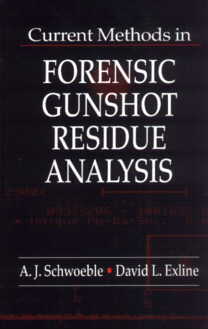
 Current Methods in Forensic Gunshot Residue Analysis, 1stEdition, by A.J.Schwoeble and David L. Exline. Hard Bound, 6" x 9.5".
CRC Press LLC, 2000 Corporate Blvd., N.W., Boca Raton, Florida 33431, Phone - 1(800)272-7737, Fax - 1(800)374-3401. Publication Date 2000. xvi + 169 pages, ISBN 0-8493-0029-0. Price $89.95
 |
|
Ask any ballistic expert, and he will tell you that the most frequently asked question in a shooting incident is "who fired the gun"? Of course there are other related questions too - where did the shooting occur, what was the firing distance, from which direction was the shot fired, which of the two is the entry wound and so on, but the commonest question remains the first one. This question is commonly answered by looking for burnt residues on the hands - and other areas, such as face, chest, hair etc - of the suspect. These residues - commonly known as GunShot Residue (GSR), Cartridge Discharge Residue (CDR) or Firearm Discharge Residue (FDR) - usually contain Lead, Antimony and Barium from various components of the primer used in the cartridge. Of course there are a number of other chemical residues too, but these three remain the most commonly sought after.
 |
One of the earliest efforts to answer this question scientifically was undertaken as early as 1933, when Teodoro Gonzalez of the Mexico City Police Laboratory developed the so called dermal nitrate or the paraffin test1. In this test Gonzalez attempted to establish the presence of nitro-compounds, instead of Pb, Sb or Ba as mentioned above. These nitro-compounds were supposed to come from the partially burnt and unburnt propellant particles. They "infected" the hands of the accused, as the "smoke" or the "plume" emanated from all openings of the gun just after shooting. He spread hot molten paraffin on the hands of the accused and made a kind of paraffin cast. This cast was then sprayed with a special chemical - a 0.25% solution of N,N'-diphenylbenzidine in concentrated sulphuric acid (this was later replaced with diphenylamine). If nitro-compounds were there on the cast, having come supposedly from the hands of the accused, the cast would turn deep blue!
Of course this test did not determine whether the accused had handled the gun or not. It merely indicated that there were nitro-compounds on his hands, which could have come from shooting. However they could come from a number of naïve sources too - from nail polishes, fertilizers, various pharmaceuticals. Even a person who had contaminated his hands from his own urine (after urination), or who had just struck a match would give positive results!
 Table of Contents Table of Contents Current Methods in Forensic Current Methods in ForensicGunshot Residue Analysis 1. Gunshot Residue as Forensic Evidence 2. Explanation of Gunshot Residue 3. Methods for Examination of Gunshot Residue 4. A study of Plume Concentrations 5. Ammunition 6. Documentation *Glossary *Bibliography *Index |
It soon dawned upon investigators, that detecting nitro-compounds would not get them anywhere. Their findings could successfully be challenged in a court of law. What needed to be determined was something less common, something less ubiquitous. What about lead, barium and antimony? We don't have many compounds around which have these elements. After almost a full quarter century - in 1959 - two scientists Harrison and Gilroy developed the so called Harrison and Gilroy test, which attempts to determine just these elements2. They improved upon the method of collection too. Instead of the traditional paraffin cast, they used swabs moistened with dilute hydrochloric acid, which were rubbed over the palms and backs of the hands of the accused. The swabs were then dried and treated with triphenylmethylarsonium iodide. They were dried again and then treated with sodium rhodizonate, and finally dilute hydrochloric acid was added. If antimony was present on the swabs, the first reagent (triphenylmethylarsonium iodide) would give a orange color, if lead or barium were present, the second reagent (sodium rhodizonate) would give a red color, and finally if just lead was present the addition of dilute hydrochloric acid would turn the spots purple. Neat!
 |
 |
The big question that remained was of sensitivity. Mainly to improve upon the sensitivity, the so-called "color tests" were done away with, and were replaced with sophisticated modern analytical methods such as Neutron Activation Analysis (NAA), Atomic Absorption Spectroscopy (AAS), Graphite Furnace Atomic Absorption Spectroscopy (GFAAS), Flameless Atomic Absorption Spectroscopy (FAAS), photoluminescence technique, Anodic Stripping Voltammetry (ASV), Differential Pulse Anodic Stripping Voltammetry (DPASV), Proton Induced X-ray Emission (PIXE), Inductively Coupled Plasma Atomic Emission Spectroscopy (ICP/AES), Inductively Coupled Plasma - mass spectrometry, X-ray microfluorescence, and histochemical techniques such as those using Alizarin Red S (ARS).
The book under review looks at many of these techniques, but the ones which are described in maximum detail are the Scanning Electron Microscopy (SEM), Energy Dispersive Spectroscopy (EDS) and the latest Computer Controlled Scanning Electron Microscopy (CCSEM). The book starts with a brief mention of The Aerospace Report of 1977, which was a landmark study of GSR, and which till date remains useful3. General information about GSR is presented in the first chapter. What is its value as trace evidence, how does it degrade in the environment with time, how is it transferred, what are the specific areas of GSR deposition and how GSR evidence is collected. Contrary to popular belief, hands are not the only places where GSR is deposited; it can get deposited over as different places as face, clothings, cars, even nostrils and ears of the subject and over inanimate objects such as tables, chairs, walls, drapes, floors, beds and a number of other items. Detection of GSR over these areas can indicate where exactly did the shooting take place.
 |
Two most widely used methods to collect GSR are cotton swabs with 5% nitric acid and adhesive stubs. The former are useful for Atomic Absorption, Neutron Activation Analysis and Inductively Coupled Plasma, and the latter for SEM. Nitric acid could not possibly be used for SEM, because it immediately starts acting upon metallic particles, transforming their shape (one of the functions of SEM is to record the morphology of the GSR particles). Another useful method to collect GSR is a multi-adhesive-layer stub, developed by Loren Sugarman in consultation with Dennis Ward. Interested readers may want to refer to the book to know details of this interesting technique.
It is vital to know the composition of the primer, if one were to understand GSR properly. Though GSR could come from any of the four sources - primer, gunpowder, cartridge and ammunition - it is the primer which is a major contributor of GSR, and hence the importance of knowing its composition.
|
QUICK NOTES
|
The primer consists of an initiator (lead styphnate), an oxidiser (barium nitrate) and the fuel (antimony sulfide). In addition there are several other components which may give rise to GSR. A sensitizer (guanylnitrosoaminoguanyltetracene) is added to styphnate to make it more "irritable". The frictionator (ground glass) helps in rupturing explosive crystals. Binders (gum arabic, gum tragacanth, starches, polyvinyl alcohol) are used to bind the material together. Coloring materials may be used to impart color and sometimes explosives such as PETN, TNT and DDNP may also be used to provide heat and energy to the reaction.
Such is the composition of the primer. What about the resulting GSR? The authors remind us that metals like lead, antimony and barium which are found in primers are also found in several other applications and there presence may be because of other reasons too. Lead for instance is used in as wide variety of things as lead batteries, solder, bearing metals, gasoline, paint, shielding sheet, matches and dyes. Similarly antimony is used in paint pigments, safety matches, brake pads and pyrotechnics, and barium is used in dyes, inks, photographic chemicals and insecticides. Finding of just one metal in GSR thus would not amount to anything. The authors conclude that a GSR particle which contains all three metals, i.e. lead, antimony and barium must be considered as unique and almost certain indicator of a firing. Because these three metals are found together in just one instance - primers. Combinations of any two metals such as Pb-Sb, Pb-Ba, Sb-Ba etc should be characteristic, but not unique.
|
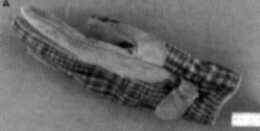
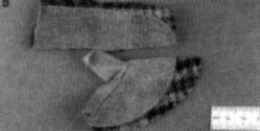
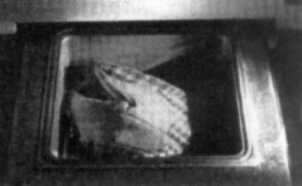
Chapter three is a very valuable chapter for those seeking to learn the details of various analytical techniques. SEM and EDS are explained in great detail. The theory of SEM is explained very clearly and succinctly and even a non-initiated can follow the chapter very easily. The chapter concludes with some actual case studies, which explain how these techniques have been actually used to detect GSR. We have reproduced figures from one such case study above.
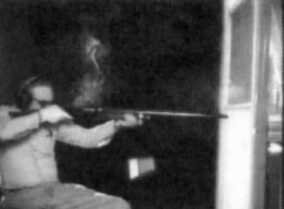
A study of plume concentrations follows in chapter 4. The authors define a plume as "the gaseous formation that exits all openings of a firearm following the discharge of a round of ammunition." This study was conducted on as many as 28 different guns and the resulting pattern of plumes was studied in all. The study was done indoors to eliminate air drafts, thus allowing for the observation of plume direction under static conditions. A 31-minute video tape was made recording the emanation and deposition of plumes at various surfaces. Recordings were made with a high-speed motion analyzer at 500 to 1000 frames per second. With each gun, the areas of highest plume concentration were noted. This is very helpful for GSR specialists for they would know the areas from where to collect samples. Take for instance Smith & Wesson Model 36. The information about this gun appears on page 51, and we are told that the area of plume concentration is over the fingers and hand, with the heaviest concentration at the web and a heavy blow-back to the wrist. But this is not the case with, say, Smith & Wesson K22 Model 16 (described on page 59), where there is a light concentration in front of the third knuckle of the trigger finger, extending back beyond the web and midway to the wrist. This is a kind of mini-atlas which spans pages 47 till 74. One just has to look at a gun to know the places, where to expect maximum deposits.
Another mini-atlas spans pages 96 through 122, where SEM images coupled with the corresponding EDS spectra of the particles ejected from various guns are shown. These two mini-atlases are the soul of this book, and should prove very useful to GSR investigators. An extensive glossary and bibliography appear at the end of the book.
How would I rate this book? Excellent value for its money. This book should prove very useful to forensic scientists involved in GSR analysis. It should also be useful for undergraduate and postgraduate students of forensic science and forensic medicine, and to law enforcement personnel in general. Fully recommended.
(1) Cowan ME, Purdon PL. A study of the paraffin test. J. Forensic Sci. 12 (1967)19-36. (Back to the review)
(2) Harrison HC, Gilroy R. Firearm discharge residues. J. Forensic Sci. 4 (1959) 184-199. (Back to the review)
(3) Wolten G.M., Nesbitt R.S., Calloway A.R., Loper G.L. and Jones P.F. Final Report on Particle Analysis for Gunshot Residue Detection, ATR-77 (7915)-3, The Aerospace Corporation, El Segundo, CA, 1977. (Back to the review)
Order this Book by clicking here
Request a PDF file of this review by clicking here. (If your screen resolution can not be increased, or if printing this page is giving you problems like overlapping of graphics and/or tables etc, you can take a proper printout from a pdf file. You will need an Acrobat Reader though.)
Contact the author by clicking here.
N.B. It is essential to read this journal - and especially this review as it contains several tables and high resolution graphics - under a screen resolution of 1600 x 1200 dpi or more. If the resolution is less than this, you may see broken or overlapping tables/graphics, graphics overlying text or other anomalies. It is strongly advised to switch over to this resolution to read this journal - and especially this review. These pages are viewed best in Netscape Navigator 4.7 and above.
-Anil Aggrawal

 [ Major links ]
[ Aims and Objectives ] [ FAQ ] [ Editorial Board ] [ Contributing Partners ] [ Sitemap ]
[ Paper/Thesis submission guidelines ] [ Editorials - Cumulative Index ] [ Be our sponsor! ]
[ Cumulative index of Book Reviews sorted by | Publishers | General Interest Books | Technical Books ] [ Animated Reviews ] [ Featured Reviews ]
[ Reviews with Quizzes ] [ Links ] [ Submit books/journals/software/multimedia for review ] [ journal CD ] [ History of the Journal ] [ Interviews ] [ Credits ]
[ Cumulative index of | Theses/dissertations | Online Courses | Awards ] [ Anil Aggrawal's Internet Journal of Book Reviews - Sister Publication ]
[ Cumulative reviews of Software/Multimedia | Books on CD/Audio tapes | Calenders | Models ] [ contact us ]
Books for review must be submitted at the following address.
Professor Anil Aggrawal (Editor-in-Chief)
Anil Aggrawal's Internet Journal of Forensic Medicine and Toxicology
S-299 Greater Kailash-1
New Delhi-110048
India
Click here to contact us.
This page has been constructed and maintained by Dr. Anil Aggrawal, Professor of Forensic Medicine, at the Maulana Azad Medical College, New Delhi-110002. You may want to give me the feedback to make this pages better. Please be kind enough to write your comments in the guestbook maintained above. These comments would help me make these pages better.
 IMPORTANT NOTE: ALL PAPERS APPEARING IN THIS ONLINE JOURNAL ARE COPYRIGHTED BY "ANIL AGGRAWAL'S INTERNET JOURNAL OF FORENSIC MEDICINE AND TOXICOLOGY" AND MAY NOT BE REPOSTED, REPRINTED OR OTHERWISE USED IN ANY MANNER WITHOUT THE WRITTEN PERMISSION OF THE WEBMASTER
Questions or suggestions ? Please use ICQ 19727771 or email to dr_anil@hotmail.com
Page Professor Anil Aggrawal via ICQ

|
 Remington 1100 (12 gauge)