|
 OTHER REVIEWS IN THIS ISSUE OTHER REVIEWS IN THIS ISSUE Pages: |1|
2|
3|
4|
5|
6|
7|
8|
9|
10|
11|
12|
13|
14|
15|
16|
17|
18| Pages: |1|
2|
3|
4|
5|
6|
7|
8|
9|
10|
11|
12|
13|
14|
15|
16|
17|
18|
[Popular Books Section]
[Books on CD/Audio Tapes]
|



|
|
|
 Forensic Examination of Fibres, 2nd Edition edited by James Robertson & Michael Grieve, Hard Bound, 246x174 mm.
(A Book from Taylor & Francis Forensic Science Series edited by James Robertson)
Taylor & Francis, 11 New Fetter Lane, London EC4P 4EE; Telephone:+44(0)1264 343071. Fax: +44(0)20 7842 2300 ; 466 pages; illus. 10 colour and 150 b+w line drawing, photos and graphs: ISBN 0-7484-0816-9. Master eBook ISBN : 0-203-48451-7. Publication Date 10 June 1999: Price, £80.00.
 |
|
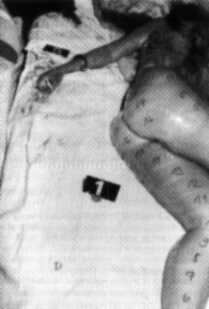
Forensic examination of fibers can be a very strong forensic tool, and may come to the aid of the forensic scientist when everything else fails. Sample this situation, which is described on pages 107-108 of the book under review: A suspect entered the victim's apartment by carefully removing the bedroom window screen. He pushed open the unlocked window and crawled into the room. The victim awoke when the suspect knocked a flowerpot off the dresser onto the floor. The suspect raped the victim, using a condom. Therefore, no semen was left at the scene or in the victim. After the rape the victim was gagged and bound with belts from her closet. The victim died from suffocation as a direct result of being gagged. The suspect took money from her wallet and a small stereo from the floor of the bedroom. Subsequent investigation revealed that the victim's next door neighbor was a registered sex offender who was on parole. A parole search of his apartment turned up a stereo that could have belonged to the victim. The suspect denied ever being in the victim's apartment, and claimed the stereo was his. A pair of jeans and a pair of red and black plaid cotton boxers were found on the floor of his bedroom. No latent fingerprints matching the suspect were found in the victim's apartment.
 |
How do we prove now that the accused was lying? How do we prove he had actually been in the victim's apartment? Forensic fiber examination comes to our rescue. Here is how?
The suspect crawled through victim's window. There must be suspect clothing fibers and hairs on the window sill. This is lead number one. There are several more. The victim was raped. The victim's clothing fibers must be on the inside surface of the suspect's boxers, or on his pubic area. You might imagine, he might have washed himself, but wait - there is more incriminating evidence. There would be suspect's clothing fibers or hair on the victim's underwear or pubic area! The victim was robbed of her stereo and money. The stereo would have the same type of fibres on it as the carpet in the victim's bedroom.....
The book goes on to describe a number of other ways, the forensic scientist could pin the suspect down to the victim's apartment. And all this happens because of a proper fibre examination.
 |
If this case kindles a spark of excitement in you, this book is for you. Written by a number of authors hailing from almost all over the world, the book provides the latest in fibre examination. In a multi-author book such as this, one of the usual disadvantages is that the chapters are rather disjointed. But this book does not show this drawback at all. Each chapter appears to dissolve neatly into the next one. Sample this line from chapter 2 entitled "The Structure of Textiles: an Introduction to the Basics" on page 33 - "The previous chapter began with the casual remark that textiles have been employed by humans since ancient times." This chapter (chapter 2) has been written by Franz-Peter Adolf, a forensic scientist from Germany. Reading this line, one would think the previous chapter must also have been written by him. But no, the first chapter entitled "Classification of Textile Fibres: Production, Structure, and Properties" comes from Shantha K. David and Michael T. Pailthorpe - two scientists from the University of New South Wales. It appears that each author - before writing his chapter - went through the works of his other fellow writers. The credit for this harmonization must go to the editors. More often than not, the editors are just content to request various authors to write their chapters and then merely paste them together in the book with minor editing, if at all. This often results in a discontinuous book, each author saying things which overlap a number of times, and what's worse, one author often contradicting the other in the very next chapter. Such kinds of discrepancies don't appear in this book.
The book has 15 chapters written by a total of 21 contributors in all. The first three chapters are introductory in nature. They serve to introduce the world of fibres and textiles to the reader. The next three chapters deal with the recovery of fibre evidence from the scene of crime and its elucidation. Chapter 7-12 deal with the laboratory examination of fibres. The last three chapters deal with the interpretation of fibre evidence, new fibre types and the future of fibre examination.
|
How many types of fibres are there? I thought I knew them all, but a reading of the first chapter really opened my eyes. Hundreds of different types of fibres are described here. There are natural fibres and there are man-made fibres. Among the natural fibres could be animal, vegetable and mineral (asbestos) fibres. Among animal fibres there are silk, wool and hair. The hair fibres can further come from either the goat family (mohair and cashmere), or camel family (camel hair, alpaca, vicuna) or from other fur bearing animals such as rabbit (angora).
The vegetable fibres could be either seed fibres (cotton, Kapok, coir), or bast (stem) fibres such as flax, hemp, jute, kenaf or ramie, or leaf fibres such as abaca or manila, henequen, phormium tenax or sisal.
And among the man-made fibres there are hundreds, which the book describes. One thing that becomes clear after reading this chapter is that we are surrounded by an innumerable number of fibres, and if we see hard enough, we are likely to find some fibre evidence at almost every scene of crime. As the book tells us on page 135, "The overwhelming majority of crimes are carried out by people wearing clothes!"
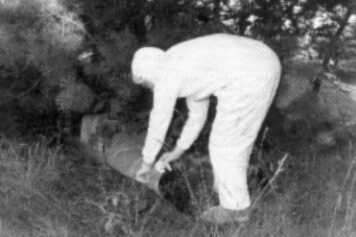
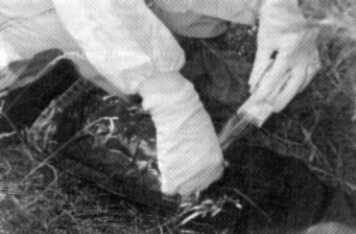
Collection of fibre evidence is a highly technical job. In chapter 5, entitled "From the Crime Scene to the Laboratory", we get to read how fibre evidence is colleted. The individual fibres or fibre tufts may be collected by hand with a clean pair of tweezers or forceps (hand retrieval). They can be retrieved by combing or brushing, scrapings or even by vacuum sweepings. But the most effective and commonly used method is the tape lifting. In this method an adhesive tape is touched repeatedly to the object to remove loose debris and then placed onto a clear protective surface - such as a glass slide - for preservation. A refinement of this procedure is 1:1 taping. In this method, one particular area of taping exactly represents the same area on the surface from which fibres are being removed. The complete surface is taped in a serial fashion. The aim of this method is to recover the transferred fibres without altering their distribution. This is the best way of preserving all of the information that can be obtained from these fibres.
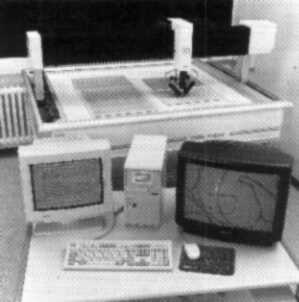 |
One of the most illustrative chapters is on fibre finding systems (chapter 6 written by a German forensic scientist Thomas W. Biermann). After the fibres have been lifted using tape lifting, the next task for the forensic scientist is to look for "foreign" fibres among the maze of background fibres. Previously this was done manually under a low magnification stereo microscope. The main search criterion was the fibre color. But if there was little color difference between the target fibres and the background fibres, the examiner tended to become tired very soon. This led to the development of automatic fibre finder systems. The book describes five of them (from four different companies). These are Fibre finder and Maxcan from Cox Analytical Systems AB, Fx5 Forensic Fibre Finder from Foster and Freeman, Q550fifi from Leica Vertrieb GmbH and Lucia Fibre Finder from Laboratory Imaging s.r.o. These systems make an automated search for fibres using fibre color as a criterion. The examiner merely "feeds" in the computer, the "mathematical color" that he is seeking. For reasons of space, I can not describe the exact procedures. The readers would be amply rewarded if they browse through the chapter and read about these new systems.
Chapters 7-12 are on the laboratory examination of fibres. The methods include such examinations as the microscopical examination of fibres, infrared microscopy, pyrolysis techniques, scanning electron microscopy, elemental analysis, microspectrophotometry, color measurement, thin layer chromatography of fibre dyes, high performance liquid chromatography, capillary electrophoresis and Surface Enhanced Resonance Raman Scattering Spectroscopy. These chapters form the core of the book, so to say, and the reader intending to take up fibre examination or improve his existing facilities would be most rewarded reading them.
QUICK NOTESSome major highlights of Forensic Examination of Fibres at a glance: |
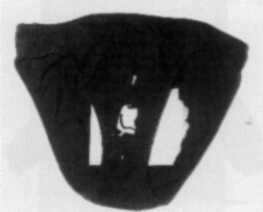
Let me round this review off, with one of the several extremely illustrative case studies described in the book. This study - which appears on pages 67-68 - explains very nicely how fibre evidence can work wonders in such seemingly unrelated areas as sexual assault. A student claimed she was raped by two male acquaintances in the toilets at her school. She alleged that her underpants were torn in the crotch area during the course of the rape. The underpants were submitted for examination at the request of the defense. And this is what the investigators found.
There were two L-shaped combination cut/tears and an irregular combination cut/tear in the crotch and lower front panel (see figure at the left). In addition, there were seven small punctures adjacent to the combination cut/tears. The garment had been washed since being damaged, which explained the 'curling over' of the severed edges. The jagged appearance of the irregular cut, the protruding narrow strips of material, the changes in direction and the 'stoppages' were all consistent with scissor-cut actions. The hypothesis that the damage was caused by physical tearing was refuted. It was also considered unlikely that a knife could reproduce the damage.
 |
This is a beautiful example of how fibre evidence - in quite an unexpected manner - came to the assistance of the accused who were actually innocent. If you want to read more of such cases, this book is certainly for you.
This book would not only be very useful for all forensic scientists - especially those engaged in forensic examination of fibres - but also to other forensic specialists such as forensic pathologists like me. They would now know about the enormous possibilities this science holds, and would be better able to co-ordinate their activities with those of the forensic scientists in the labs.
 Order Taylor & Francis books by Clicking here
or via telephone: +44(0)1264 343071
 Click here to visit the official site of this book (with extracts from this review).
 Request a PDF file of this review by clicking here. (If your screen resolution can not be increased, or if printing this page is giving you problems like overlapping of graphics and/or tables etc, you can take a proper printout from a pdf file. You will need an Acrobat Reader though.)
N.B. It is essential to read this journal - and especially this review as it contains several tables and high resolution graphics - under a screen resolution of 1600 x 1200 dpi or more. If the resolution is less than this, you may see broken or overlapping tables/graphics, graphics overlying text or other anomalies. It is strongly advised to switch over to this resolution to read this journal - and especially this review. These pages are viewed best in Netscape Navigator 4.7 and above.
-Anil Aggrawal

Books for review must be submitted at the following address.
Professor Anil Aggrawal (Editor-in-Chief)
Anil Aggrawal's Internet Journal of Forensic Medicine and Toxicology
S-299 Greater Kailash-1
New Delhi-110048
India
[ Major links ]
[ Aims and Objectives ] [ FAQ ] [ Editorial Board ] [ Contributing Partners ] [ Sitemap ]
[ Paper/Thesis submission guidelines ] [ Editorials - Cumulative Index ] [ Discussion ] [ Chat room ] [ Be our sponsor! ]
[ Cumulative index of Book Reviews sorted by | Publishers | General Interest Books | Technical Books ] [ Animated Reviews ] [ Featured Reviews ]
[ Reviews with Quizzes ] [ Links ] [ Submit books/journals/software/multimedia for review ] [ journal CD ] [ History of the Journal ] [ Interviews ] [ Credits ]
[ Cumulative index of | Theses/dissertations | [ Online Courses ] [ Awards ] [ Anil Aggrawal's Internet Journal of Book Reviews - Sister Publication ]
[ Undergraduate section | Postgraduate section ]
[ Cumulative reviews of Software/Multimedia | Books on CD/Audio tapes ] | Calenders | Models ] [ contact us ]
Click here to contact us.
This page has been constructed and maintained by Dr. Anil Aggrawal, Professor of Forensic Medicine, at the Maulana Azad Medical College, New Delhi-110002. You may want to give me the feedback to make this pages better. Please be kind enough to write your comments in the guestbook maintained above. These comments would help me make these pages better.
 IMPORTANT NOTE: ALL PAPERS APPEARING IN THIS ONLINE JOURNAL ARE COPYRIGHTED BY "ANIL AGGRAWAL'S INTERNET JOURNAL OF FORENSIC MEDICINE AND TOXICOLOGY" AND MAY NOT BE REPOSTED, REPRINTED OR OTHERWISE USED IN ANY MANNER WITHOUT THE WRITTEN PERMISSION OF THE WEBMASTER

|