|
 OTHER REVIEWS IN THIS ISSUE OTHER REVIEWS IN THIS ISSUE Pages: |1|
2|
3|
4|
5|
6|
7|
8|
9|
10|
11|
12|
13|
14|
15|
16|
17|
18| Pages: |1|
2|
3|
4|
5|
6|
7|
8|
9|
10|
11|
12|
13|
14|
15|
16|
17|
18|
[Popular Books Section]
[Books on CD/Audio Tapes]
|



|
|
 The Big Bang - A History of Explosives by G.I.Brown
Sutton Publishing Limited, Phoenix Mill, Thrupp, Stroud, Gloucestershire, GL5 2BU. Telephone : 01453 731114 Fax : 01453 731117; 256 Pages: ISBN 0-7509-2361-X: 1998 (2001 reprint): Price UK £9.99, US $16.95
 |
Can you name the three great elements of modern civilization? Or the two most damnable inventions that ever sprang from the minds of men under the influence of the devil? Or what is common between the two of them? Stumped? Want to find out the answers?
Welcome to one of the most entertaining books I have read in recent times: "The Big Bang - A History of Explosives" by G.I.Brown. It is a book dealing with the history of explosives (and fire used as a weapon) right from the Greek fire to the nuclear bombs dropped during the Second World War at Hiroshima and Nagasaki. But why do I call it "one of the most entertaining"? Because it gives you so many interesting stories, anecdotes, biographies and a number of other interesting trivia related to explosives. As a professor of forensic medicine, I teach explosives and related subjects such as firearms to my undergraduate and postgraduate students. I tend to "pepper" my lectures with interesting stories related to the subject I am teaching. But sadly I did not have a good repertoire of stories related to explosives. Thanks to this book, now I can ensure no student sleeps in my class on explosives.
|
Brown, the author of this book, has gathered material on all war contraptions which use fire in one form or the other. The book starts with the description of a number of devices which were used by the ancients. We are told that fire-pots were thrown down on troops in war as early as 900 BC! Herodotus has described that arrows tipped with burning tow were used in the Capture of Athens in 480 BC. About fifty years later, a huge bonfire was lit against the wooden walls of Platea (in 429 B.C.)
 |
The ancients used yet another extremely bizarre device in war (and from this you might get an idea about the kind of interesting, unusual, and somewhat weird stories Brown gives you in this book - there are several of them there). The ancients took petroleum, liquid pitch and oil of sulphur, mixed them in a pottery jar and buried this jar in horse manure for fifteen days. The resulting substance had the uncanny property of catching fire in the sun. They smeared crows with this mixture and flew them against the tents of the enemy BEFORE SUNRISE OR AFTER SUNSET. When the sun arose the next day, it set the crows on fire (presumably because their bodies had been smeared with this inflammable substance), and hopefully also the enemy tents, where the crows were sitting. It was important to fly the crows before sunrise or after sunset, because if you didn't do that, the crows might get consumed during their flight itself.
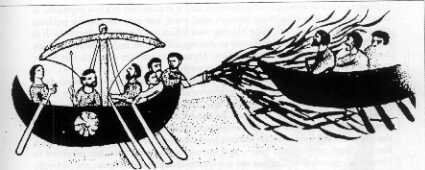
If you successfully recover from this initial shock Brown gives you, you will read about another very interesting device - the Greek Fire. Many of us have read about it during our childhood, but information about this contraption is so shrouded in mystery that not much is described in the usual sources. Brown however has gone to the original sources and has tried to fetch information right from the horse's mouth so to say. At the end of the book, he even lists the sources which he has consulted. I was very interested to know where he got his "crows story" from, and from the list he gives, I came to know that this story comes from a six-page Book of Fires (Liber Ignum), attributed to Marcus Graecus. Brown tells us that this book gives not just this, but a total of 35 similar recipes!
 ...Brown has been able to find out that the Greek fire was invented by one Greek architect Kallinikos in AD 673. The subject of Greek Fire is normally very much shrouded in mystery, and not enough information is available on this subject, but Brown gives substantial information on this substance.
... ...Brown has been able to find out that the Greek fire was invented by one Greek architect Kallinikos in AD 673. The subject of Greek Fire is normally very much shrouded in mystery, and not enough information is available on this subject, but Brown gives substantial information on this substance.
...
|
Gleaning from similar sources, Brown has been able to find out that the Greek fire was invented by one Greek architect Kallinikos in AD 673. The subject of Greek Fire is normally very much shrouded in mystery, and not enough information is available on this subject, but Brown gives substantial information on this substance.
A major part of the book is devoted to the history of black powder, which rose to the scene in 1453, when Byzantium fell. The rulers of the Byzantium had been using the Greek Fire traditionally. But the pride of place from 1453 onwards was taken by the Black Powder. We are told how the British plundered Bihar and Bengal in India where rich deposits of saltpeter were found. Saltpeter or potassium nitrate was one of the main ingredients on the black powder. Almost 30,000 tons of saltpeter was exported each year in the first half of the nineteenth century from India alone. Later Chile was found to be possessing large amounts of saltpeter. So important was the possession of saltpeter, that wars could be won or lost depending upon how much saltpeter did a nation possess. In fact during the first World War, the British Navy effectively guarded all Chilean ports so Germany could not get saltpeter from there. But the crafty Germans found an ingenious way to get round this problem. They made potassium nitrate right from the atmospheric nitrogen - through Haber's Process. The book gives a very interesting account of how Fritz Haber achieved this task.
|
The book devotes a chapter each to Nitroglycerine (chapter 8), Dynamite (chapter 9), guncotton (chapter 10), other smokeless powders (chapter 11) and Lyddite and TNT (chapter 12). These are the various so-called smokeless powders, which were a later development. In the chapter on Dynamite we read several interesting anecdotes from the life of Alfred Nobel, the inventor of dynamite. We also read about the tragic death of his brother in one of the explosions which occurred in their factory. And also how Nobels went from rags to riches and from riches to rags over and over again.
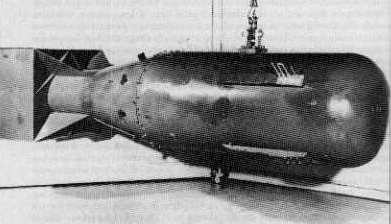
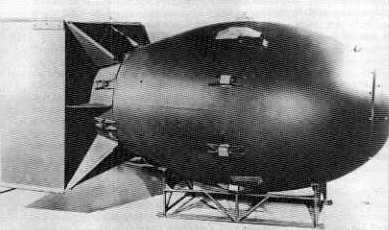
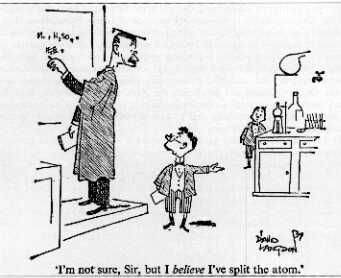
The book ends by the description of modern explosives such as nuclear bombs. There are chapters on Nuclear fission (chapter 14), The Manhattan Project (chapter 15) and Nuclear fusion (chapter 16). We also get to see the pictures of the two bombs which were dropped over Japan during World War II.
We get to read a number of interesting little facts about the Atom Bombs dropped over Japan. For instance, did you know the physical size of "Little Boy" the atom bomb dropped at Hiroshima? Well, it was about 3 m long and 0.75 m in diameter. It weighed about 4,100 kg, and had the power equivalent to 12,700 tons of TNT. There is no unanimity on the number of casualties, but the Japanese authorities calculated that 71,000 were killed and 68,000 injured. The number has been rising relentlessly ever since, with more and more people succumbing to late radiation effects. "Fat Man" the atom bomb dropped over Nagasaki was even more powerful - equivalent to 22,350 tons of TNT! Brown ends the section on these bombs with a stunning fact. The Japanese offered to surrender on 10 August without knowing that there were no more bombs left with the Americans!
One of Brown's strong points is the use of similes. He uses them throughout the book. Take for instance this example which he gives us on page 102. He is talking about the low and high explosives. Some people find the concept hard enough through usual descriptions. A low explosive such as the gunpowder burns in a matter of milliseconds and generates a pressure of about 6,000 atmospheres. A high explosive such as the nitroglycerine on the other hand, burns in only microseconds and can give rise to pressures up to 275,000 atmospheres. This is what most books on explosives describe. But Brown adds this information with this simile, "It is the difference between being bumped into by a pedal cyclist or being knocked for six by an express train".
...Little Boy" the atom bomb dropped at Hiroshima was about 3 m long and 0.75 m in diameter. It weighed about 4,100 kg, and had the power equivalent to 12,700 tons of TNT. There is no unanimity on the number of casualties, but the Japanese authorities calculated that 71,000 were killed and 68,000 injured...
|
At a number of places, Brown gives interesting derivations of various words. He follows up the above sentence with this, "So different is the effect that the word detonating (from Latin tonare, to thunder) is applied to high explosives as an alternative to the word exploding". Sometimes derivations of words may help us in understanding the subject better. We all know that ferrous sulphate is known as green vitriol, but why is it called so. It is a green colored substance alright, but why vitriol? Because its crystals look like bits of green glass and Latin vitrum means glass. This information comes from page 95 of the book. Though the book does not give the derivations of additional related words, one has only to apply little imagination to understand why copper sulphate is called blue vitriol, or the glassy substance in the posterior compartment of the eye, vitreous humor.
Answers to the questions I asked at the beginning? Well, refer to page 79 of the book, and you will get them. I will however give the answers for those who can't wait enough. Thomas Carlyle listed gunpowder as one of the three great elements of modern civilization (the other two are printing and Protestant religion). The two most damnable inventions that ever sprang from the minds of men under the influence of the devil? Gunpowder and .. banknotes!
Take my advice and read this book. You will thank me I recommended such a beauty to you.
 Order this Book by clicking here
 Request a PDF file of this review by clicking here. (If your screen resolution can not be increased, or if printing this page is giving you problems like overlapping of graphics and/or tables etc, you can take a proper printout from a pdf file. You will need an Acrobat Reader though.)
N.B. It is essential to read this journal - and especially this review as it contains several tables and high resolution graphics - under a screen resolution of 1600 x 1200 dpi or more. If the resolution is less than this, you may see broken or overlapping tables/graphics, graphics overlying text or other anomalies. It is strongly advised to switch over to this resolution to read this journal - and especially this review. These pages are viewed best in Netscape Navigator 4.7 and above.
-Anil Aggrawal

[ Major links ]
[ Aims and Objectives ] [ FAQ ] [ Editorial Board ] [ Contributing Partners ] [ Sitemap ]
[ Paper/Thesis submission guidelines ] [ Editorials - Cumulative Index ] [ Be our sponsor! ]
[ Cumulative index of Book Reviews sorted by | Publishers | General Interest Books | Technical Books ] [ Animated Reviews ] [ Featured Reviews ]
[ Links ] [ Submit books/journals/software/multimedia for review ] [ journal CD ] [ History of the Journal ] [ Interviews ] [ Credits ]
[ Online Courses ] [ Awards ] [ Anil Aggrawal's Internet Journal of Book Reviews - Sister Publication ]
[ Cumulative reviews of Software/Multimedia | Books on CD/Audio tapes ] [ contact us ]
Books for review must be submitted at the following address.
Professor Anil Aggrawal (Editor-in-Chief)
Anil Aggrawal's Internet Journal of Forensic Medicine and Toxicology
S-299 Greater Kailash-1
New Delhi-110048
India
Click here to contact us.
This page has been constructed and maintained by Dr. Anil Aggrawal, Professor of Forensic Medicine, at the Maulana Azad Medical College, New Delhi-110002. You may want to give me the feedback to make this pages better. Please be kind enough to write your comments in the guestbook maintained above. These comments would help me make these pages better.
 IMPORTANT NOTE: ALL PAPERS APPEARING IN THIS ONLINE JOURNAL ARE COPYRIGHTED BY "ANIL AGGRAWAL'S INTERNET JOURNAL OF FORENSIC MEDICINE AND TOXICOLOGY" AND MAY NOT BE REPOSTED, REPRINTED OR OTHERWISE USED IN ANY MANNER WITHOUT THE WRITTEN PERMISSION OF THE WEBMASTER
Questions or suggestions ? Please use ICQ 19727771 or email to dr_anil@hotmail.com
Page Professor Anil Aggrawal via ICQ

|