


|
|
|
|
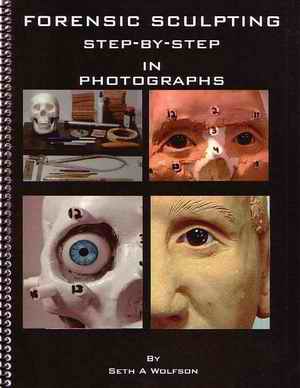
 Forensic Sculpting Step-By-Step in Photographs, 1stEdition, by Seth Wolfson. Spiral Binding, 8" x 11".
Realsculpt Press, 433 chardonnay circle, Brandon MS 39047 USA. Publication Date 2005. 60 pages, ISBN: 1-4116-3825-5. Price $19.95
 Official Site 1: Click here to visit
Official Site 2: Click here to visit
Seth Wolfson's personal Site: Click here to visit
Amazon Link: Click here to visit
 |
Human Identification is of paramount importance in many forensic cases. There are many different ways to identify a person in general. But, when it comes to forensic casework it becomes necessary to identify a person from very little knowledge available about him/her. Every basic forensic coursework includes the tools for personal identification. For e.g. identification through bones, tattoo marks, etc. Besides these there is a rather new technique of Facial Reconstruction is also very useful in case of skull recovery from scene of crime.
The present book is all about sculpting for the purpose of forensic identification of humans to help solve the crimes. In many ways this book is an important step forward in making this art more useful to society. This 60 page book describes about how to 'get into' this altogether new world of forensic art.
This piece of work will definitely prove be handy for every sculptor who wishes to work in the demanding scenario of forensic cases. I would recommend this book for every young forensic aspirant, practicing forensic sculptors and to those universities who have forensic science as a subject but don't have the forensic art a part of it. This can be a valuable reference work for Libraries both, public and private.
The book very methodically describes the start-up for the art work starting from procuring materials to how to treat them accordingly and progressing towards making the final sculpture. It has 17 parts full of good colored illustrations, starting from Materials down to Sculpting, Mouth, Eyelids, Nose, Muscles, Ears, Hair and finally texture. To have some idea of what this book all about, some excerpts are given below (from page 7).
REFRIGERATE THE CLAY FOR THIS PROJECT FOR AT LEAST 2 HOURS
This will ensure that it's firm. Even though most people think soft clay is better because it's easier to work between their fingers, it's absolutely the worst way to mold! The flesh-colored plastiline is very soft, and will not cut properly into the needed strips, which can easily cause you to mess up your sculpture. When using clay to create realistic objects such as people, you will need to sculpt fine details. In the case of a human head form, soft clay can easily dent and details will not "carve in."
In addition to describing the methodical procedure for the art work, it also suggests some quite useful tips which are essential in the practice of sculpting, for e.g. "Tip: Make sure to cover rugs with plastic, because clay will not come out of carpet."
The science of forensic sculpting uses authentic data about the physical measurements of human body, be it the tissue thickness, curvature, etc. This automatically validates the identity as it uses the scientific approach.
Consider the following passage from page 13, where Wolfson is giving some practical tips on forensic sculpting:
I recommend using a pair of calipers similar to this one, placing the edge of the calipers at the top edge of the ruler to expose the markings on the (mm) millimeter scale. Go to the closest whole millimeter, and use your thumb on the adjuster wheel to go up or down slightly to get .25, .50, or .75 of a millimeter. A slight turn of the wheel will bring you as close as you need. Now you are ready to do the cutting. NOW HERE IS THE TRICK" The caliper has an uneven level in its lower adjustable jaw. Rest the edge of the eraser at the top of the jaw, and use the utility knife against the lower jaws edge. The utility knife has a large enough blade that it can rest flat against the calipers jaw and give a straight cut. Make sure its positioned at the tables edge so the knife can come down completely. Make sure to number the markers as you cut, to the corresponding number to the chart next to their anatomical name.
Lots of similar stuff is given in this book which would be extremely helpful in understanding the finer points of sculpture making. Finally I would like to thank the author Seth Wolfson for this excellent authoritative work in the field of forensic art which he practices for more than a decade.
-Prateek Pandya
 |
-Prateek Pandya Prateek Pandya is a research scholar in the Department of Chemistry at Dayalbagh Educational Institute (D.E.I), Agra, UP, India. He can be contacted by clicking here. |
Order Realsculpt Press Books by clicking here.
 Request a PDF file of this review by clicking here. (If your screen resolution can not be increased, or if printing this page is giving you problems like overlapping of graphics and/or tables etc, you can take a proper printout from a pdf file. You will need an Acrobat Reader though.)
N.B. It is essential to read this journal - and especially this review as it contains several tables and high resolution graphics - under a screen resolution of 1600 x 1200 dpi or more. If the resolution is less than this, you may see broken or overlapping tables/graphics, graphics overlying text or other anomalies. It is strongly advised to switch over to this resolution to read this journal - and especially this review. These pages are viewed best in Netscape Navigator 4.7 and above.
-Anil Aggrawal


 [ Major links ]
[ Aims and Objectives ] [ FAQ ] [ Editorial Board ] [ Contributing Partners ] [ Sitemap ]
[ Paper/Thesis submission guidelines ] [ Editorials - Cumulative Index ] [ Discussion ] [ Chat room ] [ Be our sponsor! ]
[ Cumulative index of Book Reviews sorted by | Publishers | General Interest Books | Technical Books ] [ Animated Reviews ] [ Featured Reviews ] [ E-books ]
[ Reviews with Quizzes ] [ Links ] [ Submit books/journals/software/multimedia for review ] [ journal CD ] [ History of the Journal ] [ Interviews ] [ Credits ]
[ Cumulative index of | Theses/dissertations | [ Online Courses ] [ Awards ] [ Anil Aggrawal's Internet Journal of Book Reviews - Sister Publication ]
[ Cumulative reviews of Software/Multimedia | Books on CD/Audio tapes ] | Calenders | Models ] [ contact us ]
[ Undergraduate section | Postgraduate section ] [ Forensic gadgets/toys/other tidbits ]
Books for review must be submitted at the following address.
Professor Anil Aggrawal (Editor-in-Chief)
Anil Aggrawal's Internet Journal of Forensic Medicine and Toxicology
S-299 Greater Kailash-1
New Delhi-110048
India
Click here to contact us.
This page has been constructed and maintained by Dr. Anil Aggrawal, Professor of Forensic Medicine, at the Maulana Azad Medical College, New Delhi-110002. You may want to give me the feedback to make this pages better. Please be kind enough to write your comments in the guestbook maintained above. These comments would help me make these pages better.
 IMPORTANT NOTE: ALL PAPERS APPEARING IN THIS ONLINE JOURNAL ARE COPYRIGHTED BY "ANIL AGGRAWAL'S INTERNET JOURNAL OF FORENSIC MEDICINE AND TOXICOLOGY" AND MAY NOT BE REPOSTED, REPRINTED OR OTHERWISE USED IN ANY MANNER WITHOUT THE WRITTEN PERMISSION OF THE WEBMASTER
Questions or suggestions ? Please use ICQ 19727771 or email to dr_anil@hotmail.com
Page Professor Anil Aggrawal via ICQ

|


