|
|
|
|
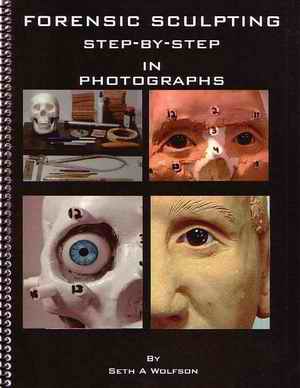
 Forensic Sculpting Step-By-Step in Photographs, 1stEdition, by Seth Wolfson. Spiral Binding, 8" x 11".
Realsculpt Press, 433 chardonnay circle, Brandon MS 39047 USA. Publication Date 2005. 60 pages, ISBN: 1-4116-3825-5. Price $19.95
 Official Site 1: Click here to visit
Official Site 2: Click here to visit
Seth Wolfson's personal Site: Click here to visit
Amazon Link: Click here to visit
 |
Forensic facial reconstruction (or facial approximation) aims to render an image from a skull of sufficient likeness to the individual when alive, so as to facilitate identification of the skeletal remains when other methods have failed. In the past, this was accomplished by two-dimensional sketches. Facial approximation is also used in archaeology to give a face to skulls from the past, for example of Egyptian mummies and ancient Mayan skulls. In the later half of the 20th century, forensic facial approximation was achieved by using a plastic method, with clay or plasticine used to build up a depth of "tissue" on a cast of a skull. Tissue depths have been worked out for 'landmark' points on the skull. Tissue depths are then interpolated between these points. These tissue depths are race-specific. The shape of the eyes, nose, ears, and mouth are largely guesswork, as is the hair and scars. The results differ between approximations and between practitioners.
The tissue depth measurements were made on cadavers in the earlier half of the 20th century. The measurements had severe limitations because they came from small samples, and also because tissue depth in the dead is not the same during life. In the 1990s, computerised methods for three-dimensional facial approximation were developed, in which computer algorithms are used to transform laser scanned images of the skull into faces. The images are more reproducible than plastic approximations, but there was still some subjectivity and they are also based on the limited tissue depth data. There has been more recent work using ultrasound and CT scans to collect tissue depth measurements.
The main advantages of a three-dimensional approach to a two-dimensional approach are that more points of the skull can be displayed, and the models can be photographed from different angles under different lighting. The main disadvantages are those of time, expense, and the high level of skill and training needed to render such a model. The artist will need to have an anthropological assessment of sex, age, race and body build.
 ...Facial approximation will remain an artistic recreation and interpretation, albeit one which is becoming more scientifically-based. The shape of the skull has only a limited resemblance to the shape of the face. Facial approximations are inherently inaccurate, and cannot be used as a positive proof of identification, and certainly, it cannot be used as evidence in a court of law... ...Facial approximation will remain an artistic recreation and interpretation, albeit one which is becoming more scientifically-based. The shape of the skull has only a limited resemblance to the shape of the face. Facial approximations are inherently inaccurate, and cannot be used as a positive proof of identification, and certainly, it cannot be used as evidence in a court of law...
|
Facial approximation will remain an artistic recreation and interpretation, albeit one which is becoming more scientifically-based. The shape of the skull has only a limited resemblance to the shape of the face. Facial approximations are inherently inaccurate, and cannot be used as a positive proof of identification, and certainly, it cannot be used as evidence in a court of law. A forensic facial approximation has some, but probably limited, value in acting as a stimulus for recollection of an absent friend or relative. When a putative candidate is identified, positive identification must be confirmed by other methods. The main use of forensic approximation is for law enforcement agencies to turn the public eye to missing persons, usually as a last resort. When used in such a manner, the public may have an unrealistic expectation that the model shows a prefect resemblance. When used to gain public attention, the newscast must make it understood that the model is just the artist's representation of what the person may look like.
The author of this book is Seth Wolfson. According to the book's website (http://www.forensicsculpting.com/), Mr Wolfson has been a professional artist and sculptor since 1988. Some of his works are featured on his website http://www.realsculpt.com/. Check out the small gallery on the website, and you will see that the author must be a talented and imaginative artist and sculptor. Mr Wolfson's experience is also listed on the website. He is a forensic sculptor for the Bensalem, Pennsylvania Police Department. He has taught in the fields of sculpting, mould making, and make-up effects. He created animatronic figures for film and television. He is currently a sculptor in a Mississippi company called Alatheia Prosthetics, a company which according to its website (http://www.alatheia.com/) manufactures medical prosthetics.
...In the preface to the book, the author states that the aim of his book is to make up for the lack of 'how-to' instruction in books and schools, by imparting methods typically kept from the novice and only picked up through years of experience. He explains some tips and tricks, do's and don'ts, and safety aspects...
|
In the preface to the book, the author states that the aim of his book is to make up for the lack of 'how-to' instruction in books and schools, by imparting methods typically kept from the novice and only picked up through years of experience. He explains some tips and tricks, do's and don'ts, and safety aspects.
I find the warnings on page 4 rather strange for a book like this. After stating the following - "Warning! There are tools referenced in this book that are not for use by unsupervised children. Make sure that an adult helps with drilling, gluing, and knife use." - the text goes on to say "This book is for the training of forensic sculpters only", and warns that "Real skulls are extremely fragile." But it's true that children, forensic sculpting and real skulls don't go together.
...There are other incongruous tips and warnings for such a book on forensic sculpting - In Part 3 ('Set up') "Don't be afraid to ask for help at the store"; In Part 4 ('Skull Mount') "Remember, the tools are not for unsupervised children. Get an adult to help"; In Part 5 ('Markers') "You will need a utility/ hobby knife . Be careful not to cut yourself"...
|
There are other incongruous tips and warnings for such a book on forensic sculpting - In Part 3 ('Set up') "Don't be afraid to ask for help at the store"; In Part 4 ('Skull Mount') "Remember, the tools are not for unsupervised children. Get an adult to help"; In Part 5 ('Markers') "You will need a utility/ hobby knife . Be careful not to cut yourself". Such tips and warnings make it feel like you are reading a hobbyist's guide on plasticine sculpting, rather than a book that intends to train you to do forensic sculpting. There are occasional spelling errors: on page 12 ("eraser materisl"), on page 13 ("knife againts the lower jaws edge", "corosponding number", anotomincal name"), on page 32 ("I will empart an obvious yet important tip").
The advice the author gives for those who wish to make a career of forensic sculpting include - putting in a significant amount of practice; testing oneself against forensic model skulls with known faces; to never stop taking sculpting lessons; attending a forensic sculpting workshop. All this is good advice. However, there is no real guidance on how someone who is interested in pursuing forensic sculpting as a career can get started and what type of qualifications or certification if any might be needed.
...The advice the author gives for those who wish to make a career of forensic sculpting include - putting in a significant amount of practice; testing oneself against forensic model skulls with known faces; to never stop taking sculpting lessons; attending a forensic sculpting workshop. All this is good advice. However, there is no real guidance on how someone who is interested in pursuing forensic sculpting as a career can get started and what type of qualifications or certification if any might be needed...
|
I found the step-by-step approach, supplemented with a very large number of photographs, very interesting reading. However, what I found disconcerting was the presentation of tables for tissue thickness (for American Caucasoids and Negroids) referenced simply to "courtesy of Dr Stan Rhine", with the Bibliography on page 60 saying "Rhine, Dr Stab. Re: Permission to use depth charts. E-mail to the author. 21 May 2005." (An internet search revealed that Dr Rhine is a forensic anthropologist at the University of New Mexico.)
Part 1 ('Materials', page 6) tells you about the materials you will need. Part 2 ('Clays', pages 7-8) tells about clays. The author uses flesh-tone sulphur-free plastiline for forensic sculpting. In Part 3 ('Set up', page 9), a photograph shows you what your set up might look like. In Part 4 ('Skull Mount', pages 10-11), you're shown how to mount a skull on a pipe and flange. In Part 5 ('Markers', pages 12-17), you're shown how to make markers from long vinyl erasers. The tables for tissue depths are on pages 14-17. In Part 6 ('Glue markers', pages 18-20), you're shown how the markers are glued on. Strangely for a book on forensic sculpting, you're advised that "you may want to consult an anatomy book" for the landmarks. In part 7 ("Eyes and Neck', pages 21-22), you're shown how to set the eyes in the orbits. In part 8 ('Formulas', pages 22-26), you're given formulae on the lengths and widths of the nose and lips. In part 9 ('Time to Cut the Clay and Start the Sculpture', pages 27-30), you're shown how to cut clay slabs to the appropriate thickness and how to apply these slabs to the skull. In part 10 ('Sculpting', pages 31-33), you're told about sculpting tools and the use of solvents. In the following 6 parts, you're shown how to sculpt the various parts of the face - part 11 ('Mouth', pages 34-35), part 12 ('Eyelids', pages 36-39), part 13 ('Nose', pages 39-41), part 14 ('Facial muscles', pages 43-47), part 15 ('Ears', 48-51), part 16 ('Hair', page 52). In part 17 ('Texture and Detail', pages 53-55), you're given tips on how to create skin texture, wrinkles, and eyebrows. Page 56 shows a photograph of the final sculpture. Page 57 gives some background information on the author. Pages 58-59 shows some non-forensic sculptures done by the author. There are no examples of the forensic work that the author has done, nor the outcome. On page 60, there is a 2-item bibliography.
...I would recommend this book as an interesting read to an artist, sculptor, investigator or forensic scientist, and who is interested in knowing about how forensic sculpting is done - but who is not really interested, willing or able to attend workshops. (I would guess that such workshops are unavailable in most countries). If you're an artist who is really interested and wants to learn how to do it, I would think that you would need to attend training workshops and get practical hands-on experience - in which case this book would be a useful beginner's supplement...
|
It is not really clear who is the intended audience for this book. Is it the hobbyist? Someone with an interest in sculpting, someone with an investigative or forensic background interested in learning more about the techniques of forensic sculpting? The serious artist wanting to pursue an career in forensic sculpting?
I would recommend this book as an interesting read to an artist, sculptor, investigator or forensic scientist, and who is interested in knowing about how forensic sculpting is done - but who is not really interested, willing or able to attend workshops. (I would guess that such workshops are unavailable in most countries). If you're an artist who is really interested and wants to learn how to do it, I would think that you would need to attend training workshops and get practical hands-on experience - in which case this book would be a useful beginner's supplement. I do not think that this book is a 'must have' for the typical in-house library of a forensic department. But it is attractively priced - so if you have US$20 to spare, I would say go ahead and get it for an interesting read.
-Dr. Teo Eng Swee Cuthbert
|
-Dr. Teo Eng Swee Cuthbert
Consultant Forensic Pathologist Singapore Email: TEO_Eng_Swee@hsa.gov.sg Dr. Cuthbert is a consultant forensic pathologist with the Health Sciences Authority, Singapore. He has a special interest in clinical forensic medicine, particularly in the areas of child abuse and family violence, and also in medical ethics and professionalism. His other appointments include Clinical Lecturer in Forensic Medicine (National University of Singapore), Visiting Consultant (Emergency Department, Changi General Hospital), and Faculty Lecturer of the Singapore Medical Association's (SMA) Professional Development Programme (Medical Ethics, Professionalism and Health Law). He is Vice-President of the Medico-Legal Society, Honorary Secretary of the Chapter of Pathologists (Academy of Medicine, Singapore). He sits on the Research and Advocacy Standing Committee and Executive Committee of the Singapore Children's Society. He is a contributing author in chapters in the textbooks The Pathology of Trauma, (Arnold 1999), Families in conflict (Subordinate Courts / Butterworths 2000), Medical Malpractice in Singapore (SMA 2002), and Forensic Medicine (Greenwich Medical Media 2003). He received a Ministry of Health commendation for work in SARS in 2003, a Service Award (Ministry of Community Development, Youth and Sports) in 2004, and the Singapore Police Force Overseas Service Medal (Tsunami) in 2005. He writes this review in his personal capacity. |
Order Realsculpt Press Books by clicking here.
 Request a PDF file of this review by clicking here. (If your screen resolution can not be increased, or if printing this page is giving you problems like overlapping of graphics and/or tables etc, you can take a proper printout from a pdf file. You will need an Acrobat Reader though.)
N.B. It is essential to read this journal - and especially this review as it contains several tables and high resolution graphics - under a screen resolution of 1600 x 1200 dpi or more. If the resolution is less than this, you may see broken or overlapping tables/graphics, graphics overlying text or other anomalies. It is strongly advised to switch over to this resolution to read this journal - and especially this review. These pages are viewed best in Netscape Navigator 4.7 and above.
-Anil Aggrawal


 [ Major links ]
[ Aims and Objectives ] [ FAQ ] [ Editorial Board ] [ Contributing Partners ] [ Sitemap ]
[ Paper/Thesis submission guidelines ] [ Editorials - Cumulative Index ] [ Discussion ] [ Chat room ] [ Be our sponsor! ]
[ Cumulative index of Book Reviews sorted by | Publishers | General Interest Books | Technical Books ] [ Animated Reviews ] [ Featured Reviews ] [ E-books ]
[ Reviews with Quizzes ] [ Links ] [ Submit books/journals/software/multimedia for review ] [ journal CD ] [ History of the Journal ] [ Interviews ] [ Credits ]
[ Cumulative index of | Theses/dissertations | [ Online Courses ] [ Awards ] [ Anil Aggrawal's Internet Journal of Book Reviews - Sister Publication ]
[ Cumulative reviews of Software/Multimedia | Books on CD/Audio tapes ] | Calenders | Models ] [ contact us ]
[ Undergraduate section | Postgraduate section ] [ Forensic gadgets/toys/other tidbits ]
Books for review must be submitted at the following address.
Professor Anil Aggrawal (Editor-in-Chief)
Anil Aggrawal's Internet Journal of Forensic Medicine and Toxicology
S-299 Greater Kailash-1
New Delhi-110048
India
Click here to contact us.
This page has been constructed and maintained by Dr. Anil Aggrawal, Professor of Forensic Medicine, at the Maulana Azad Medical College, New Delhi-110002. You may want to give me the feedback to make this pages better. Please be kind enough to write your comments in the guestbook maintained above. These comments would help me make these pages better.
 IMPORTANT NOTE: ALL PAPERS APPEARING IN THIS ONLINE JOURNAL ARE COPYRIGHTED BY "ANIL AGGRAWAL'S INTERNET JOURNAL OF FORENSIC MEDICINE AND TOXICOLOGY" AND MAY NOT BE REPOSTED, REPRINTED OR OTHERWISE USED IN ANY MANNER WITHOUT THE WRITTEN PERMISSION OF THE WEBMASTER
Questions or suggestions ? Please use ICQ 19727771 or email to dr_anil@hotmail.com
Page Professor Anil Aggrawal via ICQ

|