


|
|
|
|
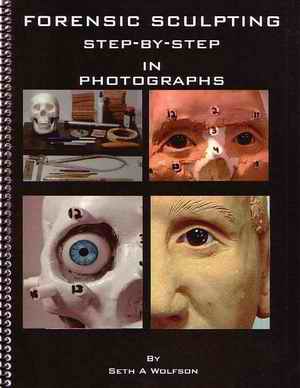
 Forensic Sculpting Step-By-Step in Photographs, 1stEdition, by Seth Wolfson. Spiral Binding, 8" x 11".
Realsculpt Press, 433 chardonnay circle, Brandon MS 39047 USA. Publication Date 2005. 60 pages, ISBN: 1-4116-3825-5. Price $19.95
 Official Site 1: Click here to visit
Official Site 2: Click here to visit
Seth Wolfson's personal Site: Click here to visit
Amazon Link: Click here to visit
 |
"OO I WANT!", exclaimed the saturnine forensic expert.
This inexpensive volume, cram-full of color photographs and easy to handle, will delight every forensic anthropologist with an interest in possible tools for research, every professional sculptor with a curiosity for unusual branches of the art, and every horror-movie or special-effect aficionado.
In addition, the type of work performed by Mr. Wolfson is connected with prosthetics, although that aspect is not treated in this particular book. No doubt quite a few medical practitioners who have no dealing with forensic matters, but plenty with amputee patients, will be glad of finding out about this.
The only flaw of this book is some carelessness in spelling, which an expert editor would have corrected, but which probably won't be noticed by 98% of the readers.
The subject is of the simplest: we are shown a plastic skull molded on a real one, which can be purchased together with a sealed photograph of the person, to check accuracy (in USA), we're shown the materials for sculpting and we're told where to buy (always in USA). Then the process of fleshing out the skull is shown, as the title says, step by step.
Even if unable or unwilling to purchase a plastic skull, many people who want to try their hand at sculpting a head (beginners, painters, model-makers, whatever) will be glad of Mr. Wolfson's homely and sensible advise. Shaping a lump of clay into a work of art is not something that can done by following instructions, but many young artists (professional or amateur) who want a realistic approach will be glad of those little workshop tips, like how to put the lines into the face without making them look like gashes, or what to use to get a skin-like texture on the face.
 ...Even if unable or unwilling to purchase a plastic skull, many people who want to try their hand at sculpting a head (beginners, painters, model-makers, whatever) will be glad of Mr. Wolfson's homely and sensible advise. Shaping a lump of clay into a work of art is not something that can done by following instructions, but many young artists (professional or amateur) who want a realistic approach will be glad of those little workshop tips, like how to put the lines into the face without making them look like gashes, or what to use to get a skin-like texture on the face... ...Even if unable or unwilling to purchase a plastic skull, many people who want to try their hand at sculpting a head (beginners, painters, model-makers, whatever) will be glad of Mr. Wolfson's homely and sensible advise. Shaping a lump of clay into a work of art is not something that can done by following instructions, but many young artists (professional or amateur) who want a realistic approach will be glad of those little workshop tips, like how to put the lines into the face without making them look like gashes, or what to use to get a skin-like texture on the face...
|
I mention the realistic approach, because many "serious" art teachers would discourage students from being "realistic". This has degrees, of course. And equally of course, this attitude, as nearly everything in this life, is governed by fashion. I am acquainted with the milieu, as it so happens that my Ma was an Art teacher and my Pa was a botanical illustrator and also the son of a well-known sculptor. My Grandpa, Juan Carlos Oliva Navarro, made monumental statues for a steady job but he was celebrated for his bas-relief portraits for medals. And for his sensitive treatment of the female nude. Trust Grandpa to insert a gorgeous person clad only in the majesty of her attitude into any sort of scene. He even sneaked one on the reverse of the commemorative medal for Thomas Alva Edison.
Living aside the picturesque angles of artistic life, anybody who wishes to undertakes forensic sculpture, whether a "professional" or not, should first be able to sculpt with reasonable dexterity. This is one point that young people tend to overlook when they first get excited about disciplines of forensic interest.
To become a forensic medic, you must first be a medic; learn to take out an inflamed appendix, to treat diarrhea and to examine people with athlete's foot. Then you specialize. To become a forensic entomologist, you must first be a biologist (five years wearing your feet out in old-fashioned labs, and preferably a small thesis), and learn about animals in general and in their natural context. Then you specialize (another four-five years and a BIG thesis. Nobody says you must be a Doctor, but in practice, nearly everybody who competes with you for a scholarship or a designation will be one, so-).
...To become a forensic sculptor, you must first study Art, become familiar with different media, decide you want to do sculpture rather than drawing, paintings, ceramics, carvings, etchings (is etching still done? I wonder). Then you should practice sculpting until you're quite dexterous, study the human anatomy until you can make a figure without gross defects, practice portrait-making until your eye gets used to see what makes one face different from another. Then you can do forensic sculpture...
|
To become a forensic sculptor, you must first study Art, become familiar with different media, decide you want to do sculpture rather than drawing, paintings, ceramics, carvings, etchings (is etching still done? I wonder). Then you should practice sculpting until you're quite dexterous, study the human anatomy until you can make a figure without gross defects, practice portrait-making until your eye gets used to see what makes one face different from another. Then you can do forensic sculpture.
How good was the artist at getting a likeness?
Heh, heh.
I did think the supposed.. er.. subject looked a bit small-skulled, to say the least. Then I went back to the photos of the plastic skull and said to myself: "Surely this is a woman's skull? The jaw is delicate, the supraorbital ridges are hardly marked. And hey, this nose hole would be a mesorhine- Oriental- or mixed Afro-American- yes, the shape of the supraorbital ridge- the triangular depression above the nose- this was a woman of mixed parentage with some African blood. Why, then, if he used tables for males, the muscles of the lower face would be far too bulky for the cranium!"
"But of course, aren't you slow today!", I scolded myself, "the author cannot use the face of a *real* person in this kind of book. Family may object- and if he's that good, the face might look like a close relative who's alive and about!"
Then I took the obvious course of asking Seth if this distortion had been intentional.
..."To answer your questions", Seth mailed back, "I did not want too detailed a final sculpture, because it could confuse the novice, they may add "character" that is not known to be true, like wrinkles, scars, etc. And you are right, the skull, I have been told, is actually a African American woman possibly (sic), it has been also used as an Asian, white female and more in books according to one source."...
|
"To answer your questions", he mailed back, "I did not want too detailed a final sculpture, because it could confuse the novice, they may add "character" that is not known to be true, like wrinkles, scars, etc. And you are right, the skull, I have been told, is actually a African American woman possibly (sic), it has been also used as an Asian, white female and more in books according to one source."
I would have given a lot to be able to see whether the incisor teeth were spade-shaped (Oriental/Amerindian character, or so it's said by anthropologists). However, I still think the shape of the supraorbital ridge is very characteristic.
"I wanted to go with a standard middle of the road chart to work with, so I went for a white male in his 30's, this keeps it simple for the reader. It also avoids anyone disagreeing with the race and sex, I admit freely that since I am not an anthropologist I cant tell! Plus there are legalities. I have permissions to use the skull from the maker, but no permissions from families etc."
That's something one must keep in mind with this book. It is not meant to show how good a portraitist is Mr. Wolfson, but to teach technique from basics.
The word "legalities" is another point which ought to be emphasized. Dead people are not objects of entertainment. It is one thing to show a few photos to a graduate class of Legal Medicine, but you may not make public any images of living people, or of dead people with living relatives, unless you have permission. As simple as that.
...The word "legalities" is another point which ought to be emphasized. Dead people are not objects of entertainment. It is one thing to show a few photos to a graduate class of Legal Medicine, but you may not make public any images of living people, or of dead people with living relatives, unless you have permission. As simple as that...
|
As to safety, I sent this question to the author:
"Your book is aimed exclusively at people doing Forensic Sculpture, which would imply adults with some previous experience. Yet I have remarked that you emphasize warnings against unsupervised children using certain tools. Very right too, but since there is an apparent contradiction, would you care to comment on why did you think the warning important?"
Answer:" I understand your question, in fact others have inquired. There are a few reasons, first, I tried to do the book in a way that not just professionals could follow and do the project, I hope that even high school students could do this in class or younger kids can do this with their parents."
"Now here is the other side of the coin, most adults don't know how to use tools properly. I currently make medical prosthetics, such as fake fingers and hands for www.alatheia.com in Mississippi. I see a good many people who have made elementary mistakes that have resulted in injury, such as cutting toward them selves, or their fingers. I have also witnessed many people with drills or dremels catch rubber gloves in them , or worse I witnessed a fellow teacher catch her hair in a Small drill and rip the hair from her scalp, due to not having it tied back. I could give a dozen more stories of injury, but I am sure by now you have remembered an incident yourself where you cut yourself accidentally."
...One can only applaud the stress laid upon safety. There appears to be something in late XXth century culture that makes people careless. Would that be unchecked Wishful Thinking? Now for the crucial question. Is this type of reconstruction any good for practical purposes?...
|
"To make a short story long, I wanted this book to be an affordable (under 20$) book that can help the novice learn the basics, or give the professional some new trick."
One can only applaud the stress laid upon safety. There appears to be something in late XXth century culture that makes people careless. Would that be unchecked Wishful Thinking?
Now for the crucial question. Is this type of reconstruction any good for practical purposes?
I must say I'm doubtful. There are some remarkable examples of portraits found on Egyptian mummies of the Roman period, and I have seen "forensic" reconstructions of the faces from the skulls, and some of them do not convince me. Take the boy Eutyches. The original shows a "Cupid's bow" upper lip, which goes with the rest of the face- Mediterranean "race", with a little mixture. The curves may appear too pronounced, but I've seen such lip shape in people who have a dollop of Alpine. And who hasn't? I mean, when you happen to be of European descent.
Well, my complaint is that the forensic reconstruction gave Eutyches an upper lip without the proper curves. I wonder: did the artist overlook the lip structure (so apparent in Mediterraneans), or was he using data from what the Americans call "Latinos"? Because the latter are mixed with Amerindian and African, and the modern portrait of Eutyches made him look precisely like a boy with one sixteenth of African blood. Which I would bet he did not happen to have, judging from the rest of his features.
Point one: during embryonic development, the upper lip is built from a pair of lateral flaps and a medial flap; the lower lip, of a pair of flaps. That much is well-known to surgeons who correct hare lip. But how many artists look for that structure on the lips? In African races, the medial flap is very narrow; sometimes the red part actually has a roof like medial line. And I have remarked than in people of mixed ancestry, dilute African genes often produce a peculiar upper lip shape in which the medial flap is hardly apparent. Conversely, "Mongolian" races (including Amerindians), and also Alpines, tend to narrow, but long medial flaps, so that the downward peak above the mouth opening is marked. And this is only one part of one feature.
What happens when broad lateral flaps (Nordic) plus with a short medial flap (Mediterranean) are superimposed on an Alpine jaw? Answer: A mouth like mine, perpetually open (if relaxed). Does that show in my bones? Wouldn't it be nice to know.
Point two: To know what thickness should be given to soft parts, artists refer to tables made by medics. There are separate tables for men and women, and for different races. This sounds good, but I'm afraid that it's not enough. Tables for "Afro-Americans" and "Amerindians" are probably accurate enough for practical purposes. But I don't believe tables for "Caucasians" are any good, and I'm going to shock my reader by explaining why.
There is no such thing as a Caucasian race.
This assert usually comes to a shock to medical persons, while anthropologists probably will be snorting "Old hat!" and "Discovered America, have ya?". Surely enough, anthropologists speak well and easily of the Nordic, the Mediterranean and the Alpine races, and quite a few more. But in the first place, "race" is a bad term. Zoologists often replace it with "subspecies", and there is no reason to think that Homo sapiens actually split into subspecies. "Strains" would be a better term.
Nowadays, no one questions that dark skin was evolved independently by several unrelated "racial" groups, because it is adaptive in the tropics as a protection from UV rays in sunlight. Considering the climate in most of Europe, it should not be surprising that all the strains of H. sapiens living in Europe should develop light skin, ranging from light brown to real white which never tans. (To freckle or not to freckle, that is the allele!). I would suppose light skin makes it easier to obtain vitamin D from sunlight, but whatever the reason, there is Europe, and there are all those people with "white" skin, and they aren't a homogeneous group, and everyone knows it. "Caucasian race" is just a convenient fiction. But lumping data together into "Caucasian" leaves us with a set - or rather two sets - of heterogeneous information.
A zoologist working on the taxonomy of an animal group will take each character in turn and try to assess whether it is primitive or derived (specialized). Of course this is not always possible, but one tries. Derived characters found in several lines of descent may mark a common ancestor, but in some cases they may have occurred independently. Like sallow-skinned strains of Homo sapiens acquiring a very melanic or a weakly melanic skin.
Now, anthropologists take for granted that H. sapiens is descended from a "simian" ancestor. So far, so good. But - perhaps as a reaction against an old school of thought which assumed that some "races" were more primitive than others - they refrain from giving weight to each character as primitive or derived. This is different from considering a human group primitive. Nordics may be ortognathous, but their lips are among the most "simian" ones; Africans have retained a bit of prognathism, but their "pouting" lips are a derived character.
As far as I can tell with my zoologist's eye, there are six European strains. I may discuss the matter freely, for I got an admixture of every one of them. Including Cromanid.
A very distinguished Spanish historian once wrote that Cro-Magnon men might be a sort of proto-Nordic. Oh dear no. Thick as it is, the Cromanid skull is more specialized that the Nordic one, because its (admittedly lower) vault has no raised parietal suture. And let me tell you that my late father had a bald head you could land toy planes on. A dolichocephalic head, of course, so I figured that was the Nordic skull, until I went to Belgium and saw my first balding Nordic with the parietal suture sticking up.
Thus it was that it took me twenty-two years to understand why Dr Mortimer of The Hound of the Baskervilles wanted to run his finger along Sherlock Holmes' parietal suture. In my family we had blue eyes, but no raised parietal sutures.
Genetics being what they are, some people get a fetching combination of features, like those Botticelli types that actually exist in Tuscany. Then again, some of us are the salad type. Why did I have to get a weak Alpine chin and large Nordic feet, when it would have been so easy to have it the other way round? The chin I don't mind so much because I haven't got to see it, but when I practice Aikido with one of the guys who also has a good dash of the Nordic in him, we keep treading on each other's large feet.
It could be worse, of course. I still look more like a human being that like a hamster, but it was touch and go. Darwin, in his Origin of Man, mentions an old unpleasant idea that people who resemble "inferior" animals are more primitive than those who look like- people and nothing else. Darwin himself did not believe in this, I'm glad to say. As a matter of fact, people who look like animals are "mosaic" mixtures. They look "other-than-human" because the parts of the face don't fit among them. Sometimes the soft parts don't fit the bones. On the other hand, people of (phenotypically) pure strain may look strange or forbidding to a foreigner, but not really ugly, because all the parts of their faces match together, so to speak.
Have a look at the sculpture of an elderly man which Seth made for Portland International Airport. Can any forehead get that domed unless Nordic + Alpine central swellings build up? With moderate Alpine suraorbital ridges? And can you see the "heart-shaped" Alpine mouth practically superimposed on the muscular Nordic lips? Salad, I said.
In addition- well, it's a delicate subject, but nineteenth-century artists used to know quite well that adipose localizations show ethnical differences. They knew, for instance, that a model of the "meridional type" would have the real amphora-shaped hips. But what's "meridional", Doc? Mediterranean? Anatolian? Half-and-half? Perhaps with a splash of Alpine, like the boy Eutyches? And we haven't got into the subject of recent crossings with noneuropean strains. But are noneuropean strains all that different from European ones? As a matter of fact, I suspect that every European strain has darker versions in other continents.
There is a folk story about God making people out of dough, just like cookies. Some batches came off white, some golden, some toasted brown. No bad jokes about half-baked, please. It's not nice to scoff at other people's physical defects.
But if what might be called loosely "bunch of people with whitish skin" are not one race, how could reliable anthropological tables be compiled? No use trying to get "pure" Nordic or Alpine or whatever. The anthropologists themselves admitted that pure "races" could no longer be found as early as around the 1940s. I think the best course would be to build extensive files from photographs and X-rays of living people. Then one could assess how far can soft parts be deduced from bone parts. This would not be cheap, but after all, there must be only so many possible combinations.
Some characters would turn out to be allele determined. The Nordic nose is large, fleshy, but based on a narrow opening; so much is "racial". The tip may be thin or thickened into a ball; that's an individual trait. So is the cleft or uncleft chin. Many such characters are identified through the work of precedent generations in human Genetics, and no doubt quite a few would show up with the examination of large samples. Not to mention work on DNA. Of course it would be nice to find out the code for every possible variant in the human body, but one finds what one looks for, and a list of physical characters cannot hurt. No doubt many anthropological teams do have good lists of characters. I'm just saying they can be improved.
Incidentally, a better understanding of, as we might say, the taxonomy of Homo sapiens might help eradicate some racist attitudes. It won't stop some people from criticizing their neighbor, though. Redhairs do have a hard life of it in some corners of the world. And being blue eyed in a "Latin" country means that some people write you down as a (probably snobbish) Anglo- or German-cross before you even open your mouth. Discrimination is no one's friend.
-Dr. Adriana Oliva
 |
-Adriana Oliva Adriana Oliva is a senior editor associated with this journal since its inception. For more information about her, please click here. She can be contacted at aoliva@macn.gov.ar |
Order Realsculpt Press Books by clicking here.
 Request a PDF file of this review by clicking here. (If your screen resolution can not be increased, or if printing this page is giving you problems like overlapping of graphics and/or tables etc, you can take a proper printout from a pdf file. You will need an Acrobat Reader though.)
N.B. It is essential to read this journal - and especially this review as it contains several tables and high resolution graphics - under a screen resolution of 1600 x 1200 dpi or more. If the resolution is less than this, you may see broken or overlapping tables/graphics, graphics overlying text or other anomalies. It is strongly advised to switch over to this resolution to read this journal - and especially this review. These pages are viewed best in Netscape Navigator 4.7 and above.
-Anil Aggrawal


 [ Major links ]
[ Aims and Objectives ] [ FAQ ] [ Editorial Board ] [ Contributing Partners ] [ Sitemap ]
[ Paper/Thesis submission guidelines ] [ Editorials - Cumulative Index ] [ Discussion ] [ Chat room ] [ Be our sponsor! ]
[ Cumulative index of Book Reviews sorted by | Publishers | General Interest Books | Technical Books ] [ Animated Reviews ] [ Featured Reviews ] [ E-books ]
[ Reviews with Quizzes ] [ Links ] [ Submit books/journals/software/multimedia for review ] [ journal CD ] [ History of the Journal ] [ Interviews ] [ Credits ]
[ Cumulative index of | Theses/dissertations | [ Online Courses ] [ Awards ] [ Anil Aggrawal's Internet Journal of Book Reviews - Sister Publication ]
[ Cumulative reviews of Software/Multimedia | Books on CD/Audio tapes ] | Calenders | Models ] [ contact us ]
[ Undergraduate section | Postgraduate section ] [ Forensic gadgets/toys/other tidbits ]
Books for review must be submitted at the following address.
Professor Anil Aggrawal (Editor-in-Chief)
Anil Aggrawal's Internet Journal of Forensic Medicine and Toxicology
S-299 Greater Kailash-1
New Delhi-110048
India
Click here to contact us.
This page has been constructed and maintained by Dr. Anil Aggrawal, Professor of Forensic Medicine, at the Maulana Azad Medical College, New Delhi-110002. You may want to give me the feedback to make this pages better. Please be kind enough to write your comments in the guestbook maintained above. These comments would help me make these pages better.
 IMPORTANT NOTE: ALL PAPERS APPEARING IN THIS ONLINE JOURNAL ARE COPYRIGHTED BY "ANIL AGGRAWAL'S INTERNET JOURNAL OF FORENSIC MEDICINE AND TOXICOLOGY" AND MAY NOT BE REPOSTED, REPRINTED OR OTHERWISE USED IN ANY MANNER WITHOUT THE WRITTEN PERMISSION OF THE WEBMASTER
Questions or suggestions ? Please use ICQ 19727771 or email to dr_anil@hotmail.com
Page Professor Anil Aggrawal via ICQ

|


