|
 OTHER REVIEWS IN THIS ISSUE OTHER REVIEWS IN THIS ISSUE Pages: |1| 2| 3| 4| 5| 6| 7| 8| 9| 10| 11| 12| 13| 14| 15| 16| 17| 18| Pages: |1| 2| 3| 4| 5| 6| 7| 8| 9| 10| 11| 12| 13| 14| 15| 16| 17| 18|
[Popular Books Section] [Books on CD/Audio Tapes]
|



|
|
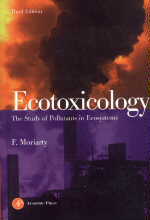
 Ecotoxicology: The Study of Pollutants in Ecosystems 3rd Edition, by F. Moriarty
Academic Press, Harcourt Place, 32 Jamestown Road, London NW1 7BY, UK; Publication Date 1999. xii + 347 pages, ISBN 0-12-506763-1. Price $49.95
 |
Ecotoxicology is conventionally considered to be a part of environmental toxicology, although it is in actuality a vast and multidisciplinary subject with biochemistry and ecology constituting the basic foundation. While toxicology can be defined as the science dealing with the effects of poisons on living organisms, the term ecotoxicology (coined by Truhaut in 1969) is restricted in its meaning to specific ecological effects of pollutants, or more appropriately toxicants, i.e., pollutants which are toxic. The basic principle in ecotoxicology is that the effects of a toxicant (as in toxicology) depend on the exposure and dose, but (unlike toxicology), the measure of the effect is on the population. Ecology itself was defined as far back as in 1927 by Elton quite vaguely as scientific natural history, but more precisely, it is the scientific study of the interactions that affect the distribution and abundance of organisms. Ecotoxicology is therefore rightfully a sub-discipline of ecology dealing with the effect of toxicants on various ecosystems.
|
Pollution arising out of industrialization was once considered an inevitable fact of life that had to be tolerated in the larger interests of "progress." It was only in the 1950s and 1960s that concerns about serious adverse impact on the environment began to be voiced. It all began with the observations on the ecological effects of agricultural pesticides on wildlife. But while this was not totally unexpected, the fact that industrial effluents discharged into the environment can have significant toxic effects on plant and animal life came into prominence after a series of reports in the 1960s and 1970s. However the main focus has never been on the effects of pollutants on all species, but on the implications for humankind. Effects on other species are appraised principally for studying the possible impact on ourselves. Contamination of food is but one example, and studies in this context are more accurately slotted as part of environmental toxicology. Chemical contamination of the environment is one of the most serious problems faced by us today, and the gravity of the situation is only increasing each day as newer chemicals are added in their hundreds. More than 9 million chemicals are listed in the Chemical Abstract Service's registry of chemicals! The need to predict the ecological effects of chemicals is today considered so important that most countries have introduced stringent legislation, beginning with the Toxic Substances Control Act of the United States in 1976.
 ...There is a discernible sequencing of chapters such that each dissolves smoothly into the next in logical progression... ...There is a discernible sequencing of chapters such that each dissolves smoothly into the next in logical progression... |
The book under review authored by an eminent expert in the field was first published in 1983, and has since seen two more editions (in 1988 and 1999). The latest (third) edition retains the original structure of the earlier editions, with the subject being discussed under two main (undefined) sections - the first 4 chapters being of an introductory nature, while the subsequent 4 chapters discuss the specifics of ecotoxicology. Chapter 9 provides some interesting relevant case studies, while chapter 10 rounds off the whole book by listing important conclusions. The main theme of the book is to do with the study of the impact of pollutants (directly or indirectly) on individual organisms, as well as the environment in its entirety. The emphasis throughout is on toxicological perspectives. The author avows (in his preface) that the book is neither meant to be a textbook nor does it represent a comprehensive review of the literature, which is as well since the literature on ecotoxicology is too enormous to be dealt with adequately in a handbook of this size. However, it is noteworthy that relevant vital information on all aspects of the subject has been incorporated, belying the compact size of the book.
The introductory chapters serve to initiate the novice into the complex field of ecotoxicology with detailed descriptions of characteristics of both pollutants and ecosystems. There is a discernible sequencing of chapters such that each dissolves smoothly into the next in logical progression. By the time the reader comes to the end of the introductory section of the book, he would have grasped the fundamental aspects of populations, communities, and genetics, and associated implications for ecotoxicology.
The subsequent chapters deal with specifics relating to the effects of pollutants on habitats and individual organisms. A notable new feature of this edition is a detailed discussion on global warming with particular reference to the mechanisms and biological effects. Coming to the chapter on methods for predicting and monitoring the effects of pollutants, the author rightly points out that screening and predictive tests based on acute toxicity are generally biased against detecting ecological effects. It is also true that the monitoring and tackling of pollution damage involves value judgments. Ultimately, the question must be asked : what are the environmentalists actually trying to achieve in terms of protection of the environment? A simplistic approach is not going to serve the purpose, since the complexity of ecosystems necessitates complex methods of analysis. With further advancements in technology, and changing equations of man's relationship with, and impact on the environment, this issue is only going to get more complicated in the future. Keeping this in mind, the author's effort at relating the problems of ecotoxicology to their ecological context without making value judgments, must be appreciated. The book on the whole is written lucidly, rendering a complicated area of toxicology easy to comprehend and assimilate. The presentation of the subject is flawless and the list of references at the end of the book is impressively exhaustive. However, had the book been in the form of a hardback, it would have been more appealing and durable.
All in all, this book could serve as an invaluable addition to any library stocking books on toxicology, as well as an asset to all students and professionals dealing with any aspect of the subject.
|
-V.V.Pillay MD, DCL
Professor, Dept. of Forensic Medicine & Toxicology Chief, Dept of Analytical Toxicology (Incl. Poison Information Service), Amrita Institute of Medical Sciences & Research, Cochin 682026, South India Phones: 0484-2804852 (O); 0484-2807055 (R), 9895282388 (Cell) Email: toxicology@medical.amrita.edu Dr.V.V.Pillay has been in the vanguard of the movement among medical professionals in India to develop the neglected field of Toxicology. He has published extensively in both the scientific and lay press on matters relating to Toxicology, as well as his chosen discipline - Forensic Medicine. Dr.Pillay has authored 6 books on Forensic Medicine and Toxicology, and has received an award for one of them (Modern Medical Toxicology), generally considered to be a trend setter among books on the subject in India. He has reviewed several books on Toxicology for the Internet Journal of Forensic Medicine and Toxicology. Dr.Pillay received a scroll of honour in appreciation of work done in the field of Toxicology from the Medicolegal Society, All India Institute of Medical Sciences, New Delhi. He has established a state-of-the-art Poison Control Centre, recognized by the World Health Organization at the institute where he is currently employed (AIMS, Cochin). Among his most sought-after publications is a 700 page reference work on Toxicology. |
 Order this Book by clicking here
or via telephone 1-800-545-2522 (during Eastern Time business hours), with any questions you may have about the order process.
 Request a PDF file of this review by clicking here. (If your screen resolution can not be increased, or if printing this page is giving you problems like overlapping of graphics and/or tables etc, you can take a proper printout from a pdf file. You will need an Acrobat Reader though.)
N.B. It is essential to read this journal - and especially this review as it contains several tables and high resolution graphics - under a screen resolution of 1600 x 1200 dpi or more. If the resolution is less than this, you may see broken or overlapping tables/graphics, graphics overlying text or other anomalies. It is strongly advised to switch over to this resolution to read this journal - and especially this review. These pages are viewed best in Netscape Navigator 4.7 and above.
-Anil Aggrawal

 [ Major links ]
[ Aims and Objectives ] [ FAQ ] [ Editorial Board ] [ Contributing Partners ] [ Sitemap ]
[ Paper/Thesis submission guidelines ] [ Editorials - Cumulative Index ] [ Be our sponsor! ]
[ Cumulative index of Book Reviews sorted by | Publishers | General Interest Books | Technical Books ] [ Animated Reviews ] [ Featured Reviews ]
[ Reviews with Quizzes ] [ Links ] [ Submit books/journals/software/multimedia for review ] [ journal CD ] [ History of the Journal ] [ Interviews ] [ Credits ]
[ Cumulative index of | Theses/dissertations | Online Courses | Awards ] [ Anil Aggrawal's Internet Journal of Book Reviews - Sister Publication ]
[ Cumulative reviews of Software/Multimedia | Books on CD/Audio tapes | Calenders | Models ] [ contact us ]
Books for review must be submitted at the following address.
Professor Anil Aggrawal (Editor-in-Chief)
Anil Aggrawal's Internet Journal of Forensic Medicine and Toxicology
S-299 Greater Kailash-1
New Delhi-110048
India
Click here to contact us.
This page has been constructed and maintained by Dr. Anil Aggrawal, Professor of Forensic Medicine, at the Maulana Azad Medical College, New Delhi-110002. You may want to give me the feedback to make this pages better. Please be kind enough to write your comments in the guestbook maintained above. These comments would help me make these pages better.
 IMPORTANT NOTE: ALL PAPERS APPEARING IN THIS ONLINE JOURNAL ARE COPYRIGHTED BY "ANIL AGGRAWAL'S INTERNET JOURNAL OF FORENSIC MEDICINE AND TOXICOLOGY" AND MAY NOT BE REPOSTED, REPRINTED OR OTHERWISE USED IN ANY MANNER WITHOUT THE WRITTEN PERMISSION OF THE WEBMASTER
Questions or suggestions ? Please use ICQ 19727771 or email to dr_anil@hotmail.com
Page Professor Anil Aggrawal via ICQ

|