|
 OTHER REVIEWS IN THIS ISSUE OTHER REVIEWS IN THIS ISSUE Pages: |1|
2|
3|
4|
5|
6|
7|
8|
9|
10|
11|
12|
13|
14|
15|
16|
17|
18| Pages: |1|
2|
3|
4|
5|
6|
7|
8|
9|
10|
11|
12|
13|
14|
15|
16|
17|
18|
[Popular Books Section]
[Books on CD/Audio Tapes]
|



|
|
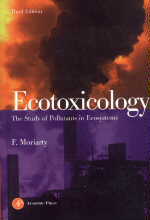
 Ecotoxicology: The Study of Pollutants in Ecosystems 3rd Edition, by F. Moriarty
Academic Press, Harcourt Place, 32 Jamestown Road, London NW1 7BY, UK; Publication Date 1999. xii + 347 pages, ISBN 0-12-506763-1. Price $49.95
 |
As a high school biology student - way back in 1970 - I read about an extremely remarkable natural event that occurred in Britain around 1850s. And it left such an indelible impression in my mind, that I still remember it very vividly. Around 1850s, a particular peppered moth Biston betularia, which normally had light wings, began to change its color suddenly and for no apparent reason at all. Suddenly there were melanic forms all over. They had dark wings. The first dark - or melanic - form was caught somewhere in Manchester in 1848, but within next fifty years, these forms had increased so much that they outnumbered the usual light-colored moth by 99 to 1!
Why was this occurring? Why was nature so generous to the black variety in preference to white - and so suddenly? Charles Darwin had just crystallized his revolutionary theory of evolution, and it offered a very neat - almost poetic - explanation. Britain was getting rapidly industrialized during those times, with the result that tree trunks were increasingly becoming black. Industries were ejecting smoke in copious amounts which was getting deposited on trees. These trees, which normally had light colored trunks, were the normal resting places of these moths. On newly turned black trunks, the light colored variety of the moth was plainly visible to the predatory birds, while the black colored variety was not. This put the evolutionary pressure strongly in favor of the dark colored variety. With the result that within fifty years the dark variety had almost totally replaced the light variety.
|
Often I wonder why I remember this instance so vividly. Perhaps because of striking diagrams of a white and a black moth both sitting on a black and a white trunk, each variety becoming so plainly visible on the opposite colored trunks. Perhaps also because it was such a dramatic proof of the Darwin's theory of Natural Selection. Perhaps because this proof came in our lap just at the right time - Darwin's theory was getting its final shape during those times. Perhaps because it was such a clear example of evolution, which one could see in one life time. Normally you need millions of years for this.
I never thought I will ever get to read that story again. Because instead of becoming a biologist, I chose to become a forensic pathologist and toxicologist. That is why I was amazed to read this story again in a most unexpected source - in the book under review.
What was this story of evolution doing in a book on ecotoxicology? What has ecotoxicology to do with peppered moths and industrialization, and perhaps with evolution? I was curious, and not being able to find an immediate answer, I turned to the first chapter.
But before doing that, I had the good sense to leaf through all the pages, and almost immediately I realized I had a hot book in my hands. Take this story for instance, which appears on pages 255-260. I enjoyed it thoroughly firstly because it read so much like the earlier one, and secondly because it was completely new to me. And it is just one of the several stories which are scattered throughout the book. Around 1960, there were several complaints in Britain that the number of peregrine falcons (Falco peregrinus) had increased dramatically. Peregrine falcons normally predated upon racing pigeons (Columbia livia). People who flew racing pigeons noted that their numbers were decreasing and they assumed - without any real scientific basis - that the cause was an increasing number of predating peregrines. A survey showed that far from being increasing in number, they were actually decreasing. An investigation into the reasons threw up a very unexpected cause. Dieldrin - a commonly used insecticide in those days - was being used as seed dressings for cereal seed. It was thought that to apply dieldrin as a seed dressing ought to be highly efficient. After all one was putting it exactly where it was needed. Racing pigeons who ate those seeds were dying of acute toxicity. The evidence also suggested that consumption of two or three heavily-contaminated pigeons could kill a peregrine! This could explain the decrease in number of both the peregrines as well as the racing pigeons.
|
However just this phenomenon failed to explain for the entire decrease in peregrine population. And herein comes the surprising part of the whole story. It was found that it inhibited the enzyme Ca2+-ATPase in the eggshell gland of peregrines, which caused them to lay thinner eggs. This caused more eggs to break and resulting lessening of population!
This illustrates how amazing and rewarding the study of ecotoxicology can be. But what exactly is ecotoxicology? To understand this term fully, we must first understand the concept of organisms, populations, communities, habitats and ecosystems. And for this we have to turn to chapter one, where the author explains all these concepts very clearly.
We all understand what an organism is. A single bacteria is an organism. A mango tree is an organism. A human being is an organism too. A collection of several organisms of a single species living together in a well defined area form a population. A well defined area, among others, can be a pond, the summit of a mountain or an isolated island. A number of fish of a particular species living in a pond would form a population. The peppered moth living in Manchester area formed a population. The peregrine falcons living in a particular area of Britain formed a population. The book goes on to define the population in a more interesting way. On page 8, we are told that a population may be defined as those individuals of a species so situated that any two of them have equal probability of mating with each other and producing offspring. The book goes on to define the concept of meta-population too, which consists of numerous separate relatively ephemeral groups.
No one population lives alone. For instance peregrine falcons living in Britain were not living alone; they were living with racing pigeons (and presumably several other birds, as well as plants, trees, grasses, animals - even moss, ferns, and bacteria!). A number of populations living in the same area and interacting with each other form a community. We know for sure that peregrine falcons and racing pigeons were interacting with each other; the former predated upon the latter. So these two formed a community.
The community does not live alone either. It has a non-living environment around it - rivers, ponds, air, soil and so on. This inanimate, or abiotic component forms the habitat of the community.
 ...The number of peregrine falcons in Britain started decreasing all of a sudden around 1960s. What was going on? Was ecotoxicology playing a part... ...The number of peregrine falcons in Britain started decreasing all of a sudden around 1960s. What was going on? Was ecotoxicology playing a part... |
The community along with its habitat forms an ecosystem. It is the effect of pollutants on ecosystems that form the subject of ecotoxicology. In other words, while ordinary clinical toxicology studies the effects of toxins on individuals, ecotoxicology studies their effects on ecosystems - or their subsets (populations, communities, habitats and so on). To put it yet another way, while the unit of study in ordinary clinical toxicology is the single organism, the unit of study in ecotoxicology is the ecosystem.
Having thus clarified the basic concepts of ecotoxicology, the author goes on to describe the effects of pollutants on organisms, populations, communities and habitats. There is a chapter on prediction of ecological effects, which is a must for everyone. The book ends with four highly interesting case studies, one of which is the one on peregrine falcons which we have just talked about. The other three are equally interesting.
Coming back to our old story of the peppered moth. What is this story doing in a book on ecotoxicology? Well, this illustrates the effect of pollutants on populations. And since this is one of the areas studied under ecotoxicology, this story finds a place here. There are several similar illustrative stories in this book. They all read like good interesting stories, each illustrating a particular aspect of ecotoxicology. I will round off this review with just one last one. This story appears on pages 86-90. And it illustrates how pollutants act directly on a population. By the way, pollutant is not the same thing as a contaminant. The book defines and differentiates between the two on page 3. A pollutant is defined as a substance that occurs in the environment at least in part as a result of man's activities, and which has a deleterious effect on living organisms. A contaminant too is released in the environment by man's activities, but it does not have any known biological effects.
|
QUICK NOTES Some major highlights of Ecotoxicology: The Study of Pollutants in Ecosystems at a glance: |
This example illustrates the effects of metals on plants. It is well known that plants can't survive in soils having high concentrations of heavy metals. But in 1934, a certain scientist Prát observed that specimens of a plant Melandrium silvestre were growing lustily on the waste tip from a copper mine at Piesky in Czechoslovakia. He was intrigued because he knew that patch of land to be high in copper and incompatible with plant growth. He collected seed from these plants, as well as from those which grew in normal areas (Botanic Gardens) and grew them in laboratory conditions, in pots which had increasing concentrations of copper carbonate. The concentration increased from 0.7% to 25% in steps by a factor of two. Seeds from the normal areas produced plants that grew poorly with 3% copper carbonate, and with higher levels did not develop beyond the cotyledon stage, and eventually died. In contrast plants from seeds from the copper mine appeared healthy at all concentrations.
What was going on here? Perhaps you can hazard a guess now. Or may be you would like to have a peep in the book and know more about this story. May be you want to read more such stories. May be you want to know more about the subject of ecotoxicology itself? If your answer is yes to these questions, this book is for you.
I must say, this is one of the most absorbing books on any subject I have read in recent times. This book will especially be useful for students in ecology, biochemistry, environmental studies, pollution science and industry. However I would fully recommend this book to everyone who wants to know more about this exciting new branch.
 Order this Book by clicking here
or via telephone 1-800-545-2522 (during Eastern Time business hours), with any questions you may have about the order process.
 Request a PDF file of this review by clicking here. (If your screen resolution can not be increased, or if printing this page is giving you problems like overlapping of graphics and/or tables etc, you can take a proper printout from a pdf file. You will need an Acrobat Reader though.)
N.B. It is essential to read this journal - and especially this review as it contains several tables and high resolution graphics - under a screen resolution of 1600 x 1200 dpi or more. If the resolution is less than this, you may see broken or overlapping tables/graphics, graphics overlying text or other anomalies. It is strongly advised to switch over to this resolution to read this journal - and especially this review. These pages are viewed best in Netscape Navigator 4.7 and above.
-Anil Aggrawal
 [ Major links ]
[ Aims and Objectives ] [ FAQ ] [ Editorial Board ] [ Contributing Partners ] [ Sitemap ]
[ Paper/Thesis submission guidelines ] [ Editorials - Cumulative Index ] [ Be our sponsor! ]
[ Cumulative index of Book Reviews sorted by | Publishers | General Interest Books | Technical Books ] [ Animated Reviews ] [ Featured Reviews ]
[ Reviews with Quizzes ] [ Links ] [ Submit books/journals/software/multimedia for review ] [ journal CD ] [ History of the Journal ] [ Interviews ] [ Credits ]
[ Cumulative index of | Theses/dissertations | Online Courses | Awards ] [ Anil Aggrawal's Internet Journal of Book Reviews - Sister Publication ]
[ Cumulative reviews of Software/Multimedia | Books on CD/Audio tapes | Calenders | Models ] [ contact us ]
Books for review must be submitted at the following address.
Professor Anil Aggrawal (Editor-in-Chief)
Anil Aggrawal's Internet Journal of Forensic Medicine and Toxicology
S-299 Greater Kailash-1
New Delhi-110048
India
Click here to contact us.
This page has been constructed and maintained by Dr. Anil Aggrawal, Professor of Forensic Medicine, at the Maulana Azad Medical College, New Delhi-110002. You may want to give me the feedback to make this pages better. Please be kind enough to write your comments in the guestbook maintained above. These comments would help me make these pages better.
 IMPORTANT NOTE: ALL PAPERS APPEARING IN THIS ONLINE JOURNAL ARE COPYRIGHTED BY "ANIL AGGRAWAL'S INTERNET JOURNAL OF FORENSIC MEDICINE AND TOXICOLOGY" AND MAY NOT BE REPOSTED, REPRINTED OR OTHERWISE USED IN ANY MANNER WITHOUT THE WRITTEN PERMISSION OF THE WEBMASTER
Questions or suggestions ? Please use ICQ 19727771 or email to dr_anil@hotmail.com
Page Professor Anil Aggrawal via ICQ

|